Frozen French Fries Import Requirements: Duties, Documents and Compliance
Frozen french fries import requirements come in four layers that must be in place before the vessel sails: correct HS classification (usually 2004.10 for fries and wedges), any facility or product registration your food authority demands of the manufacturer, a complete document set including health certificate and certificate of origin, and a documented cold chain at −18 °C. Duty and registration rules are country-specific and change, so verify both at source for every market.
Published 2026-05-27, updated 2026-10-15 · FirstFry Export Desk · Importing, duties & compliance
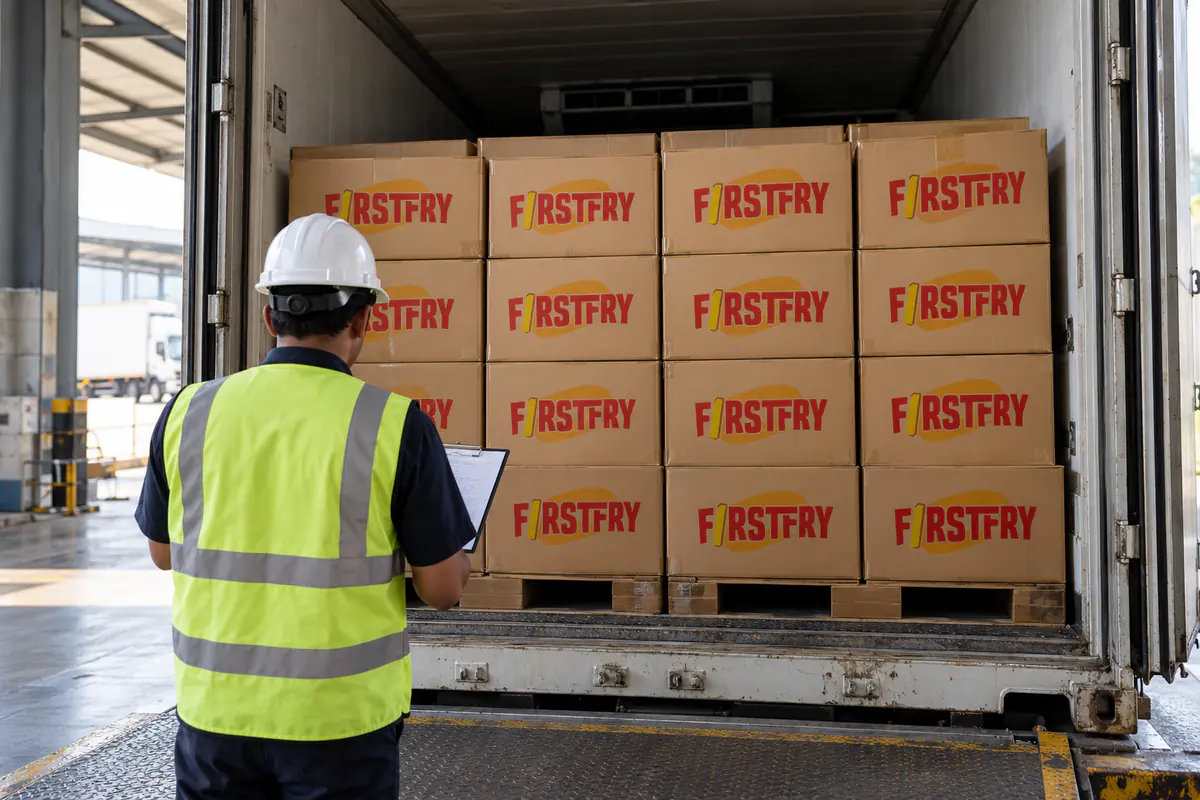
This hub covers the compliance side of a frozen fry import in general terms, then links to the market-by-market guides. If you are importing into a specific country, read this once for the framework and then go to that country's guide for the detail.
The four layers you have to satisfy
Every frozen potato consignment has to clear four independent hurdles. They fail independently too — perfect paperwork will not save a container that arrived at −9 °C, and a flawless cold chain will not release a container classified under the wrong heading.
The cold chain is also where most quality claims originate, and the port is the highest-risk stage rather than the voyage. Shelf life and cold-chain control covers the control points and what to specify contractually.
| Layer | What it decides | Who owns it | Typical failure |
|---|---|---|---|
| Classification | Duty rate, permit requirements, statistical treatment | Importer, with customs broker | Wrong or outdated HS code; 8-digit code where 12 is now required |
| Market registration | Whether this product from this facility may enter at all | Importer, using exporter's documents | Facility not registered; product registration lapsed |
| Document set | Release at the border | Exporter and importer jointly | Inconsistent weights or descriptions across documents |
| Cold chain | Whether the goods are still saleable and legally fit | Exporter, line, importer | Temperature excursion in transit or at the port; no logger to prove otherwise |
Layer 1 — classification
Frozen french fries are a prepared potato product, not a fresh vegetable. Because they are par-fried before freezing, they are classified as prepared or preserved otherwise than by vinegar or acetic acid, frozen — HS heading 2004.10. This matters commercially: fresh potatoes and prepared potatoes frequently attract different duty and different permit requirements.
- Straight-cut, crinkle, wedges, skin-on fries: normally
2004.10 - Pastry-wrapped or filled items such as samosa: normally not
2004.10; commonly2106.90, but this is a classification question for your broker - Country subheadings differ. The first six digits are internationally harmonised; everything after that is national. Always quote the destination's full national code on the invoice.
The HS code 2004.10 classification guide works through the heading, the common misclassifications and what to put on the invoice.
Layer 2 — market registration
Most food-importing countries require something to be registered before a consignment can enter: the manufacturing facility, the product, the importer, or all three. This is the layer that most often derails a first shipment, because it has a lead time measured in weeks and cannot be fixed at the port.
| Region | Common requirement pattern | Practical lead time |
|---|---|---|
| GCC | Importer licensed locally; product/label registration with the food authority; halal documentation for many categories; conformity schemes in some states | Weeks — start before ordering |
| South-East Asia | Importer licence with the national food agency; halal where applicable; import permit per consignment in some markets | Weeks |
| Africa | Pre-shipment conformity assessment in several markets; product registration with the national food or standards body; import permit | Weeks to months |
| India (domestic resale of imports) | Importer licence with the food authority; labelling in the prescribed format | Weeks |
Two rules save the most time here. First, ask your food authority in writing what is required for the specific HS heading, not for "frozen food" generally. Second, tell your supplier what they must provide from their side — facility details, process description, ingredient breakdown, shelf-life justification — at enquiry stage, not after you have placed the order.
Layer 3 — the document set
The Indian export document set is fairly consistent regardless of destination. What varies is the market-specific attachments in the last group.
| Document | Purpose | Watch for |
|---|---|---|
| Commercial invoice | Value, terms, classification | HS code, Incoterm and currency must match the contract exactly |
| Packing list | Carton and pallet detail, gross and net weight | Net weight must reconcile with the invoice and the bill of lading |
| Bill of lading | Title and transport contract | Reefer temperature setting must be stated on the document |
| Certificate of origin | Origin, and any preferential duty claim | Issued for the correct destination; preferential claims need the right form |
| Health / sanitary certificate | Fitness for human consumption | Some markets require specific wording or an original with a wet stamp |
| Certificate of analysis | Product parameters for the batch | Should match the agreed specification sheet, not a generic template |
| Halal certificate | Required in many GCC and South-East Asian markets | Must be from a body the destination recognises — not any body |
| Temperature log | Evidence the cold chain held | Agree in the contract who fits the logger and who reads it |
The most common clearance delay in this trade is not a missing document — it is an inconsistency between documents. A net weight that differs by 40 kg across invoice, packing list and bill of lading is enough to hold a reefer for days, and reefer detention accrues while it sits.
Layer 4 — the cold chain
Frozen fries have to hold −18 °C from the plant freezer to your cold store. The chain has five weak points, and all of them are contractual before they are physical:
- Loading. The container must be pre-cooled and the product loaded fast; a warm dock undoes a good freezer.
- Set point and monitoring. The temperature setting belongs on the bill of lading, and a data logger inside the container is what turns a dispute into a fact.
- Transhipment. Every port change is a plug-out risk. Fewer transhipments is a real quality specification, not just a transit-time preference.
- Destination port dwell. Power at the terminal, and how fast your broker clears, decide how long the box sits.
- Last mile. A reefer truck that is not pre-cooled can undo the whole voyage in ninety minutes.
On arrival, inspect before you accept: heavy ice crystals inside the bag, pieces frozen into a solid block rather than free-flowing, and a soft, pale fry after cooking are the classic signatures of a broken chain in a product that was IQF when it left.
Where duty actually lands
Duty on prepared frozen potatoes varies widely by destination and changes with trade policy, so a specific percentage in a blog post is worth very little. What is stable is the structure of what you will pay:
- Customs duty on the declared value under the correct national code
- VAT or sales tax at import, where the destination applies it to food
- Conformity or inspection fees where a pre-shipment or destination inspection scheme applies
- Port, reefer plug-in and handling charges, which for frozen cargo are materially higher than for dry
- Clearance and documentation fees from your broker
Model all five before you compare supplier quotes. For the destination side, trade.gov's country commercial guides and the destination customs administration's own tariff schedule are the two sources worth trusting; ask your broker to confirm against the live tariff on the day.
Market-by-market guides
Detailed walkthroughs, each with the authority names, document list and cold-chain notes for that market:
- Importing frozen fries into the UAE — ZAD registration, FIRS, halal and Jebel Ali cold-chain notes
- Importing frozen fries into Saudi Arabia — SFDA facility and product registration on FRCS, and the shelf-life rule
- Importing frozen fries into Qatar — MoPH registration and the pre-shipment certificate of conformity
- Importing frozen fries into Kuwait — PAFN registration, and why it is not the standards authority
- Importing frozen fries into Oman and Bahrain — two markets, one technical file, two front doors
Southeast Asia
- Importing frozen french fries into Malaysia — FOSIM, MAQIS border inspection and JAKIM halal recognition
- Importing frozen fries into Singapore — SFA licenses the importer, not the product
- Importing frozen fries into the Philippines — FDA Licence to Operate first, then a CPR per product variant
- Importing frozen fries into Vietnam and Indonesia — self-declaration versus BPOM registration plus halal
- Importing frozen fries into Thailand — the importer holds the Thai FDA licence, the plant supplies a GMP certificate, and Notification 450 now governs every label
Africa
- Importing frozen french fries into Nigeria — the local representative and power of attorney NAFDAC requires first
- Importing frozen fries into Kenya — KEBS PVoC verification happens at origin, before the container sails
- Importing frozen fries into Ghana and Côte d'Ivoire — FDA registration, ICUMS permits and the Francophone difference
- Importing frozen fries into South Africa — anti-dumping duties on EU origin and a strong domestic industry
North America
- Importing frozen fries into the USA — no product registration, but the importer carries an FSVP file you have to fill
- Importing frozen fries into Canada — the importer's SFC licence, preventive control plan and bilingual labelling
- Importing frozen fries into Mexico — COFEPRIS, the importer registry and the NOM-051 front-of-pack warning seals
South America
- Importing frozen fries into Brazil — ANVISA, the SISCOMEX licence and why the trade-remedy position is the first thing to read
- Importing frozen fries into Chile and Peru — one market registers the product, the other judges the label
East Asia
- Importing frozen fries into Japan — no registration at all, and a residue positive list that behaves like zero tolerance
- Importing frozen fries into South Korea — MFDS facility registration sits upstream of everything else
- Importing frozen fries into China — GACC Decree 248 registration, and the number that must be printed on the box
- Importing frozen french fries into Hong Kong: no licence and no tariff, a registered importer with 24-month records, and a ban on partially hydrogenated oil
United Kingdom and European Union
- Importing frozen fries into the UK — no approval to obtain, but a mandatory UK address on the label and HFSS rules that decide where a retail pack can sit
- Importing frozen french fries into the EU: no plant health certificate and no plant listing, but risk-based border checks, a 0.2 mg/kg chlorpropham limit on potatoes and labels in the language of sale
Australia
- Importing frozen fries into Australia — no import permit, but a BICON declaration proving washing, par-frying and seven consecutive days at -18°C, then 5% food inspection referral
Eurasian Economic Union
- Importing frozen fries into Russia and the EAEU — one declaration of conformity covers five countries, and the hard part is settlement rather than the technical file
Classification, documents and certification
- HS code 2004.10 classification — getting the heading right on the invoice
- The GCC 12-digit HS migration — why a six-digit heading is no longer a usable duty answer in the Gulf
- Export documents for frozen food from India — every document, who issues it and when
- Halal certification for frozen fries — where it legally bites, and how to read a certificate
- When a frozen container is rejected at the port: the outcomes authorities allow, the 60 and 90 day clocks, and why the contract decides who pays
Guides for further markets are added to this hub as they are written. If you need one that is not published yet, the export desk can send the current requirement list for that market.
The duty question itself is answered across markets in one place: frozen french fries import duty by country sets out the four layers behind a rate, the published MFN figures we could verify, and the five questions that let a broker confirm the national line in one reply.
What we provide from the supply side
FirstFry ships from Gujarat via Mundra and Kandla, and supplies the exporter-side documentation for the set above: specification sheet, certificate of analysis per batch, certificate of origin, health certificate, and current certification documentation shared during buyer qualification. Our fry and specialty product list lists the cut and pack specifications you will need for a product registration. If your market requires facility details or a process description for registration, ask at enquiry stage and we will provide it before you place the order — not after.
Frequently asked questions
What HS code is used for frozen french fries?
Frozen french fries are normally classified under HS heading 2004.10, which covers potatoes prepared or preserved otherwise than by vinegar or acetic acid, frozen. The first six digits are internationally harmonised; the digits after that are national, so you must quote the destination country's full code on the commercial invoice. Pastry or filled items such as samosa usually fall outside this heading.
What documents travel with a frozen fry container?
The standard set is commercial invoice, packing list, bill of lading with the reefer temperature setting stated, certificate of origin, health or sanitary certificate and certificate of analysis, plus market-specific attachments such as a halal certificate or import permit. A container temperature log should also be agreed in the contract. The most common delay is an inconsistency between documents rather than a missing one.
Do I need halal certification to import frozen fries?
In many GCC and South-East Asian markets, yes, and the certificate must come from a certification body that the destination authority recognises rather than any body. Requirements differ by country and change, so confirm with your national food authority which certifiers they accept before you order, and ask your supplier which recognitions they currently hold.
Who is responsible if the cold chain breaks in transit?
It depends entirely on the Incoterm and what your contract says about temperature monitoring. Under CIF the seller arranges carriage and insurance but risk usually transfers on loading, so a mid-voyage excursion is commonly a claim against the carrier or insurer rather than the supplier. Fit a data logger and write the set point into the bill of lading; without evidence, a temperature dispute is unwinnable.
How long does it take to get an import registration in place?
Plan in weeks rather than days, and in some African markets potentially months where pre-shipment conformity assessment is required. Registration lead time is the single most common reason a first frozen consignment is delayed, because it cannot be resolved at the port. Start the registration conversation with your food authority before you place the order, not after.
Need the exporter-side documents for your market?
Tell us your destination country and what your food authority is asking for. The export desk will confirm what we can provide — specifications, certificate of analysis, origin and health certificates, and current certification documentation — before you commit to an order.
Email BuyFry@FirstFryFoods.com or request a quote. The export desk replies within one business day.