Frozen Fries Shelf Life and Cold Chain: What 24 Months Actually Assumes
Frozen french fries typically carry 18 to 24 months of shelf life at -18C or colder. That figure assumes a stable temperature throughout. Frozen fries do not spoil microbiologically at -18C; they degrade physically, through freezer burn and ice-crystal growth caused by temperature fluctuation. Repeated small swings damage texture far faster than a steady temperature slightly above target.
Published 2026-08-07 · FirstFry Export Desk · Specifications & product science
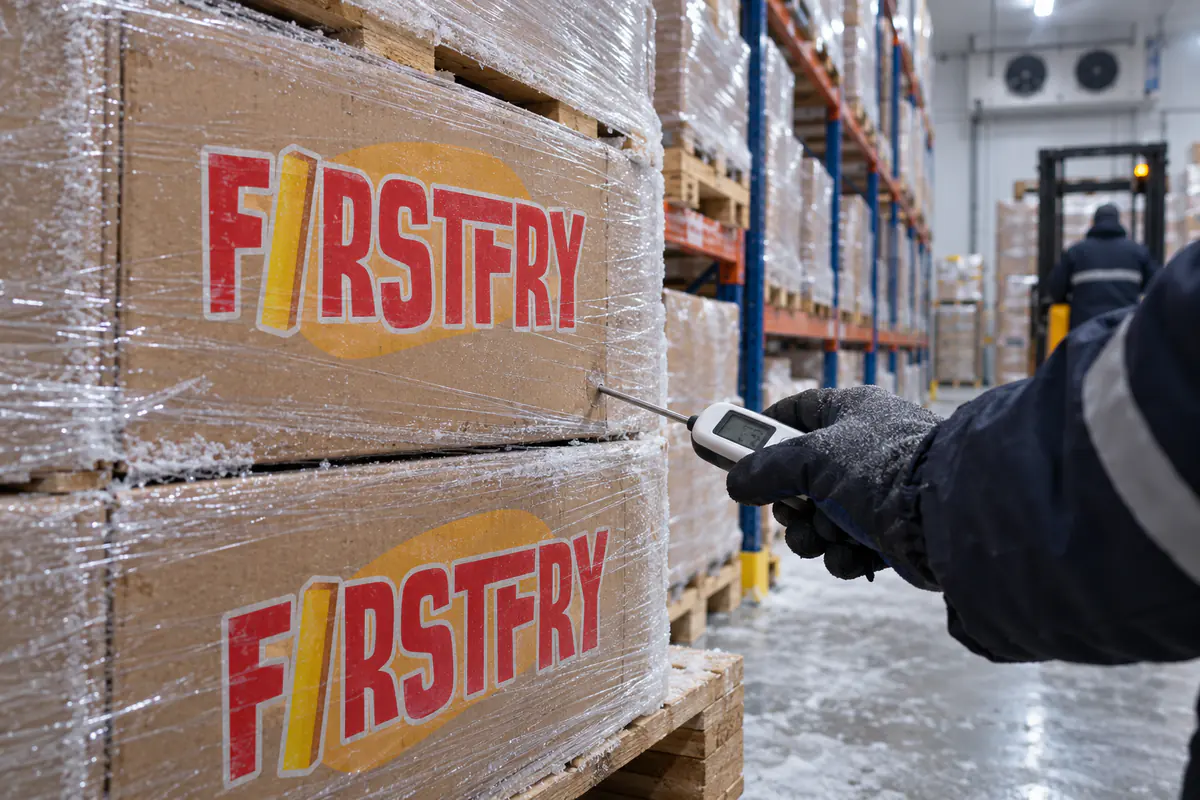
What the shelf life date actually means
At -18C, water is frozen and microbial growth stops. Pathogens are not destroyed - freezing is not a kill step - but they do not multiply. That means a frozen fry's shelf life is not a food-safety countdown in the way a chilled product's is. It is a quality prediction.
The 18 to 24 months on the carton is the period during which the manufacturer expects colour, texture and flavour to remain within specification, assuming continuous storage at or below -18C. Break that assumption and the date becomes meaningless: a consignment that spent a week at -8C in a broken-down reefer can be out of specification months before its printed date.
How frozen fries degrade
Three mechanisms do almost all the damage, and none of them involve bacteria.
| Mechanism | What happens | What you see |
|---|---|---|
| Sublimation (freezer burn) | Surface ice turns straight to vapour and escapes | Pale, dry, papery patches; leathery texture after cooking |
| Ice recrystallisation | Small crystals merge into larger ones during temperature swings | Limp, watery fries; cell structure lost |
| Oxidation | Oil absorbed during par-frying reacts with oxygen | Stale, cardboard or paint-like off-flavours |
Freezer burn is the most visible and the most misunderstood. It is not burning and not contamination. Ice on the fry's surface converts directly to water vapour, which then leaves the product and refreezes elsewhere, usually as frost on the inside of the bag. The fry is left dehydrated at the surface, which is why burnt patches cook out tough and leathery.
Recrystallisation is less visible and more destructive. Every time the temperature rises and falls, a fraction of the ice melts and refreezes onto existing crystals, so crystals grow. Large crystals rupture cell walls exactly as slow freezing does, undoing the work the IQF freezer did in the first place. Why IQF freezing protects texture explains the original mechanism.
Why fluctuation beats temperature
This is the point most cold stores get wrong. A store holding a steady -16C will usually preserve texture better than one that averages -18C but swings between -22C and -12C as doors open and defrost cycles run.
The reason is that recrystallisation is driven by change, not by level. Each cycle moves a little more water into larger crystals, and the effect accumulates. A product can therefore pass a spot temperature check and still be badly damaged, which is why data loggers matter more than a thermometer reading on arrival.
Cold-chain control points
A frozen fry passes through several handovers between the factory freezer and a fryer, and each one is a place the chain can break.
- Factory cold storeProduct is held at -18C or colder after freezing, with stock rotated by production code.
- LoadingThe reefer is pre-cooled before stuffing. Loading a warm container and relying on the unit to pull temperature down afterwards is a common and damaging shortcut.
- Sea transitThe container runs on ship power with the set point logged. Transit is usually the most stable part of the journey.
- Port and customsThe highest-risk stage. Plugged-in time, inspection delays and yard handling are where excursions happen.
- Destination cold storeProduct should move from container to store without standing on a dock. Pallets away from door lines and defrost outlets.
- Distribution and kitchenShort local runs in insulated vehicles; kitchen freezers checked, since they fluctuate most of all.
The port stage deserves the most attention because it combines long dwell times with the least direct control. Clearance delays are normal; unplugged containers during them are not.
Practical storage rules
- Store at -18C or colder and prioritise stability over chasing a lower figure
- Keep pallets clear of doors, defrost outlets and direct airflow
- Do not restack in ambient areas - break down pallets inside the cold store
- Rotate strictly by production code, first in first out
- Never refreeze product that has visibly thawed; log and remove it
- Keep bags sealed, as an open bag freezer-burns within days
In practice most texture complaints traced back through the chain end at either a warm reefer at the port or a kitchen freezer running a heavy defrost cycle. Neither shows up on a purchase specification, which is why receiving discipline matters. How to inspect a consignment on arrival sets out what to check and record.
What to specify in a contract
Buyers with cold-chain problems usually have contracts that name a shelf life and nothing else. Three additions close most of the gap: a required storage temperature stated as a maximum rather than a target, mandatory temperature logs supplied with each consignment, and a defined minimum remaining shelf life on arrival.
| Clause | Why it matters |
|---|---|
| Storage temperature as a maximum, not a target | A target invites averaging; a maximum is testable |
| Reefer temperature log supplied per consignment | A set point is a claim, recorded data is evidence |
| Minimum remaining shelf life on arrival | Commonly two-thirds of total; prevents in-date but unsaleable stock |
| Container remains plugged during clearance | The port is the highest-risk stage of the journey |
| Production coding traceable to shift and lot | Makes any later claim investigable |
| Defined claim notification window | Both sides know when the matter closes |
That last point is routinely forgotten. A 24-month product delivered with four months left is technically in date and commercially useless. Specify a minimum, commonly two-thirds of total shelf life remaining at the destination port, and the problem disappears. Every cut in export cuts with 18 to 24 month shelf life ships with production coding that makes that verifiable.
Frequently asked questions
How long do frozen french fries last?
Typically 18 to 24 months at -18C or colder, stated as a quality window rather than a safety deadline. Frozen fries do not spoil microbiologically at that temperature; they degrade physically through freezer burn, ice-crystal growth and oxidation of the oil absorbed during par-frying.
What temperature should frozen fries be stored at?
-18C or colder, held as steadily as possible. Stability matters more than the exact figure: a store at a constant -16C usually preserves texture better than one averaging -18C while swinging between -22C and -12C, because every temperature cycle grows ice crystals inside the product.
What is freezer burn on frozen fries?
Sublimation. Surface ice converts directly to water vapour and escapes the product, usually refreezing as frost inside the bag. It leaves pale, dry, papery patches on the fry that cook out tough and leathery. It is a quality defect rather than a safety hazard, and sealed packaging slows it considerably.
Can frozen fries go bad in the freezer?
They will not become unsafe at a steady -18C, because microbial growth stops. They will become unusable: texture collapses through ice recrystallisation, surfaces dehydrate through freezer burn, and the oil from par-frying eventually oxidises to a stale, cardboard-like flavour.
What minimum shelf life should I demand on arrival?
A common contractual standard is two-thirds of total shelf life remaining at the destination port, so roughly 16 months on a 24-month product. Without a clause of this kind a consignment can arrive technically in date but commercially unsaleable, particularly through a long distribution chain.
Ask for the cold-chain documentation
Every FirstFry container ships with production coding and temperature records from our line to your port. Email the export desk with your destination and required minimum shelf life on arrival.
Email BuyFry@FirstFryFoods.com or request a quote. The export desk replies within one business day.