Importing Frozen Fries into the UK: Post-Brexit Rules, the UK Address Requirement and HFSS
There is no pre-market approval for frozen fries entering the UK. The importer must be a registered food business, and responsibility for compliance sits with them. Labels follow assimilated food information law and must carry a UK address for the responsible food business operator. Great Britain and Northern Ireland operate under different arrangements, and HFSS promotion rules may apply to retail products in England.
Published 2026-08-20 · FirstFry Export Desk · Importing, duties & compliance
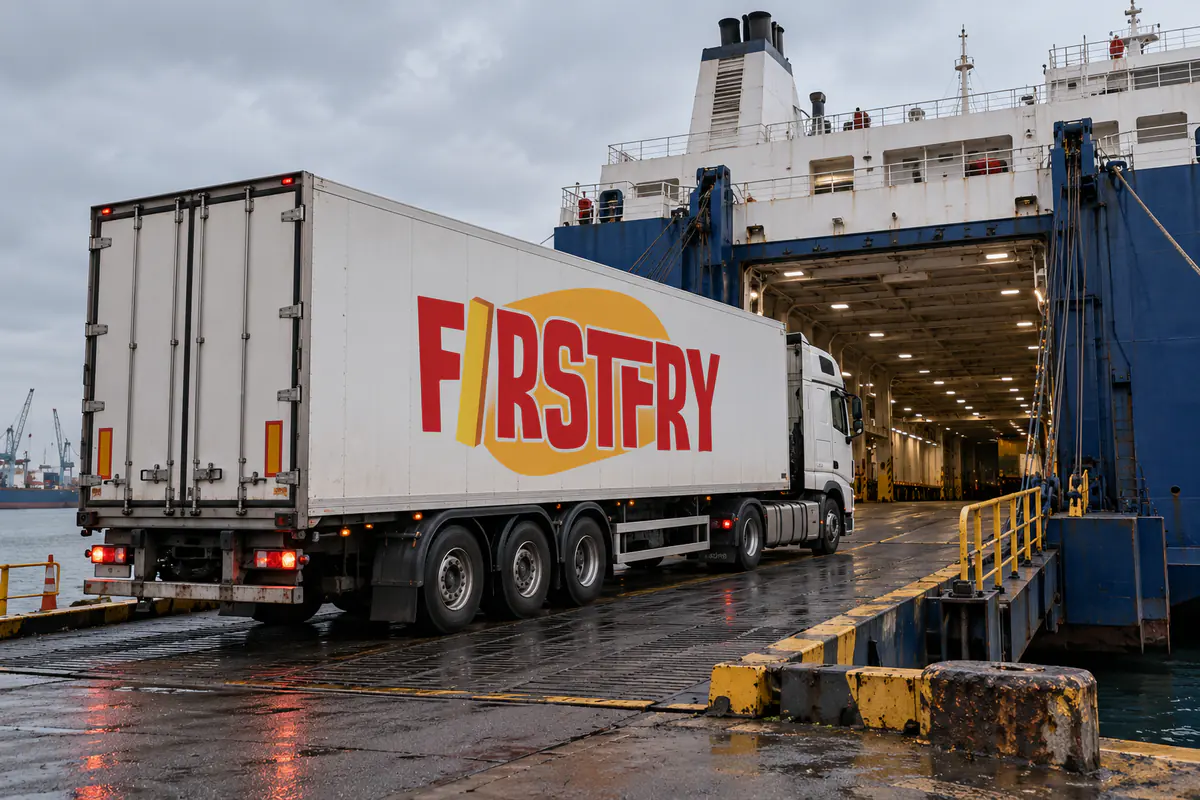
Britain eats chips at a scale that has no obvious parallel. Fish and chip shops, pub kitchens, quick service, contract catering and a large frozen retail aisle all pull from the same supply, and domestic processing does not cover it. Historically the gap has been filled from Belgium and the Netherlands.
That makes the UK unusual among the markets in this hub: it is a genuinely large, genuinely open, genuinely import-dependent market with an incumbent supply base whose landed cost is not structurally unbeatable. The regulatory route is also one of the lightest here. What catches exporters is a labelling detail and a promotions rule, not a registration queue.
Step 1 — Know which UK you are shipping to
Since Brexit the United Kingdom is not one regulatory space for food. Great Britain — England, Wales and Scotland — operates on assimilated law administered by the Food Standards Agency, with Food Standards Scotland covering Scotland. Northern Ireland operates under separate arrangements reflecting its position relative to the EU single market for goods.
For an exporter this mostly matters in two places: the address that must appear on the label, and whether goods moving from Great Britain into Northern Ireland attract additional marking obligations further down the chain. Ask your importer at the outset which territories they distribute into, because the answer changes the artwork rather than the product.
Step 2 — The importer carries the duty
There is no approval to obtain before a frozen potato product can be sold in the UK. What exists instead is a general legal duty on the food business placing it on the market. Your importer must be registered with their local authority as a food business, and they are the party answerable for safety, traceability and labelling accuracy.
This is the same structural pattern as the United States and Canada: the destination-market buyer is accountable, so the destination-market buyer does the diligence. A serious UK importer will therefore run a supplier approval process before a first order, and how quickly you satisfy it is the actual gate.
- A GFSI-benchmarked certificate — BRCGS is the most familiar scheme to UK buyers — with the audit report
- Your HACCP plan and hazard analysis for the fry process
- Specification sheets per SKU with full ingredient, nutritional and allergen data
- Traceability and lot coding that supports a recall exercise
- A completed supplier questionnaire, which most UK buyers will send unprompted
Step 3 — Labelling, and the UK address rule that catches people
Prepacked food labels follow assimilated food information law: legal name, ingredient list with allergens emphasised, quantitative ingredient declaration where relevant, net quantity, date marking, storage and use instructions, and a nutrition declaration.
The post-Brexit change worth flagging is the address. A prepacked food sold in Great Britain must carry a UK address for the food business operator responsible for the food, or for the importer where that operator is not established in the UK. An EU address alone no longer satisfies it.
That sounds trivial and is not, because it means your artwork cannot be finalised before the importer is fixed. An exporter who prints film against a distributor they then replace has printed the wrong label. Settle the responsible party before the plate change, exactly as the GACC number forces you to in China and the EAC mark does in the EAEU.
| United Kingdom | United States | Canada | |
|---|---|---|---|
| Pre-market approval | None | None | None |
| Who carries the duty | The UK food business placing it on the market | The importer, under FSVP | The importer, under their SFC licence |
| Registration | Importer registers with local authority | Foreign facility registers with FDA | Importer holds an SFC licence |
| Address on label | UK address mandatory | US manufacturer, packer or distributor | Canadian dealer name and address |
| Language | English | English | English and French |
| Extra commercial constraint | HFSS promotion rules in England | None comparable | None comparable |
Step 4 — HFSS, the rule that is commercial rather than technical
England restricts the promotion of products high in fat, salt or sugar. The restrictions bite on where a product can be sited in store and on certain promotional mechanics, and they apply to specified food categories assessed against a nutrient profiling model.
Whether a given frozen potato product is caught depends on the category it falls into and how it scores. A plain frozen chip and a heavily seasoned coated product are not the same case. This is not an admissibility question — a caught product can still be sold — but it changes shelf placement and promotional options, which changes what a retail buyer will pay for.
The practical implication mirrors Mexico and Chile: the levers are applied salt, oil uptake and the frying medium, and they are set on the line long before a UK buyer sees the pack. Ask the question before developing a retail SKU rather than after. For foodservice, it is largely moot, which is another reason foodservice is the sensible first channel.
Step 5 — Border, tariff and the trade agreement question
Frozen potatoes prepared or preserved otherwise than by vinegar or acetic acid classify in heading 2004.10 on the UK tariff. Confirm the commodity code and rate with a UK customs broker against the actual product, and confirm how the Border Target Operating Model risk-categorises your consignment, because that determines what checks and documentation apply at entry.
A comprehensive trade agreement between India and the United Kingdom has been concluded. Whether it is in force, whether heading 2004.10 benefits and on what schedule are three separate questions that must be checked against the agreement's own text rather than assumed from the headline. Where a preference applies, the certificate of origin becomes a commercially significant document and the issuing process should be settled before the first shipment.
What to send with a first UK quotation
- Specification per SKU with cut, coating, frying medium and target oil uptake
- BRCGS or equivalent certificate with the audit report and current scope
- Full nutritional data per 100 g as sold, so an HFSS assessment can be run before artwork
- Ingredient and allergen data in the emphasis format a UK label uses
- A completed supplier questionnaire, returned quickly — UK buyers treat response time as a proxy for reliability
- A clear statement of whether the SKU is offered retail or foodservice
Frequently asked questions
Do frozen fries need approval or registration before being sold in the UK?
No. There is no pre-market approval or product registration for a food of this type. The obligation sits on the UK food business placing it on the market, who must be registered with their local authority and is answerable for safety, traceability and labelling. In practice the gate is your buyer's supplier approval process, not a government queue.
What is the UK address requirement on food labels?
A prepacked food sold in Great Britain must carry a UK address for the food business operator responsible for the food, or for the importer where that operator is not established in the UK. An EU address alone is no longer sufficient. Because the address identifies your importer, artwork cannot be finalised before that relationship is fixed.
Will HFSS rules affect our frozen chips?
It depends on the product category and how it scores under the nutrient profiling model, so a plain chip and a seasoned coated product are different cases. HFSS does not stop a product being sold; it restricts siting and promotion in England, which affects what a retail buyer will pay. It is largely irrelevant for foodservice.
Does the India-UK trade agreement reduce duty on frozen fries?
An agreement has been concluded, which makes a preference claim a real question rather than a theoretical one. Whether it is in force, whether heading 2004.10 is covered and on what tariff schedule all have to be checked against the agreement text. Where preference applies, treat the certificate of origin as a commercial document and set up issuing before shipping.
Quoting a UK buyer?
Tell us the SKUs and channel and we will send the specification with as-sold nutritional data for an HFSS assessment, our BRCGS pack, and a completed supplier questionnaire in the format UK buyers usually issue.
Email BuyFry@FirstFryFoods.com or request a quote. The export desk replies within one business day.