Export Documents for Frozen Food from India: The Complete Checklist
A frozen food export from India runs on three document layers. The exporter's standing registrations — IEC from DGFT, AD code at the port, APEDA membership and an FSSAI licence — must exist before any order. The consignment documents — shipping bill, commercial invoice, packing list, certificate of origin, health certificate and certificate of analysis — travel with the goods. The transport and payment documents — bill of lading, insurance certificate and any letter-of-credit set — release the cargo and the money.
Published 2026-06-19, updated 2026-07-31 · FirstFry Export Desk · Importing, duties & compliance
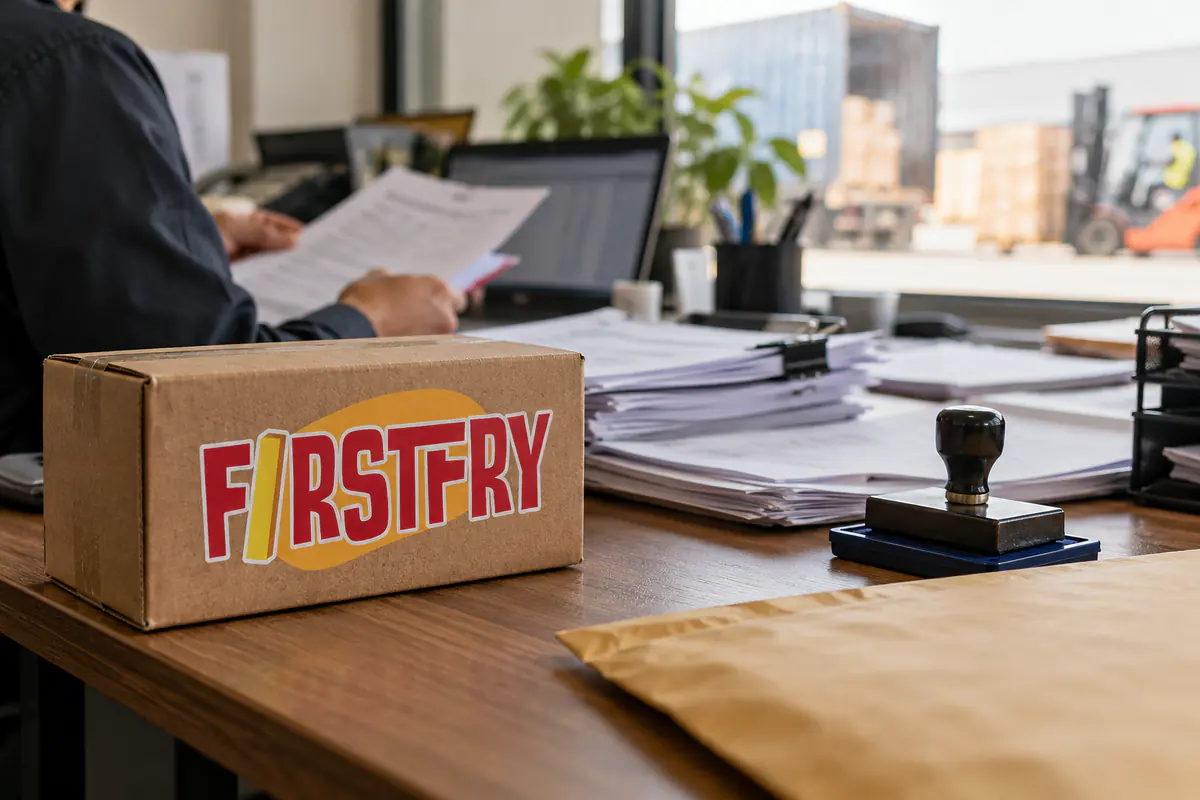
Most first-time frozen food importers discover the document set backwards: something is missing at the destination port, and the scramble to fix it happens while a reefer accrues demurrage. The set is entirely predictable. This is the whole of it, grouped by who holds it and when it is issued.
Layer 1 — The exporter's standing registrations
These belong to the manufacturer or exporter, not to your order. They exist before you enquire, and asking to see them is the fastest way to establish whether a supplier has actually exported before. A plant with genuine export history produces these in minutes.
| Registration | Issued by | What it does |
|---|---|---|
| IEC — Importer Exporter Code | DGFT | The base licence. No consignment leaves India without one |
| AD code registration | Exporter's bank, registered at the port | Links the exporter's bank account to the port so a shipping bill can be filed there |
| APEDA registration (RCMC) | APEDA | Membership body for processed fruit and vegetable exports, which is where frozen potato products sit |
| FSSAI licence | FSSAI | Food business licence covering the manufacturing facility |
| GST registration | GST authorities | Zero-rated export treatment and refund claims |
| Factory food-safety certification | Third-party certification body | Not a government export document, but the one buyers audit hardest |
Layer 2 — The consignment documents
These are issued for each shipment. Their single most important property is not that they exist but that they agree with each other: product description, HS code, net and gross weights, carton counts, values and party names must match across every document in the set. Nearly all customs delays at the destination are caused by a mismatch, not by a missing paper.
| Document | Issued by | Purpose |
|---|---|---|
| Shipping bill | Exporter via customs EDI | The export declaration filed with Indian customs |
| Commercial invoice | Exporter | Value, terms, parties — the basis for duty assessment |
| Packing list | Exporter | Cartons, pallets, net and gross weight, batch codes |
| Certificate of origin | Chamber of commerce or issuing authority | Establishes origin; preferential form where a trade agreement applies |
| Health / export-worthiness certificate | Official inspection authority | Confirms the food is fit for human consumption. Required by most food-importing markets |
| Certificate of analysis | Manufacturer or accredited lab | Batch-level microbiological and physical results |
| Phytosanitary or fumigation certificate | Plant quarantine / treatment provider | Where the destination requires it, or for the wooden pallets rather than the food |
Two of these deserve a closer look because buyers regularly misunderstand them.
Certificate of origin — preferential or not
There are two kinds. A non-preferential certificate simply states where the goods were made. A preferential certificate is issued under a specific trade agreement and can reduce the duty your buyer pays. They are not interchangeable, and the preferential form has to be requested in advance and issued in the correct format for that agreement.
If your destination has an agreement with India, ask about it at quotation stage. A duty saving obtained through the right certificate is worth more than most of the price negotiation that precedes it.
Health certificate — the one that is genuinely mandatory
Most food-importing authorities require an official certificate from the country of origin attesting that the product is safe and fit for human consumption and was produced under official supervision. It is issued by the competent authority, not by the exporter, which means it has a lead time. Confirm the exact wording your destination requires — several Gulf and African markets specify particular attestations.
For context on the sector these documents move product out of - where it is concentrated, how raw material is contracted and why supply follows a single annual crop - see India's frozen potato export industry.
Layer 3 — Transport and payment
These release the cargo and the money. For frozen cargo, one of them carries information no other document does.
- Bill of lading — title to the goods. For reefer cargo it should state the carriage temperature set point, and −18 °C on the bill is your evidence of what was contracted
- Insurance certificate — the exporter's responsibility under CIF, the buyer's under FOB or CFR. Check that frozen cargo and temperature deviation are actually within the cover
- Letter-of-credit document set — where an LC is used, the bank pays against documents, so an LC that demands a document nobody can issue is a payment failure waiting to happen
- Temperature data-logger readout — not a formal trade document, but the first thing a buyer asks for after a claim. Specify one per container
The mismatch problem, and how to kill it
A single working rule prevents most destination-side delays: one master data sheet per shipment, from which every document is populated. Product description, HS code, net weight, gross weight, carton count, pallet count, batch codes, values and party names are entered once and reused.
| Field | Appears on | Consequence of a mismatch |
|---|---|---|
| Product description | Invoice, packing list, bill of lading, certificates | Customs query; reclassification risk |
| HS code | Shipping bill, invoice, origin certificate | Wrong duty assessed, or the consignment held |
| Net vs gross weight | Packing list, bill of lading, health certificate | Physical verification fails; inspection triggered |
| Carton and pallet count | Packing list, bill of lading | Short-shipment claim on arrival |
| Consignee and notify party | Bill of lading, invoice | Cargo cannot be released to the intended party |
| Batch / lot codes | Packing list, certificate of analysis | Traceability broken; recall exposure |
What to ask a supplier before you order
- A specimen document set from a previous shipment, with commercial values redacted
- Which ports they hold AD code registration for
- Whether they have shipped to your destination market before, and what that market asked for
- Who issues their health certificate, and the typical lead time
- Whether a preferential certificate of origin is available for your market
- Confirmation that the bill of lading will state −18 °C, and that a data logger is fitted
A supplier who answers all six precisely has exported before. One who answers vaguely is going to learn on your container. The wider qualification sequence is set out in the qualification sequence before a first order.
Exporting from Gujarat
FirstFry manufactures in Morbi, Gujarat and loads through Mundra and Kandla. We issue the exporter-side set — commercial invoice, packing list, certificate of origin, health certificate, certificate of analysis per batch and specification documentation — and share a specimen set during qualification so your clearing agent can review the format before you commit to an order. Specifications for every SKU in the export range are published, with the standard 9mm cut as the usual opening line, and the classification logic behind the paperwork is covered in getting the tariff heading right.
Frequently asked questions
What documents are required to export frozen food from India?
Standing registrations held by the exporter — IEC from DGFT, AD code registered at the loading port, APEDA membership, an FSSAI licence and GST registration — plus per-shipment documents including the shipping bill, commercial invoice, packing list, certificate of origin, health certificate and certificate of analysis, and finally the bill of lading, insurance certificate and any letter-of-credit document set.
Is APEDA registration needed to export frozen french fries from India?
APEDA is the export promotion body covering processed fruit and vegetable products, which is where frozen potato products sit, and its Registration-Cum-Membership Certificate is part of the standard registration set an established exporter holds. Confirm the current requirement for your product and destination with your customs house agent, since scheduled-product coverage is periodically updated.
What is an AD code and why does the port matter?
The AD code links an exporter's bank account to a specific port so that a shipping bill can be filed there. It is registered per port, so an exporter who has only shipped from one port must register separately before loading from another. Treat it as a lead-time item when a buyer asks for a different port of loading.
What causes most customs delays on a frozen food consignment?
Inconsistency between documents rather than a missing document. Product description, HS code, net and gross weight, carton count, party names and values must match across the invoice, packing list, bill of lading and certificates. Populating every document from one master data sheet per shipment removes most of the risk.
Should the bill of lading state the temperature?
Yes. For reefer cargo the bill of lading should state the carriage set point, and −18 °C on the bill is the exporter's and importer's shared evidence of what was contracted. Pair it with a data logger in the container and require the readout on arrival.
Want to see the document set first?
Tell us your destination port and the SKUs you are considering, and we will send a specimen export document set with values redacted, so your clearing agent can review the format before you place a first order.
Email BuyFry@FirstFryFoods.com or request a quote. The export desk replies within one business day.