Importing Frozen French Fries into the UAE: Trade Licence, ZAD, FIRS and Labelling
Importing frozen french fries into the UAE requires, in order: a UAE trade licence carrying a food import or foodstuff trading activity, product registration on the federal ZAD platform managed by MOCCAE, registration on Dubai Municipality's FIRS system where Dubai is the port of entry, bilingual Arabic and English labelling, and a complete document set including certificate of origin and health certificate. Registration takes weeks and cannot be fixed at the port, so start it before you order.
Published 2026-06-15, updated 2026-09-23 · FirstFry Export Desk · Importing, duties & compliance
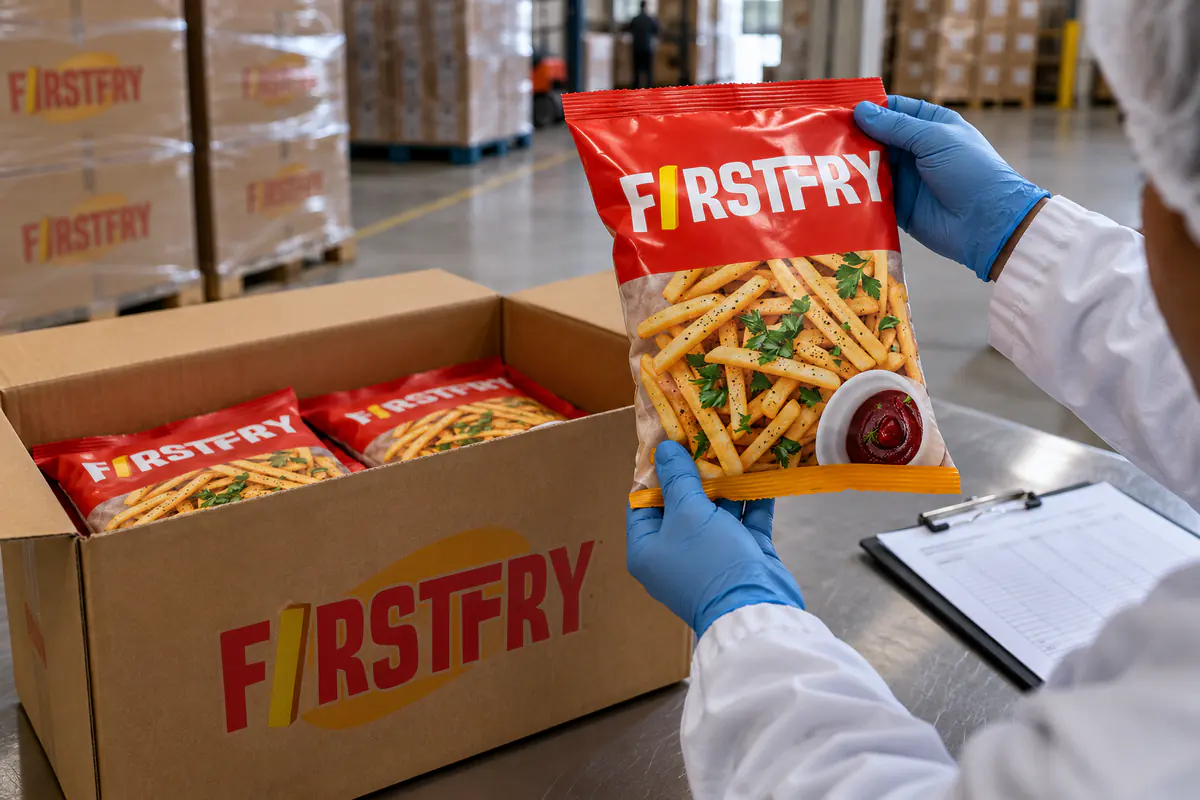
The UAE is the largest single entry point for frozen potato products into the Gulf, and Jebel Ali is where most of that volume lands. It is also a market where the compliance sequence genuinely matters: the physical logistics from India are short and simple, and almost every problem a first-time importer hits is a registration or labelling problem discovered too late.
The UAE sits inside a regional market that imports almost all of its frozen potato products, and the channel mix there shapes which cuts sell. The GCC frozen potato market covers demand, channels and the compliance points that recur across Gulf states.
Step 1 — The right trade licence
Your UAE entity must hold a licence with a food import or foodstuff trading activity on it. This is the gate: without that activity on the licence you cannot register products or access the import platforms, regardless of what your supplier has ready.
If you are a foreign exporter without a UAE entity, you sell to a licensed UAE importer or distributor who holds this — you do not import in your own name.
Step 2 — Product registration on ZAD
ZAD is the federal electronic food registration platform operated by the Ministry of Climate Change and Environment (MOCCAE), introduced under Ministerial Decree No. 239 of 2018. Every food product — imported or locally produced — must be registered on it before it can be handled, sold or distributed.
For a frozen fry SKU you will typically need the following from your supplier. Ask for all of it at enquiry stage:
| Item | Why it is needed |
|---|---|
| Product specification sheet | Product identity, cut, process and physical parameters |
| Full ingredient list with percentages | Ingredient declaration and label build |
| Nutritional data | Mandatory label panel |
| Shelf-life justification | To support the stated 24-month claim at −18 °C |
| Label artwork, Arabic and English | Reviewed as part of registration |
| Manufacturer details and certifications | Facility identity and food-safety evidence |
| Free-sale or health certificate | Confirms the product is legally sold in the country of origin |
Step 3 — FIRS, where Dubai is the port of entry
Dubai Municipality operates the Food Import and Re-export System (FIRS) for consignments entering through Dubai. Depending on your port of entry and emirate, you may be working with FIRS alongside the federal ZAD registration, and Abu Dhabi consignments involve that emirate's own food control authority.
Practical implication: decide your port of entry early, because it determines which emirate-level system your broker will file in. Changing port mid-process is not a small administrative change.
Step 4 — Labelling
UAE labelling is prescriptive and is one of the two most common reasons a first consignment is rejected. Imported food labels must be bilingual Arabic and English and carry, at minimum:
- Product name and description
- Full ingredient list in descending order
- Net weight
- Production date and expiry date
- Storage conditions — for frozen fries, −18 °C
- Country of origin
- Manufacturer name and address
- Importer or distributor details
- Nutritional information panel
- Batch or lot identification
Two operational points that catch importers out. First, dates must be printed as required rather than applied as a sticker in the destination — agree the date-coding format with the manufacturer. Second, if you are going to private label, the artwork approval and printed-film lead time sits before the production slot, not after it, so it has to start at the same time as registration.
Step 5 — Classification, duty and VAT
Par-fried frozen fries classify under HS heading 2004.10 as a prepared, frozen potato product — see HS 2004.10 classification for why they do not sit in the frozen-vegetable heading. Two things to confirm with your broker rather than assume:
| Charge | How it works | What to verify |
|---|---|---|
| Customs duty | Applied under the GCC common customs tariff against the declared value | The current rate for your full national code — the GCC moved several states to 12-digit lines from 1 January 2025 |
| VAT at import | UAE VAT applied on import value plus duty | The current rate and treatment for your product category |
| Port and reefer charges | Terminal handling plus reefer plug-in and monitoring | Materially higher than dry cargo — get the reefer tariff, not the general one |
| Inspection and clearance | Food control inspection and broker fees | Whether your SKU is subject to sampling on first import |
Model all four into landed cost before you compare supplier quotes. Reefer plug-in and inspection are the two lines new importers routinely omit.
Step 6 — Halal, honestly assessed
Halal certification is mandatory in the UAE for meat, poultry and products containing animal-derived ingredients. Plain potato fries fried in vegetable oil contain no animal-derived ingredient, so the legal requirement is different from that for a meat product.
That said, treat it as a commercial requirement rather than a technicality:
- Many UAE distributors and foodservice customers ask for halal documentation regardless of category, because their own customers do
- If a coating, seasoning or the frying oil contains any animal-derived component, the requirement becomes a real one
- Certification must come from a body the destination authority recognises — not any certifier
- Ask your supplier which recognitions they currently hold, and get the certificate document with its number and validity dates
Step 7 — The container and the cold chain
This is the easy part from India. Mundra to Jebel Ali is a short, well-served route with direct sailings, which is precisely why Indian origin competes so effectively into the Gulf on landed cost. Specify the following anyway:
- Set point −18 °C, stated on the bill of lading
- Container pre-cooled before loading begins
- Direct sailing where available — each transhipment is a plug-out risk
- Data logger fitted, with the readout sent to you on arrival
- Pre-arranged reefer plug-in at the terminal and a pre-cooled reefer truck for the last mile
- Production date on the cartons, so you know how much of the 24-month shelf life you are buying
For a first shipment, CIF or CFR Jebel Ali is usually the sensible term so the supplier handles the ocean leg — see which Incoterm to request.
A realistic timeline
| Stage | Runs in parallel with | Indicative duration |
|---|---|---|
| Trade licence activity confirmed | — | Before anything else |
| Supplier qualification and samples | Registration document gathering | 2–3 weeks |
| ZAD product registration per SKU | Label artwork development | Weeks — the critical path |
| Label artwork and film printing (private label) | Registration | Weeks; starts early |
| Order confirmation and production | — | Supplier and season dependent |
| Sailing Mundra → Jebel Ali | — | Short, direct routes available |
| Clearance and inspection | — | Days, if documents are consistent |
The lesson from the table: registration and artwork are the long poles and they run in parallel with everything else. Buyers who treat them as post-order tasks are the ones whose container waits.
Supplying from India
FirstFry manufactures in Morbi, Gujarat and loads through Mundra and Kandla — days from Jebel Ali. We provide the exporter-side documentation the ZAD file needs: specification sheets, ingredient and nutritional data, shelf-life basis, certificate of analysis per batch, certificate of origin, health certificate, and current certification documentation shared during qualification. Our complete export range is published so you can build a registration file before placing an order, and most UAE programmes start with 9mm classic straight-cut fries as the volume line.
That is the regulatory half. The commercial half — why Indian origin competes into the Gulf, what the India-UAE CEPA certificate of origin changes, how to time an order around Ramadan and how a Jebel Ali programme re-exports across the Gulf — is in choosing a frozen fries supplier for the UAE.
Frequently asked questions
What do I need to import frozen french fries into the UAE?
A UAE trade licence carrying a food import or foodstuff trading activity, product registration on the federal ZAD platform managed by MOCCAE, registration in the relevant emirate's system such as Dubai Municipality's FIRS where Dubai is the port of entry, bilingual Arabic and English labelling, and a complete document set including commercial invoice, packing list, bill of lading, certificate of origin and health certificate.
What is ZAD registration?
ZAD is the UAE's federal electronic food product registration platform, managed by the Ministry of Climate Change and Environment and introduced under Ministerial Decree No. 239 of 2018. Every food product, imported or locally produced, must be registered on it before it can be handled, sold or distributed. Registration is normally per SKU, so a mixed container of several products requires several registrations.
Do frozen french fries need halal certification for the UAE?
Halal certification is mandatory for meat, poultry and products containing animal-derived ingredients, so plain potato fries fried in vegetable oil sit in a different legal position from a meat product. In practice many UAE distributors request halal documentation regardless, and the requirement becomes a genuine one if any coating, seasoning or oil contains an animal-derived component. Certification must come from a body the UAE authority recognises.
How long does it take to get a frozen fry SKU ready for the UAE?
Plan in weeks rather than days. ZAD product registration and, for private label, label artwork and film printing are the critical path, and both should run in parallel with supplier qualification rather than after the order is placed. The shipping leg itself is short — Mundra to Jebel Ali has direct sailings — so almost all first-shipment delays are documentary.
What duty applies to frozen fries entering the UAE?
Customs duty is applied under the GCC common customs tariff against the declared value of the consignment, with VAT applied at import on top. Rates and national tariff lines change, and several GCC states moved from 8-digit to 12-digit codes from 1 January 2025, so confirm the current rate for your full national code with a licensed broker on the day rather than relying on a published figure.
Building a ZAD file?
Tell us which SKUs you intend to register and we will send the specification sheets, ingredient and nutritional data, shelf-life basis and manufacturer documentation your registration needs — before you place an order, so the paperwork and the production slot run in parallel.
Email BuyFry@FirstFryFoods.com or request a quote. The export desk replies within one business day.