Importing Frozen Fries into China: GACC Decree 248 Registration, CIFER and GB Labelling
Frozen fries entering China require the overseas producer to be registered with the General Administration of Customs of China under Decree 248, normally through the CIFER system. The registration number must appear on both inner and outer packaging. Labelling follows the GB standards for prepackaged food in Chinese, and each consignment is declared to customs under Decree 249 import controls.
Published 2026-08-29 · FirstFry Export Desk · Importing, duties & compliance
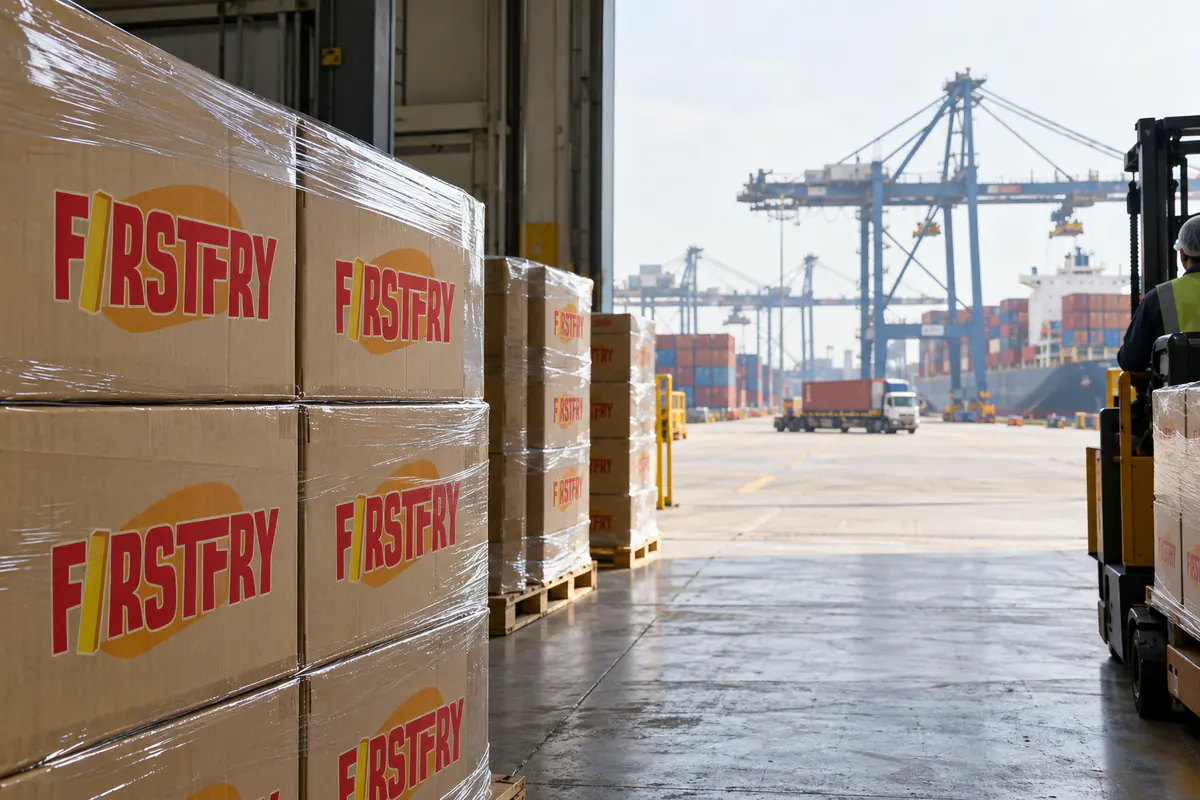
China's food import regime was restructured around two GACC decrees, and the practical effect for an exporter is that a number now sits between you and the market. Get the number, print the number, and the rest is ordinary trade. Skip either step and nothing else you did matters.
Step 1 — Work out which registration route applies
Decree 248 requires overseas producers of imported food to be registered. It splits them into two routes. A defined set of higher-risk categories must be recommended for registration by the competent authority of the exporting country. Everything else registers directly, by the producer or an agent, through the CIFER system.
Which route applies to a given product turns on how the product is categorised, and that assignment is the first thing to settle. It is not always intuitive for a processed potato product, and the answer determines whether your timeline includes an Indian competent authority step or not — which can be the difference between weeks and months.
Establish it in writing, from GACC guidance or a Chinese regulatory consultant, before building a launch plan. An assumption here is expensive because it is discovered late.
Step 2 — CIFER registration
Registration is submitted through CIFER, the China Import Food Enterprise Registration system. The application identifies the producer, the facility, the products, the production process and the food safety management system, and it must be maintained: registrations are granted for a period and require renewal, and material changes have to be updated.
- Facility details exactly as they will appear on every downstream document
- A process flow for the fry line, from intake through blanching, par-fry, freezing and packing
- The food safety management system in place and its certification
- The product list you intend to export, described in Chinese categories
- A named contact who can respond to GACC queries promptly, because queries are timed
Treat the application as a technical document rather than a form. Inconsistencies between the process description, the certificate scope and the product list are the most common reason an application stalls, and each round trip costs weeks.
Step 3 — The number goes on the packaging
This is the requirement that surprises people. The registration number assigned to the overseas producer must appear on the packaging of the food — both inner and outer packaging. It is a physical printing requirement, not a documentation one.
The consequence for production planning is immediate. Film and carton artwork cannot be finalised until the number exists, which means the registration is upstream of the print run, which is upstream of production. Any plan that schedules printing in parallel with registration is a plan to reprint.
| Step | Gates | Typical failure |
|---|---|---|
| Category assignment | Which registration route applies | Assumed, then discovered late |
| CIFER registration | Everything downstream | Stalls on internal inconsistency in the file |
| Registration number issued | Artwork and print run | Print scheduled before the number exists |
| Chinese label to GB standards | Retail admissibility | Translated from another market instead of built |
| Customs declaration | Release | Documents that do not match the pack |
| Consignment inspection | Clearance timing | First-shipment scrutiny not budgeted for |
Step 4 — GB labelling
Prepackaged food for the Chinese market carries a Chinese-language label built to the applicable GB standards, covering the food name, ingredient list, net content and specification, date of manufacture and shelf life, storage conditions, the producer and the in-China distributor or importer, and nutrition information where required.
As in Japan and Korea, this is a label to be built rather than translated. The mandatory content, the nutrition table format and the way shelf life is expressed all follow the Chinese standard, and a competent Chinese labelling consultant will resolve in a week what a translation agency will get subtly wrong in a month.
Step 5 — Customs, tariff and cold chain
Frozen potatoes prepared or preserved otherwise than by vinegar or acetic acid classify in heading 2004.10, with the Chinese tariff line to be confirmed by a customs broker against the actual product. There is no bilateral free trade agreement between India and China, so the applicable rate is the one that applies, and it should be modelled as such rather than optimistically.
On the cold chain, Chinese ports handle very large reefer volumes competently, and the routing from the Indian west coast is shorter than the Americas equivalents. The usual disciplines still apply: setpoint on the booking, a logger in the box, a named person to download it at discharge, and an agreed tolerance in writing.
What to send with a first Chinese quotation
- Facility details in the exact form they will carry through CIFER and every document after it
- Process flow for the fry line, described the way the registration will describe it
- Certification pack and audit report, with the scope matching the product list
- Full specification and ingredient data structured for a GB-standard label
- A realistic sequence showing registration before artwork before production
Frequently asked questions
Do frozen fries need GACC registration to enter China?
Overseas producers of imported food require registration with GACC under Decree 248. Which route applies — direct registration through CIFER, or recommendation by the exporting country's competent authority — depends on how the product is categorised. Settle that categorisation in writing before planning a launch, because it determines whether an Indian authority step is on your timeline.
Does the GACC registration number really have to be printed on the pack?
Yes. The registration number of the overseas producer must appear on both inner and outer packaging. It is a physical printing requirement, which makes the registration upstream of artwork and artwork upstream of the print run. Any schedule that runs printing in parallel with registration is a schedule that ends in a reprint.
Can we use our Gulf or European label artwork for China?
No. The Chinese label is built to the applicable GB standards, in Chinese, with prescribed content, a specific nutrition table format and its own way of expressing shelf life, plus the in-China responsible party and the GACC number. Use a Chinese labelling consultant rather than a translation of existing artwork.
Is there a preferential duty rate for Indian frozen fries in China?
There is no bilateral free trade agreement between India and China, so model the applicable most-favoured-nation rate rather than assuming a preference. Have a Chinese customs broker confirm the exact tariff line and rate against the actual product specification, and build the landed-cost case on that figure from the start.
Planning a China entry?
Tell us the SKUs and we will send the facility and process detail in the form a CIFER application needs, plus the specification and ingredient data your labelling consultant needs for a GB-standard label.
Email BuyFry@FirstFryFoods.com or request a quote. The export desk replies within one business day.