Frozen French Fries Export from India: The Complete Buyer's Guide
Sourcing frozen french fries from India means qualifying a manufacturer on eight verifiable points — capacity, cut specification, freezing method, packaging, certification documentation, container readiness, Incoterms and payment terms — then moving through samples and one trial consignment before committing to volume. India is now the fastest-growing fry origin by export volume, and Gujarat is its production centre.
Published 2026-05-25, updated 2026-09-23 · FirstFry Export Desk · Sourcing & supplier qualification
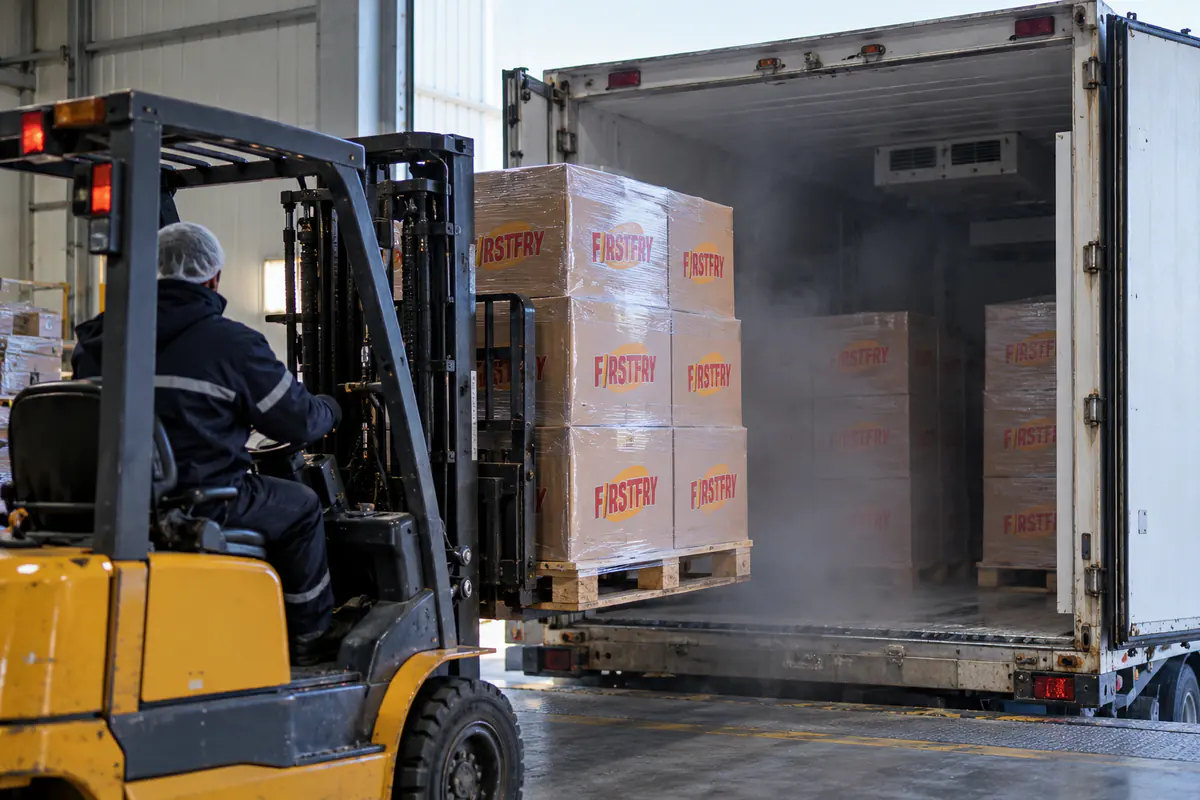
This is the hub guide. It walks the whole sourcing process end to end and links out to the detailed guide for each step. If you are comparing origins for the first time, read it in order. If you already have quotes in hand, jump to the sections on landed cost and qualification.
Why India became a serious fry origin
For two decades the frozen fry trade ran on Belgian, Dutch and Canadian product. That has changed quickly. India's frozen fry exports reached roughly 196,150 tonnes in the twelve months to May 2025 — about 34% higher year on year, according to DCA Market Intelligence trade data, and frozen potato export volume crossed 180,000 tonnes in FY 2024-25, up more than 40% across five years.
Three structural reasons sit behind that, and they matter to a buyer because they determine whether the price advantage is durable or temporary:
- Agronomy. Gujarat's sandy-loam soils, cool winters and long daylight hours produce processing potatoes with high dry matter and low reducing sugars — the two variables that decide fry colour and oil uptake.
- Freight geography. From Mundra or Kandla, transit to Jebel Ali is days rather than weeks. For GCC, East Africa and South-East Asia buyers, an Indian origin removes a large chunk of ocean freight and financing cost from the landed price.
- Capacity. Large lines have come online in Gujarat and more are being built, which means supply is no longer the constraint it was in 2019.
What you are actually buying
A frozen french fry is a manufactured product with a narrow spec window, not a commodity. Two suppliers quoting "9mm fries" can ship materially different goods. These are the fields that decide performance in your customer's kitchen:
The fields that separate two apparently identical quotes are dry matter, coating, par-fry time and defect tolerance. How to read a frozen fry specification works through each one, and the potato varieties behind a good fry covers the raw material those numbers come from.
| Field | Typical export value | Why the buyer should care |
|---|---|---|
| Cut | 6, 7, 9, 10 mm straight; crinkle; wedge; skin-on | Decides cook time, crispness and portion count per kilo |
| Process | Par-fried, then IQF flash-frozen | Par-frying sets the crust; IQF keeps pieces separate rather than in a block |
| Length grading | % of pieces above a stated length | Plate presentation; the single biggest driver of premium pricing |
| Dry matter / solids | Variety-dependent | Higher solids means less oil pickup and better yield |
| Coating | Uncoated or clear-coated | Coated cuts hold crispness far longer under lamps and in delivery |
| Pack | 2.5 kg × 4 in a carton | Freezer handling, portion control and carton count per pallet |
| Shelf life | Up to 24 months at −18 °C | Determines how far ahead you can buy and how long stock can sit |
| Storage | −18 °C, unbroken | Any excursion above this shortens life and shows as clumping on arrival |
Ask every shortlisted supplier for a written specification sheet covering all eight rows before you compare prices. A quote without a spec sheet is not a quote — it is a number. Our own range and its specs sit on the export range with full specifications, including the 7mm and 9mm classic straight-cut fries most importers start with.
The eight things to verify before you shortlist
Supplier qualification in this category comes down to eight verifiable facts. Ask for each one in writing, in this order — the sequence is designed so that a supplier who cannot answer early questions never costs you time on the later ones.
- Installed capacity and current utilisationTonnes per hour on the line and how much of it is already committed. Capacity you cannot access is not capacity.
- Cut range actually in productionNot the brochure list. Which cuts ran last month, at what volume.
- Freezing methodIQF versus block. IQF is what allows partial-bag use in a commercial kitchen.
- Certification documentationAsk for the certificate documents themselves — number, issuing body and validity dates — not a logo strip on a website.
- Packaging capabilityBag sizes, carton formats, print capability, and whether private label is possible at your volume.
- Container and cold-chain readinessReefer loading experience, pre-cooling procedure, temperature-logger policy, port of loading.
- Documentation track recordWhich destination markets they already ship to, and whether they have handled your market's specific registration requirements.
- Commercial termsIncoterms offered, payment terms for a first order, and who carries the risk at which point.
The supplier qualification checklist breaks each of these into the exact question to ask and what a weak answer looks like.
Order volumes: what a first order really looks like
Most first-time importers overestimate the commitment required and underestimate the freight economics. Indicative loading figures, which vary with pack format and palletisation:
| Equipment | Approx. net product | Approx. 10 kg cartons | Typical use |
|---|---|---|---|
| 20 ft reefer | 10–12 t | 1,000–1,200 | Trial consignment, small market, cash-flow-constrained first order |
| 40 ft high-cube reefer | 20–24 t | 2,000–2,400 | Standard commercial FCL, best freight cost per kilo |
| LCL / part load | 1–5 t | 100–500 | Sampling at scale; expensive per kilo, useful for a market test |
A 40 ft FCL is almost always cheaper per kilo than a 20 ft, so the real question is not "what is the MOQ" but "can I sell a full container inside the product's shelf life." With 24 months of shelf life at −18 °C, that maths is usually more forgiving than buyers expect. The realistic first-order volumes guide works through the FCL-versus-LCL decision properly, and mixed-SKU containers explain how to spread a first order across several cuts instead of betting it all on one.
How a quote is built
Frozen fry pricing is quoted, never listed, because the same product has a different cost to serve for every buyer. What moves your number:
- Raw potato cost, which is seasonal and the largest single input
- Cut and grading — longer, tighter-graded product costs more to produce because more of the potato is rejected
- Coating and oil — coated cuts and oil price movements both show up directly
- Packaging — plain export cartons versus printed private-label film are different cost bases
- Volume and frequency — a committed monthly programme prices differently from a one-off
- Incoterm and destination port — the difference between EXW and CIF is entirely freight, insurance and handling
- Payment terms — advance, LC at sight and credit each carry a different financing cost that lands in the unit price
Compare offers on landed cost per kilo at your warehouse, never on FOB alone. Two quotes 4% apart on FOB can invert once freight, duty and financing are included. See what drives price per kilo for the full build-up, and Incoterms for frozen fries for which term to ask for on a first shipment.
Documents and compliance
A frozen consignment moves on paperwork as much as on a vessel. The core Indian export set is consistent across markets; what changes is the destination side.
| Layer | Typically includes | Who provides it |
|---|---|---|
| Commercial | Invoice, packing list, sales contract or purchase order | Exporter |
| Transport | Bill of lading, reefer temperature setting instruction, container temperature log | Exporter and shipping line |
| Origin & product | Certificate of origin, health or sanitary certificate, certificate of analysis | Exporter, with the relevant authority |
| Market-specific | Product or facility registration, halal certification where required, import permit, conformity certificate | Varies — usually a joint exporter/importer task |
The importing, duties and compliance hub covers this layer in detail, including HS code 2004.10 classification and a worked example for importing into the UAE.
The qualification sequence
The order of operations matters more than the speed. Buyers who compress this sequence are the ones who end up with a container of product their customers reject.
- 1. Enquiry with real parametersState destination port, monthly volume, cut, pack and target price band. Vague enquiries get vague quotes.
- 2. Spec sheet and quoteCompare specs first, prices second. Reject any quote without a written spec.
- 3. SamplesFry them yourself, in your customers' equipment, at your customers' oil temperature. Judge colour, crispness, hold time and yield.
- 4. Reference and document checkCertificates, existing destination markets, and — where you can — a buyer reference in a comparable market.
- 5. Trial consignmentOne container, mixed SKUs if possible, on terms that protect you. Log arrival temperature and inspect for clumping.
- 6. ProgrammeOnly after a clean trial: agree a monthly volume, a price mechanism and a lead time you can plan on.
Each step is expanded in sample request to first container.
The last check before the trial container leaves is the one most often skipped. Pre-shipment inspection for frozen fries sets out when to book it, what the inspector samples and measures, and how loading supervision catches the problems a cold store inspection cannot.
Red flags worth walking away from
- A price quoted before any spec has been discussed
- Certification claimed as logos, with the actual certificates never produced
- No willingness to send samples, or samples that arrive without a spec sheet
- Vague answers on freezing method — a supplier who is evasive about IQF versus block is telling you something
- Pressure to skip the trial container and commit to a monthly programme immediately
- A quote that is dramatically below the market band; in a low-margin category that usually means a different product than the one specified
Where FirstFry fits
FirstFry Foods India Private Limited manufactures and exports frozen french fries and potato specialties from Morbi, Gujarat — par-fried, IQF flash-frozen, supplied by the container and under private label. The range covers nine products: classic straight-cut, crinkle cut, extra-long and skin-on fries, coated wedges, oval and triangle hash browns, aloo patties and ready-to-fry samosa. Standard export pack is 2.5 kg × 4 per carton, with custom and private-label formats available.
Before agreeing a delivery date on a distant market, read reefer transit times and transhipment risk. The sea leg is rarely what damages a frozen load; unplugged hours at a transhipment port are, and the routing decides how many of those there are.
For the wider context of how this sector developed - the Gujarat processing belt, contract farming of processing varieties and the single-crop constraint that shapes pricing - see India's frozen potato export industry.
We publish specifications openly on the export range with full specifications and share current certification documentation during buyer qualification. Pricing is quoted against your destination port, volume and cut — see pricing and how to order for how a quote is built and what the ordering sequence looks like.
Buying for a specific market? The market supply guides pick up where this one stops, from the sourcing side rather than the regulatory one: the UAE for the Gulf and Jebel Ali re-export, Southeast Asia for the region as a whole, and then Thailand, Vietnam, the Philippines, Indonesia and Malaysia market by market. Buyers in Singapore who are weighing cartons from a distributor against a container of their own should start with frozen fries wholesale in Singapore.
Frequently asked questions
Is it cheaper to import frozen fries from India than from Europe?
For buyers in the GCC, East Africa, South Asia and South-East Asia it usually is, because the ocean freight leg is far shorter and the raw potato cost base is lower. The comparison has to be made on landed cost per kilo at your warehouse — including freight, duty, financing and any conformity costs — not on FOB price, since freight is exactly where the Indian advantage sits.
What is the minimum order for frozen french fries from India?
Commercially, a 20 ft reefer holding roughly 10-12 tonnes is the smallest sensible full order, and a 40 ft high-cube at 20-24 tonnes gives the best freight cost per kilo. Smaller LCL part-loads are possible for a market test but cost significantly more per kilo. Many manufacturers, including FirstFry, will run a mixed-SKU container so a first order can spread across several cuts.
How long do frozen french fries last?
Up to 24 months from production at minus 18 degrees Celsius in an unbroken cold chain. Any temperature excursion shortens that, and repeated excursions show up as ice crystals, clumped pieces and a soft fry after cooking. Fit a temperature logger to the container so you can prove the chain held on arrival.
Which cut should a new importer start with?
Classic straight-cut at 7mm or 9mm is the highest-volume, lowest-risk starting cut because it suits the widest range of foodservice customers. Add crinkle cut for delivery and heat-lamp applications where hold time matters, and wedges or skin-on where the market wants a rustic, premium-looking product.
What certifications should I ask an Indian fry exporter for?
Ask for the certificate documents themselves rather than a list of names: the issuing body, certificate number and validity dates, plus any registration your own market requires of the manufacturing facility. Logos on a website are not evidence. A supplier who is willing to share current documentation during qualification is demonstrating something a claim cannot.
Get a quote against your port and volume
Send your destination port, monthly volume, cut specification and pack format. The export desk returns a quote, a full spec sheet and current certification documentation within one business day.
Email BuyFry@FirstFryFoods.com or request a quote. The export desk replies within one business day.