Frozen Fries MOQ Explained: FCL, LCL and a Realistic First Order
For frozen french fries, the practical minimum order is one reefer container: roughly 10–12 tonnes in a 20 ft and 20–24 tonnes in a 40 ft high-cube, or about 1,000–1,200 and 2,000–2,400 ten-kilogram cartons respectively. LCL part-loads of one to five tonnes are possible for a market test but cost far more per kilo. With up to 24 months of shelf life at −18 °C, a full container is usually easier to justify than buyers expect.
Published 2026-06-01, updated 2026-10-15 · FirstFry Export Desk · Sourcing & supplier qualification
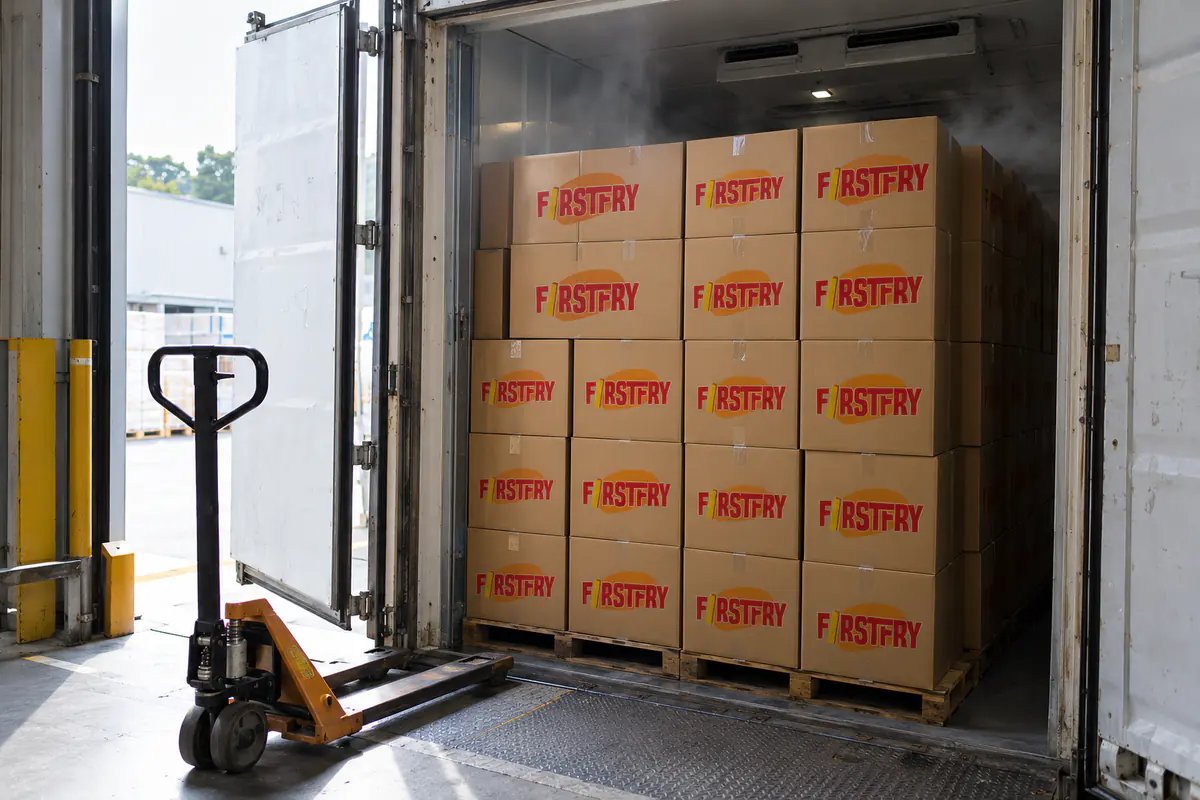
MOQ is a freight question, not a factory question
Buyers usually ask "what is your MOQ" expecting a production constraint. In frozen fries it rarely is one. A 2 tonne-per-hour line produces a 40 ft container's worth of product in roughly half a shift. The binding constraint is that frozen goods move in refrigerated containers, and a half-empty reefer costs almost the same to ship as a full one.
So the real MOQ question is: what is the smallest shipment where the freight cost per kilo does not destroy your margin?
The loading numbers
| Equipment | Net product | Cartons (10 kg) | Freight cost per kg | Best for |
|---|---|---|---|---|
| LCL part load | 1–5 t | 100–500 | Highest | Market test, first customer trial, sample volume at scale |
| 20 ft reefer | 10–12 t | 1,000–1,200 | Middle | Small market, tight cash flow, cold store with limited space |
| 40 ft HC reefer | 20–24 t | 2,000–2,400 | Lowest | Standard commercial order once demand is proven |
The 40 ft is not twice the freight cost of the 20 ft — it is usually far less than twice for double the product. That gap is why experienced importers move to 40 ft as soon as they can, and why a supplier suggesting a 40 ft is not necessarily upselling you.
How LCL shipping works for frozen food
LCL (less than container load) for frozen food means your pallets share one refrigerated container with other shippers' frozen cargo. A consolidator receives each shipper's pallets at a cold store or temperature-controlled freight station, stuffs one reefer at a single setpoint, ships it, and strips it again at a cold store at destination before each consignee collects. Fewer consolidators run reefer groupage than dry LCL, and only on some routes, so the first question is whether a sailing exists on your lane at all.
- Charging: LCL is priced per cubic metre or per tonne, whichever is greater, plus handling at the cold stores at both ends. Expect a cost per kilo several times that of a full container, not a small premium.
- One setpoint for the whole box: frozen fries at -18°C or colder can share with other frozen cargo, never with chilled goods.
- More handling: the cargo is moved at origin, at the consolidator's store and again at destination, and each transfer is a chance for cartons to sit on a warm dock. Put your own logger in your own pallets.
- Shared delays: the box sails when the consolidator fills it, and a customs examination of another consignee's goods can hold yours at destination too.
- Documents: you receive a house bill of lading from the consolidator, so check that your payment terms accept one.
LCL suits one to five tonnes: a market test, samples at commercial scale, or a top-up between full containers. Somewhere above that the arithmetic flips and a 20 ft reefer of your own costs less per kilo, so ask your forwarder for both prices on your lane before comparing supplier quotes.
Can you sell it inside the shelf life?
This is the calculation that decides your order size, and it is simpler than it looks. Frozen fries carry up to 24 months of shelf life at −18 °C. Work backwards from your monthly offtake:
| Your monthly offtake | 20 ft (11 t) | 40 ft (22 t) | Comment |
|---|---|---|---|
| 1 t / month | 11 months | 22 months | 40 ft is technically inside shelf life but leaves no margin for error — start with a 20 ft |
| 3 t / month | ~3.7 months | ~7.3 months | 40 ft is comfortable |
| 8 t / month | ~1.4 months | ~2.7 months | 40 ft, and start planning a second before the first lands |
| 20 t / month | 2 weeks | ~1 month | Monthly programme; talk about a price mechanism, not spot quotes |
What else a container commits you to
Volume is only one of four commitments. Size the order against all four:
- Cold store space. 22 tonnes of 10 kg cartons needs real pallet positions at −18 °C. Confirm capacity, and the cost per pallet per month, before you order.
- Working capital. Product plus freight plus duty, tied up from payment until you have sold through. Frozen inventory is expensive inventory.
- Demand risk. One SKU across a full container is a concentrated bet. Splitting across cuts reduces it — see mixed-SKU container loading.
- Cold-chain risk. A single container is a single point of failure. Fit a data logger and inspect on arrival.
How to size a first order sensibly
A pattern that works for most new importers:
- Samples first, in your customers' kitchensFree or paid, air-freighted. Judge colour, crispness, hold time and portion yield in the equipment your customers actually use.
- One mixed-SKU container as the trial20 ft if your cold store or cash flow is tight, 40 ft if your offtake supports it. Spread it across three or four cuts so you learn what your market prefers.
- Log everything on arrivalArrival temperature, clumping, defect rate, fry colour, yield per kilo. This is the baseline you will hold future shipments against.
- Then commit to a programmeOnce a trial has cleared, a monthly or quarterly volume gets you better pricing, planned production slots and a lead time you can promise your own customers.
When to be sceptical of a low MOQ
A supplier offering a very small minimum — a few hundred kilos, say — is either shipping LCL at a cost you will feel later, consolidating with someone else's cargo, or selling from finished stock of unknown age. None of those is automatically bad, but ask which it is, and ask for the production date on the cartons.
Whatever size you settle on, specify a minimum remaining shelf life on arrival rather than relying on the printed date. A product delivered with a few months left is technically in date and commercially useless - shelf life and the cold chain behind it covers what to put in the contract.
Conversely, a supplier who insists on multiple containers for a first order is asking you to carry all the risk of an unproven relationship. A single trial container is the reasonable middle, and most manufacturers will do it.
What we do
FirstFry supports trial runs through to full containers, and will load mixed-SKU containers across the export range available for mixed loading so a first order does not have to be a single-cut bet. Most first-time importers start with classic straight-cut fries as the volume line and add crinkle cut, wedges or skin-on alongside it to test the market.
Frequently asked questions
How many tonnes of frozen fries fit in a 40 ft container?
Roughly 20 to 24 tonnes net in a 40 ft high-cube reefer, which is about 2,000 to 2,400 cartons at the standard 10 kg pack (2.5 kg times four bags). The exact figure depends on carton dimensions, palletisation and the shipping line's payload limit, so confirm with your forwarder before booking. A 20 ft reefer holds roughly 10 to 12 tonnes.
Is there a minimum order quantity for frozen french fries?
In practice the minimum is one reefer container, because a part-loaded refrigerated container costs almost as much to ship as a full one. Production is rarely the constraint: a 2 tonne-per-hour line makes a 40 ft container's worth of product in about half a shift. LCL part-loads of one to five tonnes are possible for a market test but the freight cost per kilo is significantly higher.
Should a first order be a 20 ft or a 40 ft container?
Choose on offtake and cold store space rather than on caution. If you sell more than about three tonnes a month, a 40 ft clears comfortably inside the 24-month shelf life and gives a materially lower freight cost per kilo. A 20 ft makes sense for a genuinely small market, limited pallet positions, or tight working capital.
Can I order more than one cut in a single container?
Yes, and for a first order it is usually the better choice. A mixed-SKU container spreads demand risk across several cuts and lets you learn what your market prefers before committing a whole container to one specification. Ask your supplier for the minimum quantity per SKU within a mixed load.
Can frozen food be shipped LCL?
Yes, through a consolidator that runs reefer groupage: your pallets share one frozen container with other shippers' cargo at a single setpoint, usually -18°C or colder. It is offered on fewer routes than dry LCL, is charged per cubic metre or tonne with cold-store handling at both ends, and adds transfers and shared delays. It suits one to five tonnes, such as a market test; above that a 20 ft reefer of your own is usually cheaper per kilo.
Size your first container with us
Tell us your monthly offtake, cold store capacity and destination port. The export desk will come back with a 20 ft and a 40 ft option, a mixed-SKU split, and the landed cost difference between them.
Email BuyFry@FirstFryFoods.com or request a quote. The export desk replies within one business day.