Potato Varieties for Frozen French Fries: Why the Tuber Decides the Fry
Good frozen fries need potatoes with high dry matter, around 20 to 24 percent, low reducing sugars, and a long oval shape that yields long strips. Russet Burbank, Innovator, Shepody and Markies dominate in North America and Europe. India's processing crop is built on Kufri Chipsona and Kufri Frysona lines plus imported varieties such as Santana, grown mainly in Gujarat, Punjab and West Bengal.
Published 2026-08-06 · FirstFry Export Desk · Specifications & product science
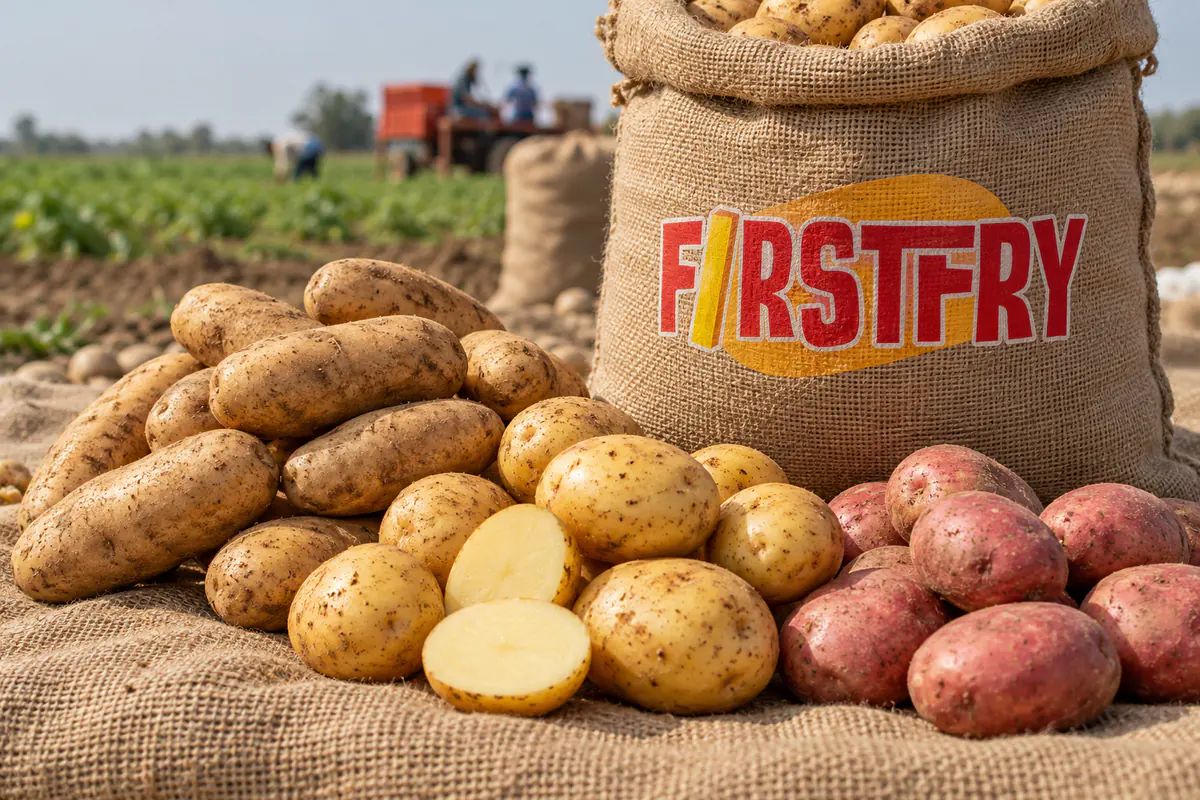
Why the variety name matters less than the numbers
Buyers often ask which variety a fry is made from as if the name were the specification. It is not. The same variety grown in different soils, climates and storage regimes produces meaningfully different fries, and a well-grown local variety will beat a badly grown famous one every time.
What actually predicts fry quality is three measurable properties: dry matter, reducing sugar content, and tuber geometry. Variety influences all three, but so do agronomy, harvest timing and how the crop was stored. Ask for the numbers rather than the name.
Dry matter: the yield and texture driver
Dry matter is everything in the tuber that is not water, mostly starch. Processing crops target roughly 20 to 24 percent, often expressed as specific gravity between about 1.080 and 1.095.
The logic is simple. Water in the potato boils off in the fryer and oil moves in to replace it. A high-solids potato has less water to lose, so it shrinks less, absorbs less oil and holds a firmer structure. A low-solids potato gives you a limp, greasy fry and a poor yield per tonne of raw material, which is why processors pay on solids rather than on weight alone.
Reducing sugars and the cold-sweetening trap
Glucose and fructose in the tuber caramelise in hot oil. A little gives appetising golden colour; too much gives dark ends and a burnt appearance, even when the fry is perfectly cooked.
The complication is storage. Potatoes held below roughly 4C convert starch into sugar to protect themselves from freezing, a process called cold sweetening. Processing crops are therefore stored warmer than table potatoes, typically around 7 to 10C with sprout suppression, and a sweetened batch can sometimes be recovered by reconditioning at warmer temperatures for a few weeks.
The varieties used around the world
| Variety | Origin / main use | Notable traits |
|---|---|---|
| Russet Burbank | North America, the classic fry potato | Very long tubers, high solids, demanding agronomy |
| Innovator | Europe and North America | Long shape, good storage, russet skin |
| Shepody | North America, early season | High solids early, shorter storage life |
| Markies | Northwest Europe | Long oval, strong storage stability |
| Santana | Europe, widely grown in India | Good fry colour, adapts to warmer climates |
| Kufri Chipsona 1 / 2 / 3 | India, ICAR-CPRI bred | High dry matter, low reducing sugars, processing focus |
| Kufri Frysona | India, ICAR-CPRI bred | India's first french-fry-specific variety: oblong tubers over 80mm, dry matter above 20%, reducing sugars under 0.1% |
Russet Burbank remains the benchmark for long fries but is agronomically fussy and unsuited to many climates. Northwest European processors lean on Markies, Innovator and similar long-oval varieties bred for storage stability.
What India actually grows for processing
India's processing crop was built deliberately. Table varieties dominant in Indian agriculture are generally too low in solids and too high in sugars to fry well, so ICAR-CPRI released the Kufri Chipsona series specifically for processing, followed by Kufri Frysona aimed at french fry geometry rather than chips.
Alongside these, European varieties such as Santana are grown under contract where they suit local conditions. The processing belt is concentrated in northern Gujarat - Deesa and the Banaskantha and Sabarkantha districts - along with Punjab, Uttar Pradesh and West Bengal, chosen for soil, a suitable cool growing window and dense cold-store capacity.
Kufri Frysona is the clearest example of that engineering. Developed by ICAR-CPRI as India's first indigenous variety bred specifically for french fries, it was selected for the long oblong tuber shape the format requires - reported at over 80mm in length - together with dry matter above 20 percent and reducing sugars below 0.1 percent. Those three properties are precisely the specification a fry line needs, and none of them were reliably available from India's traditional table varieties. ICAR-CPRI has continued releasing processing varieties since, including newer lines aimed at the chip and fry segments.
- Planting - typically October to November as the rabi crop
- Harvest - January to March, when the crop is lifted for processing and storage
- Storage - controlled-temperature cold stores supply the lines year round
- Contract farming - processors specify variety, seed source and agronomy rather than buying on the open market
Contract farming is the important part. Buying processing potatoes on a spot market means accepting whatever solids and sugars arrive; contracting the crop means specifying them upfront. The Indian potato crop calendar covers how that shapes supply through the year.
Tuber shape and why long fries cost more
A fry cannot be longer than the potato it came from. Long-cut and extra-long grades require a supply of large, elongated tubers, which is partly variety and partly grading: the biggest and best-shaped tubers are selected out of the crop before cutting.
| Question | Good answer | Warning sign |
|---|---|---|
| What dry matter range do you hold to? | A stated range, e.g. 20-23% | A single flattering number, or none |
| What happens late in the storage season? | Specific process adjustments | Nothing changes |
| Is raw material contracted or bought spot? | Contracted, with specified seed | Bought on the open market |
| What is your reducing-sugar specification? | A numeric limit | Vague reference to quality |
| Is cold storage owned or rented? | Owned, with temperature history | Rented, no records |
That selection is why long grades carry a premium and why availability tightens in a poor season. Round or short-oval tubers still produce excellent fries, just shorter ones, and they often go to crinkle, dice or wedge formats where length is irrelevant. See extra long fries and the tubers they demand for what the top length band involves.
What to ask your supplier
Rather than asking which variety, ask what dry matter range they hold to, what their reducing-sugar specification is, how the crop is stored and whether raw material is contracted or bought on the open market. Those four answers tell you far more about the fry you will receive than any variety name.
A supplier who contracts specified varieties, controls storage temperature and grades on solids will deliver consistent fries across a season. One who buys spot will deliver whatever the market gave them that week.
Frequently asked questions
Which potato variety is best for french fries?
There is no single best variety. Russet Burbank is the traditional benchmark for long fries, with Innovator, Markies and Santana widely used in Europe. What matters more than the name is dry matter of roughly 20 to 24 percent, low reducing sugars and a long oval shape, all of which depend on growing conditions as much as genetics.
What potatoes does India use for frozen fries?
Mainly the Kufri Chipsona series and Kufri Frysona, bred by ICAR-CPRI specifically for processing, along with European varieties such as Santana grown under contract. Production is concentrated in northern Gujarat, particularly the Deesa, Banaskantha and Sabarkantha areas, plus Punjab, Uttar Pradesh and West Bengal.
What dry matter do potatoes need for good fries?
Around 20 to 24 percent, corresponding to a specific gravity of roughly 1.080 to 1.095. Below about 19 percent the fry absorbs excess oil, shrinks heavily and eats limp. Much above 25 percent it can eat dry and mealy, and consistent supply at that level is difficult.
Why do frozen fries sometimes have dark ends?
Excess reducing sugars caramelising in the fryer. The usual cause is cold sweetening, where potatoes stored below about 4C convert starch to sugar. Processing crops are stored warmer, around 7 to 10C, and a sweetened batch can sometimes be reconditioned at higher temperature before use.
Why are extra long fries more expensive?
Because a fry cannot be longer than its potato. Long grades require large, elongated tubers that are selected out of the crop before cutting, so a smaller share of each harvest qualifies. The grading tightens further in a poor season, which is when long-cut availability and price move most.
Ask about our raw material
We can share the varieties under contract for the current crop year, our dry matter and reducing-sugar specifications, and how the crop is stored between harvest and production. Email the export desk for the current season's detail.
Email BuyFry@FirstFryFoods.com or request a quote. The export desk replies within one business day.