India's Frozen Potato Export Industry: How It Grew and Where It Sits
India's frozen potato export industry is concentrated in northern Gujarat, particularly the Deesa, Banaskantha and Sabarkantha belt, supported by contract farming of processing varieties such as the Kufri Chipsona series. Its structural advantages are a competitive raw-material and labour cost base and short sailing times to the Gulf, East Africa and Southeast Asia from Mundra and Kandla. Its constraints are a single annual crop and dependence on cold storage.
Published 2026-08-15, updated 2026-09-06 · FirstFry Export Desk · Market intelligence
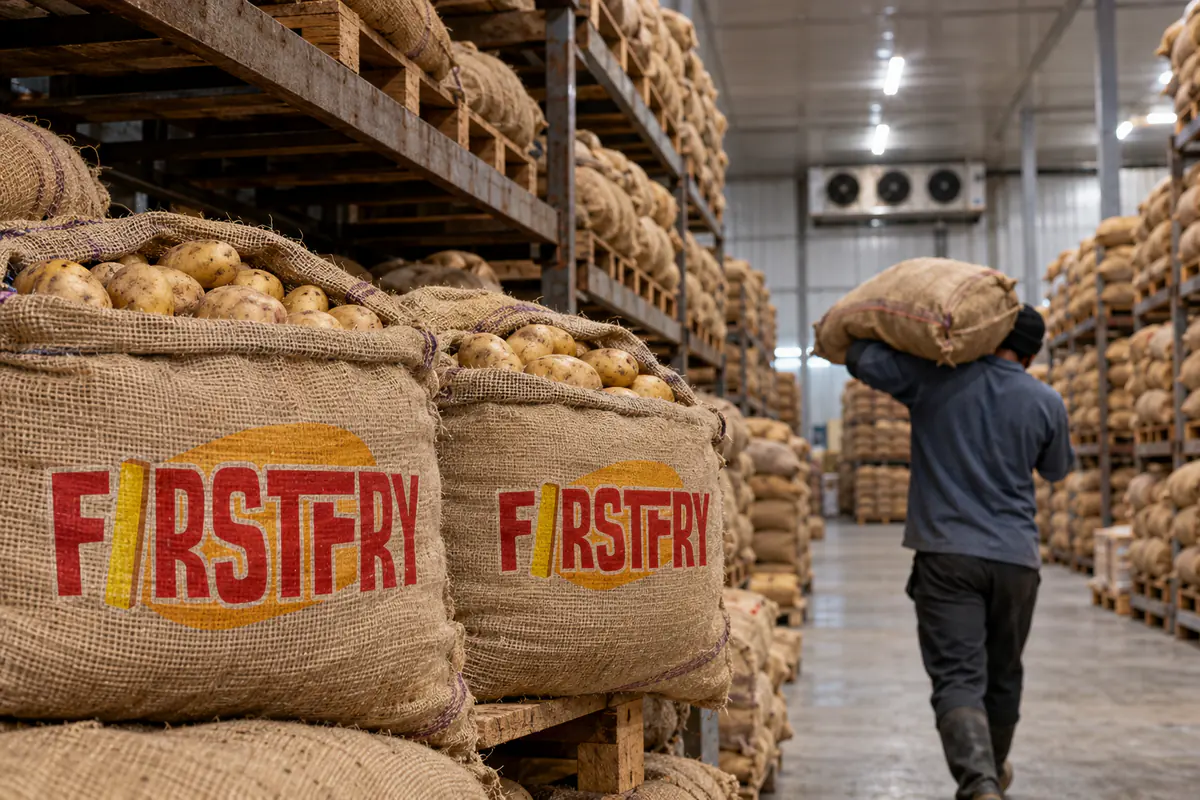
An industry built in the opposite order
Most potato-processing countries developed the crop first and the factories afterwards. India did the reverse. The varieties that dominated Indian agriculture were bred for table use - low in dry matter, high in reducing sugars - and would have made poor fries.
So the processing sector had to engineer its own raw material. ICAR's Central Potato Research Institute released the Kufri Chipsona series specifically for processing, later followed by Kufri Frysona aimed at french fry geometry. Processors imported European varieties such as Santana in parallel and adapted the agronomy to Indian conditions.
That history explains a structural feature of the industry today: raw material is contracted rather than bought. A processor specifies the variety, supplies or approves the seed, and often dictates the agronomy, because buying processing-grade potatoes on the open market simply is not possible at scale.
Why northern Gujarat
The concentration around Deesa and the Banaskantha and Sabarkantha districts is not accidental. Several conditions had to coincide.
| Factor | Why it matters |
|---|---|
| Sandy loam soils | Suits tuber shape and makes lifting cleaner, lowering damage |
| Cool dry winter window | The rabi season gives the growing conditions processing varieties need |
| Dense cold storage | A single annual harvest must be stored to feed factories year round |
| Established grower base | Decades of potato farming, receptive to contract arrangements |
| Proximity to Mundra and Kandla | Short inland leg to major container ports |
| Reliable power and utilities | Freezing and cold storage are energy-intensive and interruption-sensitive |
The last two matter more than they might appear. A frozen fry plant that loses power loses product, and a long inland reefer leg adds both cost and cold-chain risk before the container even reaches the port.
Capacity has kept expanding, and it is beginning to spread beyond the original belt. Falcon Agrifriz commissioned a fry line at Kadi in Mehsana, Gujarat in 2025, and McCain announced a large greenfield facility in Agar-Malwa, Madhya Pradesh in the same year. APEDA has also facilitated first-time frozen fry shipments from newer producing states, including a consignment from Uttarakhand to Iraq. Gujarat remains the centre of gravity, but it is no longer the only location.
The named players a buyer will encounter include McCain's Indian operation, HyFun Foods, Iscon Balaji Foods and Falcon Agrifriz, alongside a growing tier of mid-sized processors such as FirstFry. Capability across that tier varies widely, which is why the qualification questions at the end of this guide matter more than the country on the label.
The freight advantage
India's most durable structural advantage in this trade is geography. Sailing times from Mundra to Jebel Ali are measured in days rather than weeks, and the same proximity applies to much of East Africa and, to a lesser degree, Southeast Asia.
For a frozen product, transit time is not just a cost. Every additional week at sea is another week of reefer power, another week of cold-chain exposure, and another week of shelf life consumed before the product reaches a distributor's cold store.
- Shorter transit - less shelf life consumed in transit, more remaining on arrival
- Lower reefer cost - fewer days of powered container time
- Faster replenishment - smaller safety stock needed at the destination
- Reduced risk exposure - fewer days in which something can go wrong
European origins compete on established brand recognition and a longer processing history; India competes on cost and proximity to the markets growing fastest. How India compares with European origins sets the two side by side.
The single-crop constraint
India's principal structural weakness is that the processing crop is harvested once a year, between roughly January and March. Everything produced for the following twelve months comes out of cold storage.
This creates two effects buyers should understand. First, raw-material cost for the whole year is largely set at harvest, so a poor crop propagates through twelve months of pricing rather than being corrected by the next planting. Second, tuber quality drifts through the storage season as sugars slowly change, which is why fry colour can vary between a January production run and an October one from the same plant.
The crop calendar behind Indian supply covers how to plan orders around it.
Where the exports go
Indian frozen potato exports have been driven primarily by demand in the Gulf, Southeast Asia and increasingly East and West Africa. The common thread across those markets is rapid growth in quick-service restaurants and modern retail, in economies where imported European product carries a significant freight and price premium.
The scale is now material rather than emerging. In 2025-26 India's exports of processed vegetables reached about USD 932 million across roughly 727,000 tonnes, of which value-added potato products accounted for approximately 277,000 tonnes worth around USD 289 million. Frozen potato export volume had already passed 180,000 tonnes in 2024-25, having grown more than 40 percent across five years.
| Measure | Reported figure | Period |
|---|---|---|
| Processed vegetable exports, total | About USD 932 million / 727,000 tonnes | 2025-26 |
| Value-added potato products | About USD 289 million / 277,000 tonnes | 2025-26 |
| Frozen potato export volume | Passed 180,000 tonnes | 2024-25 |
| Five-year volume growth | More than 40 percent | To 2024-25 |
The GCC is the anchor market: high per-capita foodservice spending, near-total import dependence for processed potato, and short sailings. GCC demand, India's largest export market covers it specifically.
African markets are earlier in the curve but growing, with the practical complication that each destination has its own conformity assessment and registration regime, which favours exporters with documentation experience over those competing purely on price.
What to look for in an Indian supplier
The industry spans large integrated processors and smaller plants of widely varying capability, so origin alone tells you little. The questions that separate them are consistent.
- Is raw material contracted or bought spot? Contracted supply means specified varieties and predictable solids.
- What certifications are held, and are they current? Ask for certificates with dates rather than logos on a brochure.
- What is the dry matter specification, and what happens late in the season?
- Is there in-house cold storage, or is it rented? Owned storage means controlled temperature history.
- What documentation experience exists for my destination market? Registration and conformity requirements differ sharply by country.
- Can they supply mixed-SKU containers? Important for a first order into a new market.
Those six questions map onto the stages of the chain itself. The frozen french fry supply chain from contract farm to fryer walks each stage, from seed and the single harvest through storage, the plant, the reefer leg and the last mile, and shows where each one fails.
A supplier who answers all six precisely is running a controlled operation. Vague answers on raw material and storage are the ones that eventually turn into quality complaints. The specifications behind frozen fries and potato specialties made in Gujarat are written to answer exactly these questions.
Frequently asked questions
Where are frozen french fries made in India?
Production is concentrated in northern Gujarat, particularly the Deesa area and the Banaskantha and Sabarkantha districts, with additional processing in Punjab and Uttar Pradesh. The Gujarat belt combines suitable soils, a cool rabi growing window, dense cold storage and short inland access to Mundra and Kandla ports.
Why did India develop a frozen fry industry?
Because domestic demand from quick-service restaurants and modern retail grew quickly, and because the cost base and proximity to Gulf and African markets made export viable. The processing potato crop had to be engineered for it, since traditional Indian table varieties are too low in dry matter and too high in sugars to fry well.
What is India's advantage over European fry exporters?
Cost base and freight proximity. Sailing times from Mundra to Jebel Ali are days rather than weeks, which reduces reefer cost, consumes less shelf life in transit and allows faster replenishment with smaller safety stock. European origins compete on longer processing history and brand recognition.
Is Indian frozen fry supply available year round?
Yes, but from a single annual crop. The processing harvest runs roughly January to March and feeds factories from cold storage for the following twelve months. Supply is continuous; what varies is raw-material quality through the storage season, which well-run processors manage through storage control and process adjustment.
How do I check an Indian frozen fry supplier is credible?
Ask whether raw material is contracted or bought spot, what certifications they hold with current dates, their dry matter specification and how it changes late in the season, whether cold storage is owned or rented, and what documentation experience they have for your specific destination market.
Talk to a Gujarat manufacturer directly
FirstFry manufactures in Gujarat with contracted raw material and in-house cold storage. Email the export desk with your market, volumes and required specifications for a container quote and current certification documents.
Email BuyFry@FirstFryFoods.com or request a quote. The export desk replies within one business day.