How to Order a Mixed-SKU Container of Frozen Potato Products
A mixed-SKU container carries several frozen potato products in one refrigerated load, typically three to five cuts across a 40 ft high-cube holding roughly 20–24 tonnes. It keeps freight cost per kilo at full-container levels while spreading demand risk across products, which is why it is the standard structure for a first order. Suppliers normally set a minimum quantity per SKU — commonly a pallet or a few hundred cartons.
Published 2026-06-10 · FirstFry Export Desk · Sourcing & supplier qualification
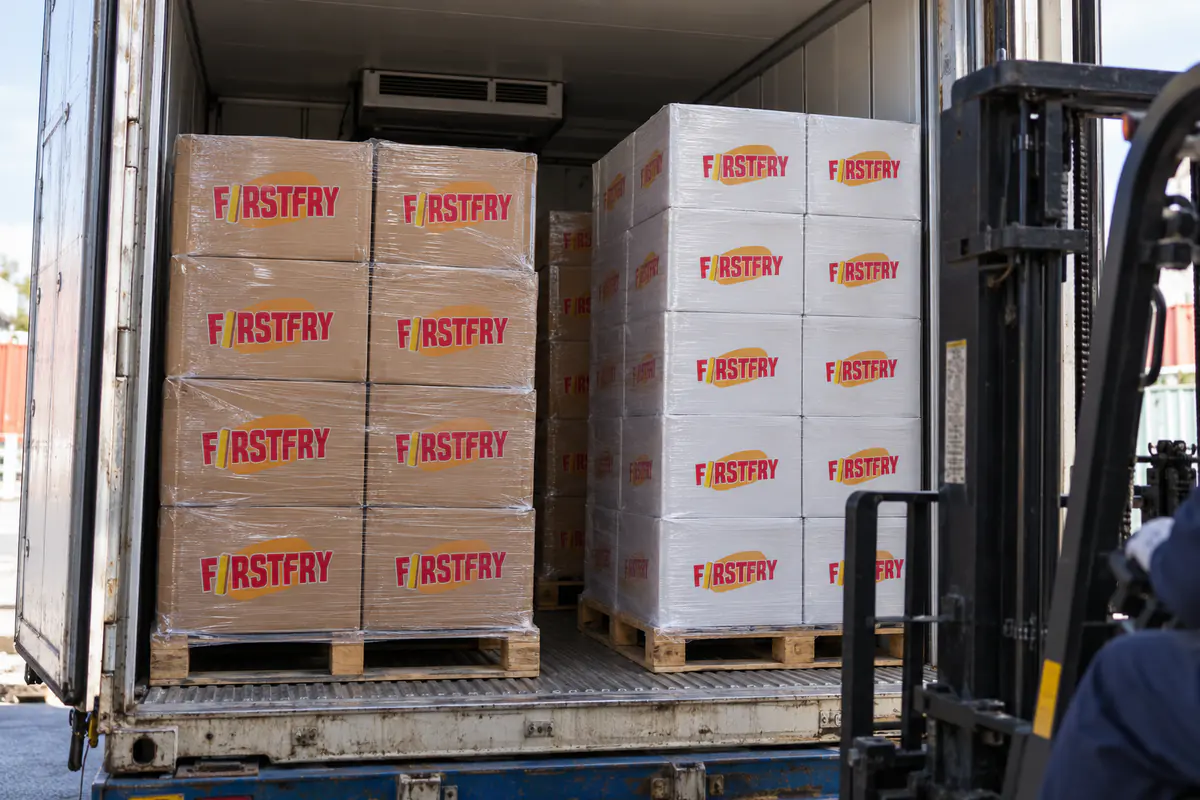
The problem a mixed container solves
A first-time importer faces a genuine dilemma. Full-container freight is far cheaper per kilo than part loads, so economics push you toward a 40 ft. But a 40 ft of a single cut is a concentrated bet on a product your market has not yet chosen. Buy 22 tonnes of 9mm straight-cut and discover your customers actually want crinkle for delivery, and you have a year of slow-moving stock.
A mixed-SKU container resolves it: one reefer, one bill of lading, one clearance — several products.
A worked 40 ft split
An illustrative structure for a distributor entering a new market, on a roughly 22 tonne load:
| Product | Share of load | Approx. tonnes | Channel it tests |
|---|---|---|---|
| Classic straight-cut 9/10 mm | 45% | ~10 t | Core foodservice volume; the safest line |
| Crinkle cut | 20% | ~4.4 t | Delivery and heat-lamp holding |
| Coated wedges | 15% | ~3.3 t | Premium and pub/casual dining |
| Skin-on | 12% | ~2.6 t | Rustic and hotel presentation |
| Samosa or specialty | 8% | ~1.8 t | Ethnic retail and appetiser menus |
The logic: put roughly half the load into the cut you are most confident about, then use the rest to test. After one selling cycle you will know your real mix, and the second container can be weighted accordingly.
Splitting a load is also the cheapest way to test how each cut performs in your own service. Yield, holding time and delivery survivability vary sharply between formats - the foodservice performance guide covers what to measure, and how long a fry holds under a lamp covers the test itself.
Minimums per SKU
Manufacturers set a minimum per line because each SKU means a separate production run, changeover and packaging setup. The practical unit is usually a pallet.
- Ask for the minimum cartons or pallets per SKU before you design the split
- Ask whether private-label printing changes that minimum — it almost always raises it, because printed film has its own minimum order
- Ask whether plain-carton and printed SKUs can share one container. Usually yes, but confirm.
- Check whether any SKU has a different HS classification — pastry items such as samosa typically do not sit under the fries heading
Loading and stowage
A mixed load has more ways to go wrong physically than a single-SKU one. Specify these in the purchase order:
- Pallet segregation by SKU, so your cold store can receive and put away without sorting a mixed pallet at the dock
- A stowage plan or loading photographs, so you know which pallet is which before the doors open
- Carton labelling with product name, production date and batch on every carton face that will be visible
- Airflow discipline — the container must not be over-stacked past the load line; blocked airflow is a classic cause of warm spots in a mixed load
- Logger placement, ideally more than one for a mixed load, since a single sensor in one pallet tells you about that pallet
The documentation consequence
Every SKU is a separate product for compliance purposes. That means:
| Item | Per container | Per SKU |
|---|---|---|
| Bill of lading | One | — |
| Commercial invoice | One, itemised | A line per SKU with its own HS code where they differ |
| Packing list | One | Cartons, net and gross weight per SKU |
| Specification sheet | — | One per SKU |
| Certificate of analysis | — | One per batch per SKU |
| Product registration in your market | — | Often required per SKU — check before ordering |
That last row is the one that catches people. If your market registers products individually, a five-SKU container needs five registrations in place before arrival. Start that process before you place the order — see the import documents and compliance guide.
When a mixed container is the wrong choice
- You already know your mix. If you have sold three containers and 90% is one cut, a single-SKU load is simpler and cheaper to handle.
- Your market registers products slowly. Five registrations may take longer than one; start with two SKUs.
- Your cold store cannot segregate. Mixed pallets arriving into a store with no put-away discipline creates picking errors that cost more than the risk you avoided.
- Private label across every SKU. Printed film minimums per SKU can make a five-way split more expensive than two separate shipments.
What we load
FirstFry loads mixed-SKU containers across the products available for mixed loading — classic straight-cut, crinkle cut, extra-long and skin-on fries, coated skin-on wedges, oval and triangle hash browns, aloo patties and ready-to-fry samosa. Tell us your channel mix and target load size and we will propose a split, confirm the minimum per SKU, and flag which lines need a separate classification on the invoice. For the volume side, see container loading and MOQ figures; for how to run the shipment as a controlled trial, see the trial container protocol.
Frequently asked questions
Can I order several different frozen fry cuts in one container?
Yes. A mixed-SKU container carries several products in one refrigerated load, keeping freight cost per kilo at full-container levels while spreading demand risk across products. It is the standard structure for a first order. Suppliers set a minimum quantity per SKU, usually around one pallet, because each line means a separate production run and packaging setup.
How should I split a first mixed container?
Put roughly half the load into the cut you are most confident about, then use the remainder to test two or three alternatives your channel might prefer. Keep each tested SKU large enough to be a genuine market test — a line at three percent of a container is usually below the supplier minimum and too small to learn from anyway.
Does a mixed container cost more than a single-product container?
Freight is the same, since it is one reefer. There can be a small production premium because each SKU requires a changeover, and printed private-label film raises the minimum per line. Against that, a mixed load usually saves far more by avoiding a container of slow-moving stock in the wrong specification.
Do all products in a mixed container use the same HS code?
Not necessarily. Fries, crinkle cut, wedges and skin-on normally sit under the frozen prepared potato heading 2004.10, but pastry or filled items such as samosa typically classify elsewhere, commonly under 2106.90. Your commercial invoice needs a line per SKU with the correct national code, and your broker should confirm each one.
Design your mixed container with us
Tell us your channel mix — foodservice, delivery, retail, hotel — your destination port and target load size. We will propose an SKU split, confirm minimums per line, and flag any product that needs its own classification on the invoice.
Email BuyFry@FirstFryFoods.com or request a quote. The export desk replies within one business day.