Frozen Fries Wholesale in Singapore: Buying by the Carton or by the Container from India
A Singapore buyer can source frozen fries wholesale two ways: by the carton from a local distributor, or by the reefer container direct from a manufacturer. Importing direct needs a free Singapore Food Agency registration to import processed food and a TradeNet permit for each consignment. Singapore charges no customs duty on fries, only 9% GST, and has banned partially hydrogenated oil in all food since June 2021.
Published 2026-10-07 · FirstFry Export Desk · Sourcing & supplier qualification
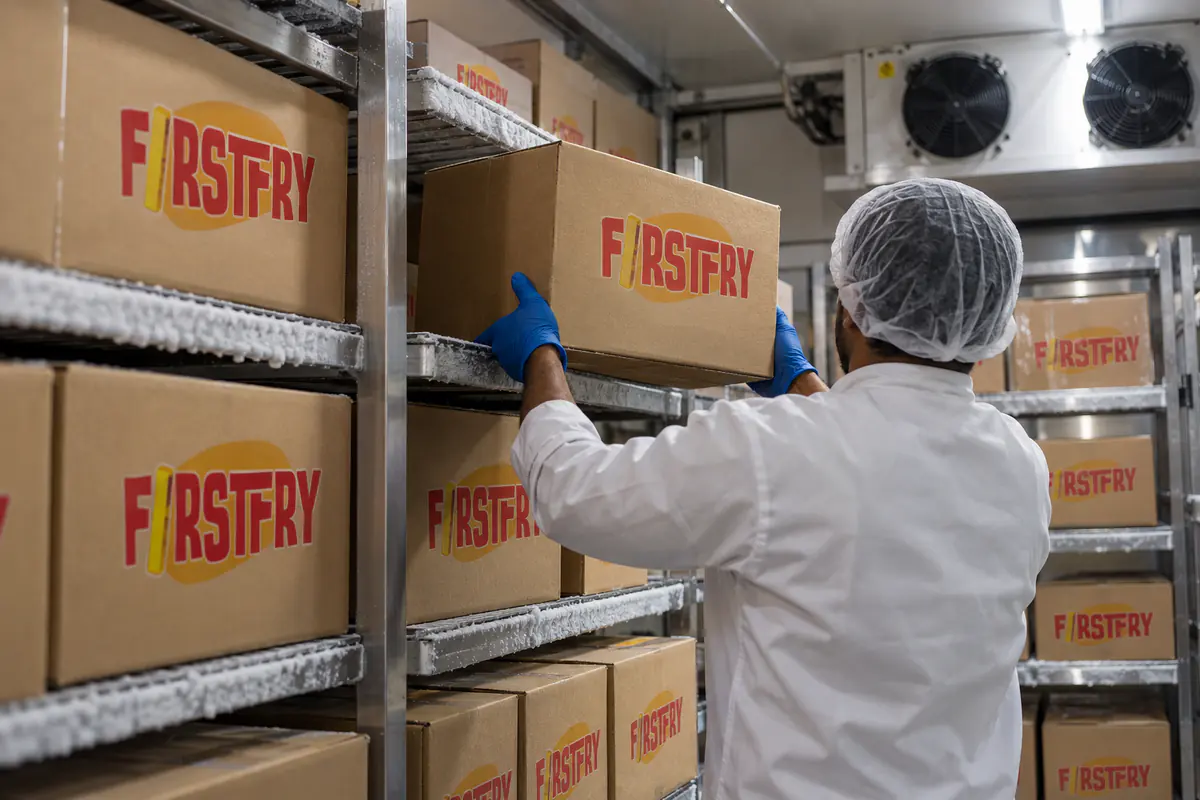
Singapore grows almost none of its own food, so practically every fry sold on the island came in through the port. Wholesale here means one of two things. Either you buy cartons from a company that has already imported them, or you become the importer. Most small operators never look at the second route because they assume it needs a licence, a warehouse and a customs department. For this product it needs none of those to begin with.
Carton or container: the two routes compared
| Cartons from a local distributor | Container direct from the manufacturer | |
|---|---|---|
| Who it suits | Single outlets, small groups, anyone testing a menu | Distributors, central kitchens, groups with steady weekly volume |
| Smallest order | A few cartons | One 20 ft reefer, roughly 10 to 12 tonnes |
| Who is the importer | The distributor | You, under your own registration |
| Where stock sits | In the distributor's cold store | In cold storage you rent or own |
| Cash tied up | One delivery at a time | A full container, paid before or on arrival |
| Choice of cut and pack | What the distributor carries | Any cut and pack the plant makes, including your own label |
| Price basis | Delivered price per carton | CIF Singapore per tonne, plus GST, port and storage |
The comparison that matters is not price per kilo. It is price per kilo after storage. A direct container is cheaper at the port and then starts costing money every week it sits in a cold store, so the route pays once a container sells through in a predictable number of weeks. Work that out from your own weekly usage before asking anyone for a quote.
What importing direct requires
Singapore regulates the importing business, not the product. For processed food other than meat, fish and fresh produce, the Singapore Food Agency asks for a Registration to Import Processed Food Products and Food Appliances. There is no fee, and no supporting documents are needed for the application.
- A registered businessOnly businesses registered with ACRA can apply, and the Unique Entity Number must be activated with Singapore Customs.
- The processed food registrationApplied for online with the Singapore Food Agency. Frozen potato products fall under processed food.
- A TradeNet account or a declaring agentPermits are filed through TradeNet. Most first-time importers use a freight forwarder as declaring agent.
- A permit for each consignmentThe Cargo Clearance Permit also serves as the food import permit. Complete applications are normally processed within one working day.
- A compliant labelPrepacked food must follow the agency's labelling rules before it is imported or sold.
That is the whole gate for a first container. The detail of licence classes, labelling content and transhipment risk is in the Singapore licensing guide. One thing to watch: the Food Safety and Security Act 2025 is replacing the older food laws in stages through 2028, and its import provisions are being switched on in stages, so ask the agency or your forwarder which rules are in force on the day you ship.
Duty, GST and the oil rule
Singapore Customs charges duty on four groups of goods only: intoxicating liquors, tobacco, motor vehicles and petroleum products. Everything else, frozen fries included, is non-dutiable. Goods and Services Tax at 9% is charged on the CIF value at import, and a GST-registered business claims it back in the normal way. No certificate of origin is needed to obtain a duty rate, because there is no duty to reduce.
The rule that reaches back to the factory is on oil. Partially hydrogenated oil has been banned as an ingredient in all food sold in Singapore, local or imported, since June 2021, and importers are expected to make sure their range complies. Par-fried fries carry some of the oil they were fried in, so ask any supplier for two lines in writing: the frying oil by name, and a statement that it is not partially hydrogenated.
Halal: not the law for fries, but often the contract
Singapore does not require imported fries to be halal certified. Many buyers do. A halal-certified restaurant or central kitchen has to show that its inputs are halal, and for food made overseas MUIS does not certify the product itself. It recognises foreign halal certification bodies in the exporting country. That list moved to an enhanced framework on 1 October 2025, with each body's status and validity published on a searchable MUIS portal.
- Ask the supplier which body issued the halal certificate and for the certificate itself
- Look that body up on the current MUIS list on the day you place the order, not from an old PDF
- Check the certificate names the plant and the products you are buying
- Check the expiry date covers the production date of your order
How to read a halal certificate goes through the document line by line.
Sizing the first order
A 20 ft reefer carries roughly 10 to 12 tonnes of frozen fries and a 40 ft high-cube 20 to 24 tonnes. For a buyer moving from cartons to containers the 20 ft is the natural first step. Three decisions keep it manageable.
- Mix the cuts. One container can hold several products, so the load matches the menu rather than one fast seller. See how a mixed container is planned
- Book the cold store before the vessel. Cold storage is the constraint for most first-time importers, and the container has to be unloaded on arrival
- Avoid part loads for frozen. A shared reefer means more handling and less control of temperature. The trade-off is set out in full container against part loads
Menus in Singapore lean on a short list. Straight-cut Classic Fries carry burgers, fried chicken and western stalls. Crinkle cut fries hold sauce and suit delivery. Hash browns cover cafe breakfasts. A first mixed container can split across two or three of these.
Questions to put to a supplier
- What is the frying oil, and will you state in writing that it is not partially hydrogenated?
- Which halal body certifies the plant, and is it on the MUIS list today?
- What shelf life will be left when the container lands, counted from the production date?
- Can one container carry more than one cut, and what is the smallest quantity of each?
- Which label data will you supply for the Singapore label, and who prints it?
- What documents come with the shipment, and when do the drafts arrive for checking?
Where FirstFry fits
FirstFry Foods India Private Limited manufactures frozen french fries and potato specialties in Morbi, Gujarat, and loads through Mundra and Kandla. We sell by the container, mixed where the buyer needs it, on CIF or FOB terms, and under the buyer's own label where volumes allow. We are not a carton wholesaler in Singapore: a buyer below container volume is better served by a local distributor, and we will say so. The full range and pack sizes are published for comparison with what you buy today.
Frequently asked questions
Can a restaurant or small business import frozen fries into Singapore directly?
Yes. Any business registered with ACRA can apply to the Singapore Food Agency for a Registration to Import Processed Food Products, which is free. Each consignment then needs an import permit filed through TradeNet, usually by a freight forwarder acting as declaring agent. The practical limit is volume, since the smallest direct order is one reefer container.
Is there import duty on frozen fries in Singapore?
No. Singapore charges customs or excise duty only on intoxicating liquors, tobacco, motor vehicles and petroleum products. Frozen fries are non-dutiable. GST at 9% is charged on the CIF value at import and can be claimed back by a GST-registered business.
Do frozen fries need halal certification to be sold in Singapore?
It is not a legal import requirement for fries. Halal-certified restaurants and kitchens need halal inputs, so many buyers ask for it. For food made overseas, MUIS recognises foreign halal certification bodies, and the supplier's certifier should be checked against the current MUIS list.
How much frozen fries is the minimum wholesale order from a manufacturer?
One reefer container. A 20 ft reefer carries roughly 10 to 12 tonnes and a 40 ft high-cube 20 to 24 tonnes. The container can be mixed across several cuts. Buyers who need less than that should buy cartons from a local distributor.
Moving from cartons to containers?
Tell us your weekly usage by cut and the pack size you buy now. We will set out a mixed 20 ft load, the documents and label data, and a CIF Singapore quote to compare with your carton price.
Email BuyFry@FirstFryFoods.com or request a quote. The export desk replies within one business day.