Frozen French Fry Specifications Explained: How to Read a Spec Sheet
A frozen french fry specification describes six things that matter: cut size in millimetres, potato dry matter, whether the fry is coated, the par-fry and freezing method, oil uptake, and defect tolerances. Cut size sets portion count and cook time. Dry matter, usually 20 to 24 percent, drives yield and crispness. Coating extends holding time. Everything else on the sheet is packaging and logistics detail.
Published 2026-08-01, updated 2026-09-15 · FirstFry Export Desk · Specifications & product science
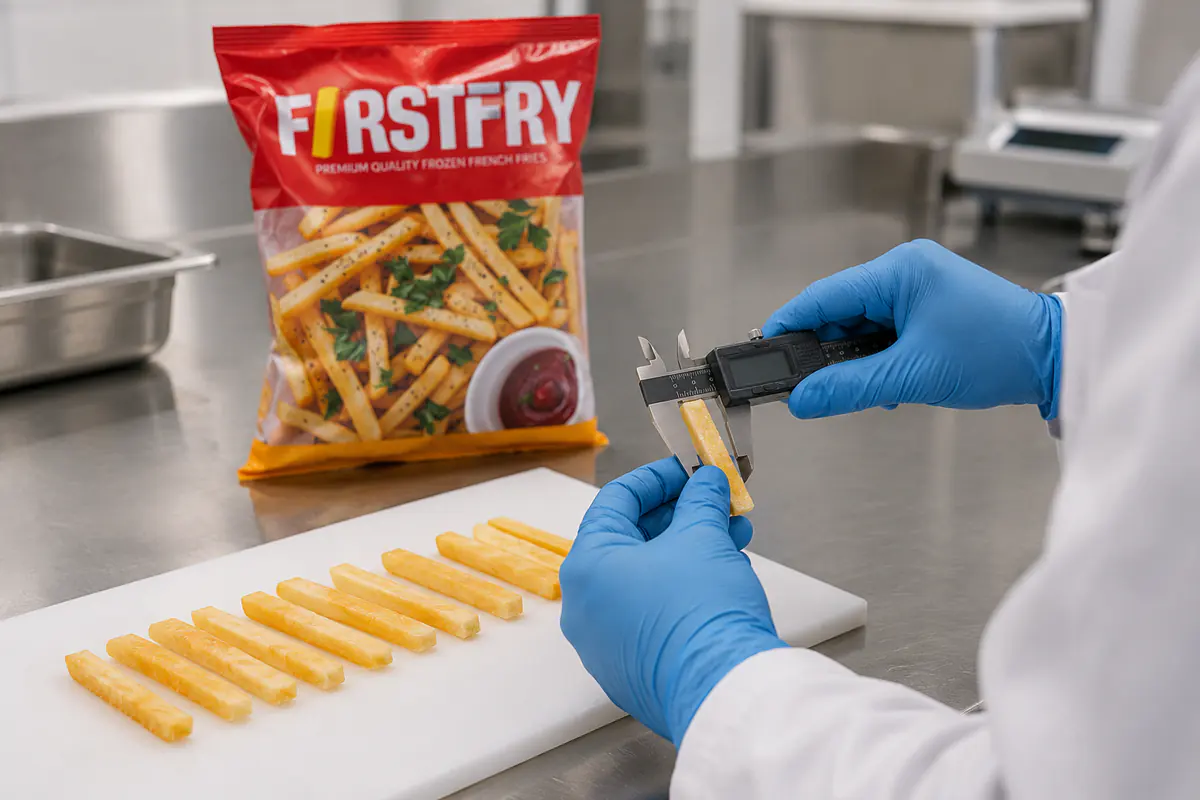
Why two identical-looking specs perform differently
Most frozen fry spec sheets look interchangeable. They lead with cut size, list a pack format, quote a shelf life and stop. Two suppliers can both write 9mm straight cut, 2.5kg x 4, 24 months at -18C and ship products that behave nothing alike in a fryer.
The difference lives in the fields buyers skip: dry matter, coating, par-fry time and defect tolerance. Those four decide whether a fry holds for three minutes or fifteen, whether a kilo yields 700g or 780g of servable product, and whether your kitchen throws away the short pieces at the bottom of every bag.
Cut size: the field everyone reads
Cut size is the cross-section of the fry in millimetres, and it is the only spec field most buyers compare. It sets the surface-area-to-volume ratio, which in turn sets cook time, crispness and how many pieces land in a portion.
| Cut | Cross-section | Cook time from frozen | Best suited to |
|---|---|---|---|
| Shoestring / julienne | 6mm | 2.0-2.5 min | Fast casual, high crisp, short hold |
| Thin straight | 7mm | 2.5-3.0 min | QSR standard, high portion count |
| Regular straight | 9mm | 3.0-3.5 min | All-purpose foodservice and retail |
| Crinkle | ~10mm ridged | 3.5-4.0 min | Sauce carry, visual premium, delivery |
| Steak / thick | 11-13mm | 4.0-5.0 min | Pub menus, fluffy interior |
| Wedge | 8-cut skin-on | 4.5-6.0 min | Sharing plates, heat-lamp holding |
Thinner cuts crisp faster and look more generous per gram because portion count rises. Thicker cuts hold heat longer and read as more substantial. Neither is better; they answer different menu problems. See how cut size changes cook time and portion count for the portion maths.
Dry matter: the field that predicts yield
Dry matter is the percentage of the potato that is not water. It is the single most useful number on a spec sheet and the one least often printed. Processing-grade potatoes for fries sit around 20 to 24 percent dry matter, corresponding to a specific gravity of roughly 1.080 to 1.095.
| Dry matter | Oil uptake | Yield after cooking | Eating quality |
|---|---|---|---|
| Low, under 19% | Higher - water leaves, oil replaces it | Poor, heavy shrink | Limp and greasy, collapses under a lamp |
| Target, 20-24% | Moderate and predictable | Good, typically 72-78% of frozen weight | Crisp shell, dry fluffy centre |
| Very high, over 25% | Low | High | Can eat dry or mealy, harder to source consistently |
A low-solids fry is expensive twice over: you pay for water in the carton, then pay again in fryer oil that replaces the water as it boils off. Ask for the dry matter range rather than a single figure, and ask what happens to it late in the storage season.
Coated or uncoated is a holding-time decision
A clear coat is a thin batter, usually modified starch with rice or potato flour, applied before par-frying. It is invisible on the plate and does one job: it slows moisture migration from the centre to the surface, which is what turns a crisp fry soft.
- Uncoated - cleaner potato flavour, crisps fast, softens within roughly 5-7 minutes
- Coated - holds crisp for 12-20 minutes, survives heat lamps and delivery bags
- Batter type matters - some coatings add audible crunch, others only extend hold
If fries leave your kitchen in a bag, coating is not optional. If they travel two metres to a table, uncoated usually eats better. How long coated and uncoated fries hold under a heat lamp sets out the mechanism, and the operator's performance guide puts holding time next to yield, oil uptake and waste.
Par-fry, freezing and oil uptake
Frozen fries are already partly cooked. The strip is blanched, dried, then par-fried for roughly 30 to 60 seconds at around 175 to 180C to set a shell, then frozen. That par-fry deposits 4 to 8 percent oil into the fry before it ever reaches you, and that figure belongs on the spec sheet.
Freezing method matters just as much. IQF, individually quick frozen, drives the core below -18C fast enough that ice crystals stay small and cell walls survive. Slow freezing produces large crystals that rupture cells, and those fries cook out watery no matter how good the potato was.
Defect tolerance: what you can actually serve
Defect limits define how much of each carton is servable. They are usually expressed as a maximum percentage by weight, checked on a graded sample.
| Defect | What it looks like | Why it matters |
|---|---|---|
| Short pieces and slivers | Fragments below the minimum length | Burn first, fill the bottom of the bag, waste |
| Dark ends | Brown or black tips after frying | Reducing-sugar problem, reads as burnt |
| After-cooking darkening | Grey-blue discolouration minutes after frying | Iron-chlorogenic acid, controlled with SAPP |
| Peel and eye residue | Skin flecks on a peeled cut | Cosmetic on white cuts, expected on skin-on |
| Clumping | Fries frozen together in blocks | Signals a cold-chain break or weak IQF |
Clumping deserves particular attention because it is diagnostic. A properly frozen bag pours loose. Blocks mean the product partly thawed and refroze somewhere between the factory freezer and your cold store, and everything else in that container is suspect. Reading defect tolerances on a spec sheet covers how to sample and score them. What a specific lot actually measured against those tolerances belongs on its frozen fries certificate of analysis, which is the document to check before a claim rather than after one.
The rest of the sheet
Pack format, net weight, shelf life, storage temperature and carton dimensions are logistics fields rather than performance fields. They decide container maths and cold-store planning, not what happens in a fryer. The standard export format is 2.5kg x 4 bags per 10kg carton at 18 to 24 months at -18C, but pack size is configurable and worth matching to your channel rather than accepting as given.
Two formats carry fields a straight-cut sheet does not. A skin-on cut needs a skin-coverage proportion and a separate defect line for eyes and greening, set out in skin-on fries for wholesale and their specification. A filled snack such as samosa is specified on piece weight, pastry and declarations rather than on cut and colour; frozen samosa for bulk supply and export covers those fields. Wedges are different again: their size follows the tuber rather than the cutter, so frozen potato wedges specifications are written on cut count, piece size, coating and a defect line for greening and broken pieces.
Every field above appears on the specification for the FirstFry export range and its specifications, including the ones most sheets leave out. If you are comparing quotes, ask each supplier for the same fields and the differences stop being invisible.
Frequently asked questions
What is the most important field on a frozen fry spec sheet?
Dry matter, usually given as a percentage between 20 and 24. It predicts yield, oil uptake and structural strength better than any other single number, and it is the field most commonly missing from supplier documentation. Cut size gets more attention but tells you less about how the fry will perform.
What does 9mm mean on a french fry specification?
It is the cross-section of the cut strip, 9mm by 9mm. It is the most common all-purpose foodservice size, cooking from frozen in roughly three to three and a half minutes. Thinner cuts like 7mm crisp faster and give more pieces per portion; thicker cuts like 11 to 13mm hold heat longer.
Should I buy coated or uncoated frozen fries?
Coated if the fries travel, meaning delivery, drive-through or any heat-lamp holding, where a clear-coat fry stays crisp for 12 to 20 minutes against 5 to 7 for uncoated. Uncoated if fries go straight from fryer to table, where the cleaner potato flavour and texture usually eat better.
How much oil do frozen fries already contain?
Typically 4 to 8 percent, deposited during the 30 to 60 second par-fry the strips receive before freezing. The final fry in your kitchen adds more, bringing total fat in the served product to roughly 12 to 15 percent depending on cut size, coating and fryer discipline.
Why do some frozen fries arrive stuck together in blocks?
Clumping means the product partly thawed and refroze. Properly individually quick frozen fries pour loose from the bag. Blocks point to a cold-chain break between the factory freezer and your cold store, and the rest of that consignment should be treated as suspect until checked.
Get the full specification, not the brochure
Tell us your cut, channel and destination market and the export desk will send the complete spec sheet - dry matter range, coating detail, par-fry figures and defect tolerances - alongside a sample plan.
Email BuyFry@FirstFryFoods.com or request a quote. The export desk replies within one business day.