The Frozen French Fry Supply Chain: From Contract Farm to Fryer, and Where It Breaks
The frozen french fry supply chain runs from seed and contract farming through a single annual harvest, then twelve months of controlled potato storage that feeds a plant where a tuber becomes a par-fried, IQF-frozen strip in under an hour. The frozen product then moves through the factory cold store, a reefer container, the destination cold store and a distributor to a kitchen freezer. Each transfer between stages is where quality is lost: late-season sugar in storage, a temperature excursion at a transhipment port, or a last-mile van without refrigeration.
Published 2026-09-06 · FirstFry Export Desk · Market intelligence
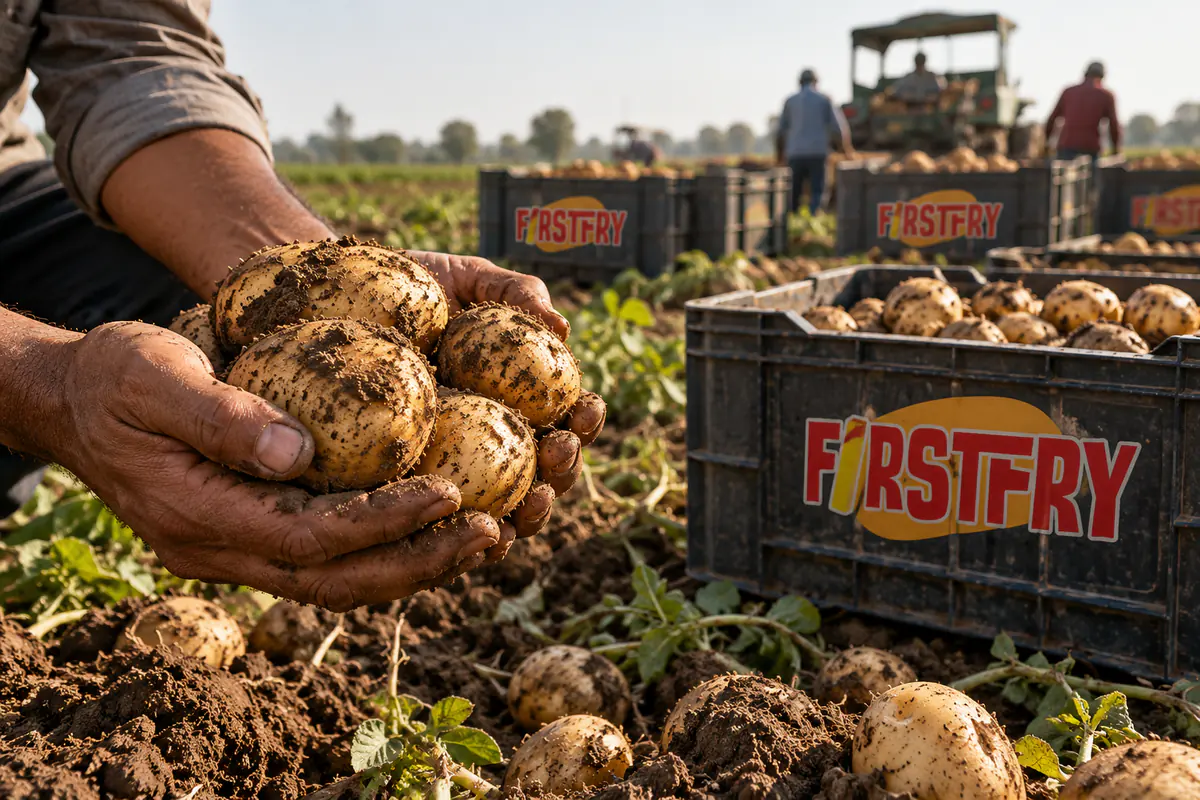
Buyers tend to picture a frozen fry as a factory product, made in a plant and shipped from a port. It is more accurate to picture it as a storage product. Of the year or so between a potato being planted and a fry being eaten, well under an hour is spent on the processing line. Almost everything else is waiting: in a field, in a cold store, in a container, in a freezer.
That matters because quality is lost in the waiting and at the handovers, not on the line. A plant that runs well does the same thing every shift. What varies is the potato that arrives at its door and what happens to the frozen product after it leaves. A buyer who understands the whole chain knows which questions actually predict the carton they will open.
The chain stage by stage
| Stage | What happens | Where it fails | What to ask for |
|---|---|---|---|
| Contract farming | Variety, seed source, acreage and price agreed with growers before planting | Spot buying substitutes table varieties with wrong solids and sugars | Share of raw material contracted versus bought spot |
| Harvest | Single crop lifted over a few weeks; tubers cured before storage | Bruising and wet harvest raise defect rates for the whole year | Harvest window and curing practice |
| Potato storage | Controlled temperature and humidity hold tubers for up to twelve months | Cold sweetening, sprouting and disease late in the season | Owned or rented store; sugar testing frequency |
| Processing | Wash, peel, cut, blanch, dry, par-fry, IQF freeze, pack | Line drift shows as colour, defect and length variation | Certificate of analysis per batch; process controls |
| Factory cold store | Product held frozen and palletised for loading | Door discipline and overloading cause fluctuation | Temperature log for the batch |
| Reefer leg | Pre-cooled container, port, vessel, possible transhipment, port | Unplugged hours at a transhipment hub | Setpoint on the booking; a data logger in the box |
| Destination cold store | Clearance, inspection, unpacking to pallets | Inspection outside the cold store; slow clearance on power | Free time agreed; logger downloaded on arrival |
| Distribution | Pallets broken to cartons and delivered to sites | Unrefrigerated vans, dock time in the sun | Distributor's cold-chain policy for the last mile |
| Kitchen freezer | Cartons held until service | Warm freezers, thawed and refrozen bags | Storage instructions on the carton; staff training |
Upstream: seed, contract farming and the single harvest
The chain starts before the potato exists, with the decision about what to plant. Processing varieties are chosen for dry matter and for low reducing sugars, because those two numbers set the fry's texture and colour months before the fryer. A plant that contracts acreage with growers specifies the variety and the seed source, agrees a price and a delivery window, and supports the crop through the season. A plant that buys spot takes whatever the market has, which in a tight year means table varieties that fry dark and soft. Which varieties India grows for processing explains why the choice is narrow and why it matters.
India's processing crop is lifted once, roughly between January and March in the Gujarat belt, which is the single most important structural fact about the chain. There is no second harvest to correct a poor first one. The crop calendar and when to contract follows from it, and so does the pricing pattern: raw material is cheapest and best at harvest, and everything after that is a storage cost.
Storage: the twelve-month bridge
Between harvests the plant runs on stored potatoes, and the store is where the year's quality is quietly won or lost. Processing potatoes are held at a controlled temperature, higher than the near-freezing temperature used for table potatoes, because cold converts starch to sugar and sugar fries dark. They are also held at high humidity to limit weight loss, and treated to suppress sprouting.
Even in a well-run store the tuber changes. Late in the storage year reducing sugars creep up, skins thicken and disease pressure rises, so the same variety from the same field fries differently in November than it did in April. A plant manages that by testing sugars before each lot is released to the line, by reconditioning stock at a warmer temperature to burn sugar back down, and by adjusting blanching. A buyer sees it as slight colour drift across a year of deliveries. Whether the store is owned or rented is the question that predicts how well any of this is controlled, because a rented store's temperature history belongs to somebody else.
The plant: tuber to frozen fry in under an hour
The processing line is the shortest stage and the most documented. Tubers are washed, steam peeled, cut, blanched to set texture and pull out surface sugar, dried, par-fried to set the crust, and frozen individually so the strips stay loose in the bag. How a frozen fry is made, stage by stage covers each step and what it does to the plate; what IQF freezing does to a fry explains why the freezing rate matters as much as the freezing temperature.
From the buyer's side, the plant is where the chain becomes auditable. A certificate of analysis per batch, a defect score, a colour reading and a length grade are all generated here, and they are the documents that let a container be accepted on evidence rather than on trust. The export cuts that come off the line are specified on those fields for exactly that reason. A length grade only means something against the cut it was graded for; what each cut size is for, from 6mm to 13mm sets out the trade-offs.
Frozen storage and the reefer leg
Once frozen, the product's enemy is not temperature but temperature change. A fry held steadily at -18°C keeps for two years; a fry that cycles between -18°C and -10°C grows ice crystals, dries at the surface and clumps in the bag, and does so in weeks. Why temperature fluctuation matters more than temperature is the single most useful idea a buyer can carry through the rest of the chain.
The reefer leg is where fluctuation is most likely and least visible. The container is pre-cooled, loaded fast with airflow preserved through the stack, plugged at the terminal, carried, sometimes discharged at a transhipment hub and replugged, and carried again. How a reefer container is loaded covers the stuffing; transit times and transhipment risk covers the part nobody writes on the bill of lading, which is how many hours the box waited unplugged at a hub. A data logger inside the load is the only record that survives the voyage.
Destination: cold store, distributor, kitchen
At the destination port the chain passes to the importer, and the risks change character. Clearance and inspection can take days; a container that is inspected outside a cold store or left waiting on a plug it has to pay for is a container losing shelf life. Once inside the importer's cold store the temperature record restarts, and the logger from the container should be downloaded and filed before anyone opens a carton.
Distribution is the least-controlled stage of the whole chain. Pallets are broken into cartons and delivered to sites in vans that may or may not be refrigerated, across docks that may or may not be shaded, to freezers that may or may not be at temperature. The kitchen freezer is the last link, and a bag that thaws in a warm freezer and refreezes is a bag that will fry badly however well the previous eleven months went. None of this is the supplier's to control, which is why a supplier's carton carries storage instructions and why a distributor's cold-chain policy is worth reading before signing. What happens after the kitchen freezer is covered in how frozen fries perform in a commercial kitchen and how long a fry stays crisp once it is cooked.
Where the chain actually breaks
- Spot raw material in a tight year — wrong variety, wrong solids, dark fries; visible as colour drift, fixable only by contracting
- Late-season sugars — colour drift in the last quarter of the storage year; managed by testing and reconditioning, and by blanching adjustment
- Cold-store door discipline — fluctuation at the plant that shows as clumping months later
- Transhipment — unplugged hours at a hub, invisible without a logger
- Slow clearance — days on a paid plug at destination, or inspection outside the cold store
- The last mile — an unrefrigerated van or a warm site freezer undoing everything upstream
What to ask a supplier about their chain
- What share of your raw material is contracted, and with which varieties? The answer predicts year-round consistency better than any certificate.
- Is potato storage owned or rented, and how often are sugars tested before release? Owned and tested means controlled colour late in the season.
- What does a certificate of analysis include per batch? Colour, defects, length grade and dry matter at minimum.
- What is your cold-store temperature record, and can I see it for my batch? A plant that logs will show you.
- Do you place a logger in the container, and who downloads it? If the answer is no, the reefer leg is unrecorded.
- Which ports and services do you ship on, and how many transhipments? The routing decides the plug risk.
A supplier who answers all six precisely runs the chain rather than just the plant. How India's frozen potato industry is structured explains why the integrated processors that contract acreage and own storage have pulled ahead of the plants that do not, and why the straight-cut fry that anchors the range is specified with the storage year, not just the line, in mind.
Frequently asked questions
How long does it take to make a frozen french fry?
The processing line turns a tuber into a par-fried, IQF-frozen strip in well under an hour. The rest of the fry's life is storage: up to twelve months as a potato in a controlled store, weeks in a factory cold store and a reefer container, and further weeks in a destination cold store, a distributor's warehouse and a kitchen freezer.
Why does the same frozen fry look different late in the year?
Because India's processing crop is harvested once, roughly January to March, and the plant runs on stored potatoes for the rest of the year. Reducing sugars rise late in storage and fry darker, so a plant tests sugars before release, reconditions stock and adjusts blanching. Slight colour drift in the last quarter of the storage year is the visible sign of a single harvest, not of a process fault.
Where in the supply chain is a frozen fry most likely to be damaged?
At the handovers rather than inside any stage: unplugged hours at a transhipment port, slow clearance on a paid plug at destination, an unrefrigerated last-mile van, or a warm kitchen freezer. Temperature fluctuation, not the nominal temperature, is what causes ice crystals, surface drying and clumping, and it happens where the box changes hands.
What is contract farming for processing potatoes?
An agreement between a processor and growers, made before planting, that fixes the variety, seed source, acreage, delivery window and price. It gives the plant raw material with the dry matter and sugar levels a fry needs and gives the grower a guaranteed buyer. A plant that buys on the spot market instead takes whatever is available, which in a tight year means table varieties that fry dark and soft.
Want to see the chain behind a carton?
Ask the export desk for the contracted-acreage share, the storage and cold-store records, and the logger and routing plan for your destination. We answer all six questions in writing.
Email BuyFry@FirstFryFoods.com or request a quote. The export desk replies within one business day.