Frozen Fry Seasonality: The Crop Calendar Behind Your Supply
Frozen fries are available year round but come from a single annual harvest held in cold storage. India's processing crop is planted around October to November and harvested January to March, then stored for the following twelve months. Tuber quality drifts through the storage season as sugars change, which is why fry colour can vary between early and late season production from the same plant.
Published 2026-08-19 · FirstFry Export Desk · Market intelligence
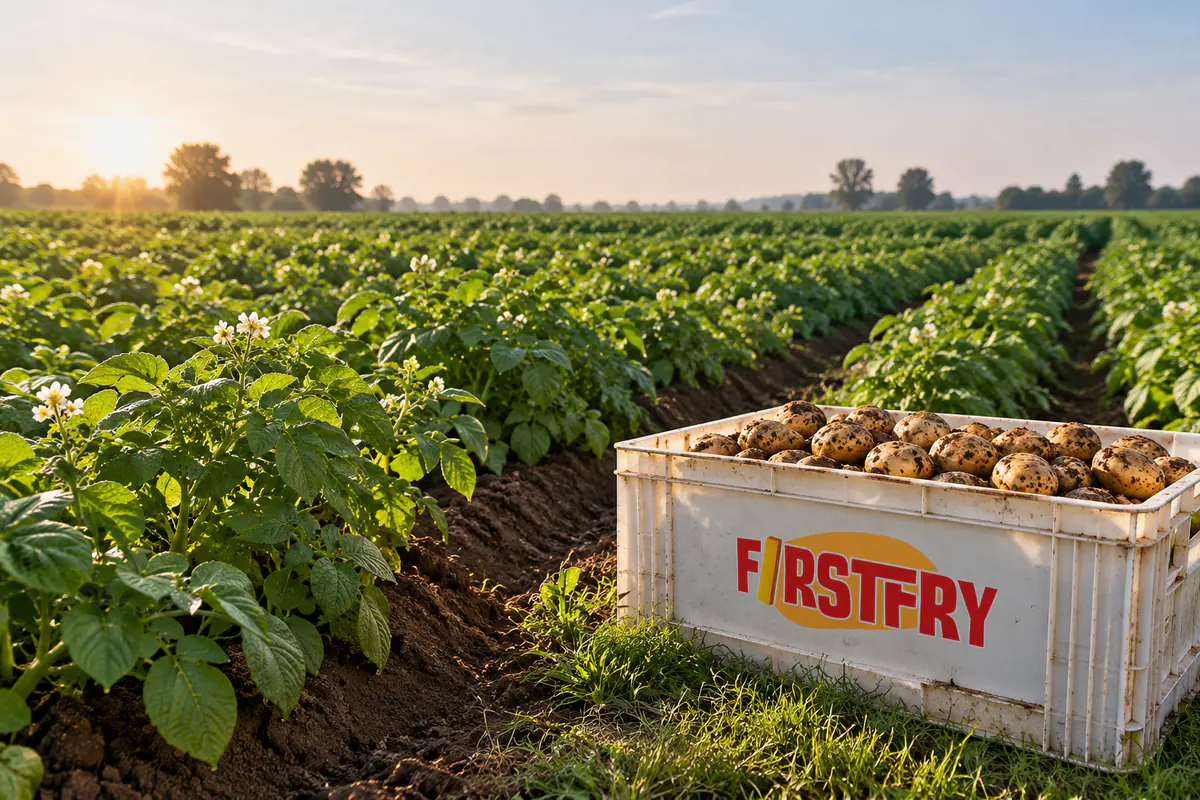
One crop, twelve months of production
A frozen fry factory runs all year. The potatoes it processes do not grow all year. In a single-crop origin the entire annual requirement is harvested inside a window of a few weeks and then held in controlled cold storage until it is needed.
That single fact drives almost everything commercially distinctive about this product: why prices step rather than drift, why quality can vary between production runs, why supply shocks propagate for a full year, and why processors contract their raw material instead of buying it.
The Indian calendar in detail
India's processing potatoes are a rabi crop, grown in the cool dry winter window.
| Period | What happens | What it means for a buyer |
|---|---|---|
| Oct-Nov | Planting | Next year's cost and volume are being committed |
| Jan-Mar | Harvest, grading, intake to cold store | New crop cost known; the best time to negotiate annual terms |
| Feb-May | Processing from fresh and early stored crop | Typically the most consistent colour and solids |
| Jun-Sep | Processing from stored crop | Storage management starts to matter; still stable in a good year |
| Oct-Jan | Processing from oldest stored crop | Tightest availability, most process adjustment required |
European origins run the same pattern shifted by about half a year, with harvest in late summer and autumn. That counter-seasonality is one of the better arguments for qualifying suppliers in both regions.
What changes during storage
Potatoes are alive in storage. They respire, lose a little weight, and adjust their internal chemistry in response to temperature. The commercially important change is in sugars.
Stored below roughly 4C, potatoes convert starch into sugar as an anti-freeze response, a process called cold sweetening. Those sugars caramelise in the fryer and produce dark or burnt-looking fries. Processing crops are therefore stored warmer than table potatoes, typically around 7 to 10C, with sprout suppression to compensate for the warmth.
- Sugar drift - the main driver of colour variation between early and late season
- Weight loss - respiration and moisture loss over months in store
- Sprouting pressure - rises with time and temperature, managed chemically or by ventilation
- Dry matter - relatively stable, but the usable share of the crop declines as defects develop
A well-run processor manages sugar drift by adjusting the blanch and the dextrose dip through the season, so the finished fry stays within colour specification even as the raw material changes. That is a real capability, not a given. The varieties behind the processing crop covers why some varieties store better than others.
The question to ask a supplier
There is one question that separates processors who manage seasonality from those who are simply subject to it: what changes in your process between February and November?
A good answer describes specifics - storage temperature regimes, reconditioning of sweetened lots before processing, blanch time adjustment, dextrose dosing changed against measured sugar levels, tighter colour grading late in the season. A supplier who says nothing changes is either not measuring or not telling you.
Planning orders around the calendar
Knowing the calendar lets you make three decisions better than a buyer who does not.
| When | Action | Why then |
|---|---|---|
| Just after harvest, Feb-Apr | Negotiate annual terms | Crop cost, yield and dry matter are known |
| Early season, Feb-May | Book long-cut and extra-long grades | The qualifying tuber pool is at its largest |
| Mid season, Jun-Sep | Run routine replenishment | Quality stable in a normal year |
| Late season, Oct-Jan | Tighten incoming colour checks | Sugar drift is at its most pronounced |
| Across the changeover | Hold a buffer stock | Old-to-new crop transition is least predictable |
- Negotiate annual terms after harvest, when crop cost, yield and quality are known. Before harvest a supplier is pricing an unknown and will price the risk.
- Expect availability to tighten late in the season, particularly for long-cut grades where the qualifying share of the crop declines. Book those earlier.
- Plan a buffer across the changeover. The transition from old crop to new is where availability and consistency are least predictable.
For long-cut and extra-long grades the timing point matters most. Those grades depend on large, well-shaped tubers, and as a season progresses the pool of qualifying tubers shrinks. A buyer committing to long cuts should secure them earlier rather than assuming availability late in the year.
Why a bad harvest lasts a year
In most food categories a poor crop is corrected by the next planting a few months later. In a single-crop origin there is no next planting for twelve months, so a bad harvest propagates through an entire year of production and pricing.
A poor season can mean lower yields per hectare, lower dry matter requiring more raw potato per tonne of fries, a smaller share of tubers qualifying for long cuts, and more defects developing in storage. Those effects compound rather than offset. Why prices step at harvest covers how that reaches your quotation.
The practical defence is diversification across counter-seasonal origins and contracting volume rather than buying spot. Both are cheaper to arrange in a comfortable year than in a difficult one, which is precisely when buyers tend to think of them.
Frequently asked questions
When is the potato harvest for frozen fries in India?
The processing crop is a rabi crop, planted around October to November and harvested from January to March. It is then held in controlled cold storage and processed over the following twelve months, so production is continuous even though the harvest is confined to a few weeks.
Are frozen fries available all year round?
Yes. Production runs continuously from stored crop, so supply does not stop between harvests. What varies through the year is raw material condition, particularly sugar levels, which well-run processors compensate for by adjusting storage temperature, blanching and the dextrose dip.
Why does fry colour vary between deliveries?
Usually because of sugar drift in the stored crop. Potatoes convert starch to sugar in storage, especially if held too cold, and those sugars caramelise in the fryer producing darker fries. Processors adjust blanch time and dextrose dosing to compensate, but the raw material genuinely changes across a season.
When should I negotiate an annual fry supply contract?
Shortly after harvest, once crop cost, yield and dry matter are known. Negotiating before harvest means the supplier is pricing an unknown crop and will build in a risk premium. For long-cut grades, book earlier still, since the qualifying share of the crop declines through the season.
Why does one bad harvest affect prices for a whole year?
Because there is no second crop to correct it. In a single-crop origin the entire annual requirement is harvested in a few weeks, so a poor season carries through twelve months of production - as lower yields, lower dry matter requiring more raw potato per tonne, and fewer tubers qualifying for long cuts.
Plan your year around the crop
Tell us your annual volume and cut requirements and the export desk will map an order schedule against the current season, flagging when to book long-cut grades before availability tightens.
Email BuyFry@FirstFryFoods.com or request a quote. The export desk replies within one business day.