Fry Holding Time: How Long a Fry Really Lasts Under a Heat Lamp
Uncoated french fries hold crisp for roughly 5 to 7 minutes under a heat lamp, and thin cuts less than that. Clear-coated fries hold 12 to 20 minutes depending on cut thickness. The limiting factor is not temperature but moisture: steam migrating from the fry's hot centre re-wets the crisp shell from inside. A heat lamp keeps fries warm but accelerates that process.
Published 2026-08-11 · FirstFry Export Desk · Foodservice performance
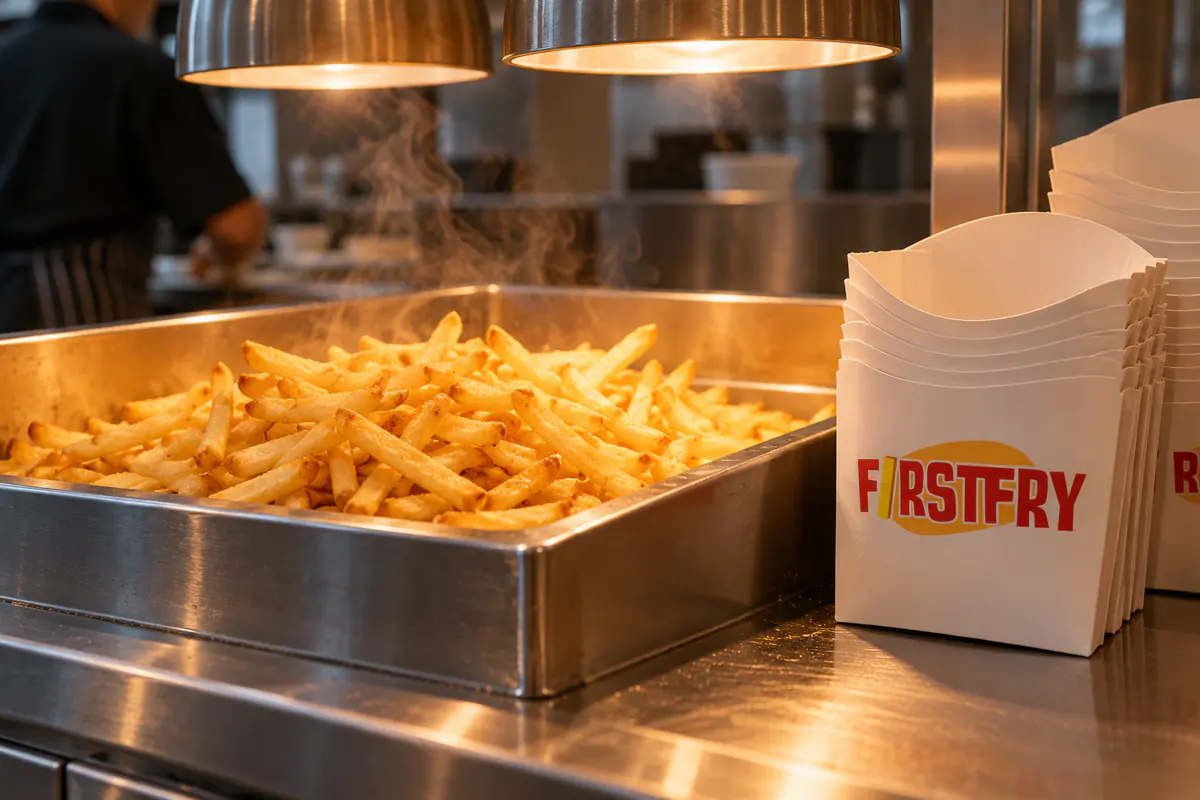
What actually happens in those minutes
A fry leaves the fryer with a dehydrated, crisp outer shell and a hot, moist interior. That interior is well above the boiling point of the water it contains, so it immediately begins turning that water to steam.
The steam has to go somewhere, and the only route out is through the shell. As it passes through, it rehydrates the very structure that made the fry crisp. Within minutes the shell has absorbed enough moisture to lose its snap, and the fry reads as soft even though it is still hot.
This is why a heat lamp cannot solve the problem. Keeping the fry hot keeps the interior generating steam. A lamp buys you temperature and costs you texture, which is a trade most operators make without realising they are making it.
The realistic holding windows
| Product | Crisp | Acceptable | Unservable |
|---|---|---|---|
| 6-7mm uncoated | 0-3 min | 3-5 min | Beyond 5 min |
| 9mm uncoated | 0-5 min | 5-7 min | Beyond 7 min |
| 9mm coated | 0-10 min | 10-15 min | Beyond 15 min |
| 10mm crinkle coated | 0-12 min | 12-18 min | Beyond 18 min |
| Skin-on wedge coated | 0-14 min | 14-20 min | Beyond 20 min |
The four things that shorten your window
Product choice sets the ceiling. Handling decides whether you get anywhere near it.
- Piling deep. Fries in a deep pile trap each other's steam. The ones underneath are effectively being steamed. Hold in a shallow layer, ideally one or two fries deep.
- Under-draining. Surface oil holds heat against the shell and carries moisture. Shake and drain for a consistent few seconds before the fries leave the basket.
- Salting too early. Salt is hygroscopic and draws moisture to the surface. Salt at the point of service, not into the holding tray.
- Covering or lidding. Any cover traps steam and turns a holding station into a steamer. If fries must be covered, they must be vented.
Of these, piling deep is the most common and the most costly. A holding tray heaped at the start of a peak will have soft fries at the bottom within three minutes regardless of the product's specification.
What coating actually buys
A clear coat is a partial moisture barrier applied before par-frying. It does not stop steam migrating; it slows it. That is the entire mechanism, and it roughly doubles to triples the holding window.
The corollary is that coating is worth paying for exactly in proportion to how long your fries wait. In a restaurant plating fries straight from the basket, a coating adds cost for a benefit no customer experiences. In a kitchen with a holding station at peak, it is the difference between serving and discarding. What a clear coat changes covers the trade-offs in flavour and cost.
Test your real window in twenty minutes
Supplier holding claims are made in ideal conditions. Yours are not ideal. Run this once with each product you are considering.
- Cook a normal basket loadTo specification, at your service oil temperature, with a basket load you would use at peak.
- Drain and hold as you actually doSame tray, same lamp setting, same depth. Do not tidy up your process for the test.
- Taste at fixed intervalsSample at 3, 5, 7, 10, 15 and 20 minutes. Same taster each time.
- Score snap, not temperatureRecord whether a fry bends or breaks when held horizontally. Bending is the failure point customers notice.
- Note where it failsThe last interval that scored acceptable is your real holding window. Set batch sizes to it.
Most kitchens find their real window is meaningfully shorter than the supplier's figure, usually because of pile depth. That is useful to know before it shows up in reviews.
Designing batch size around the window
Once you know the number, batch size follows arithmetic. If your holding window is ten minutes and you sell twelve portions in a peak ten minutes, cook twelve portions per batch. Cooking twenty means eight portions will be served soft or discarded.
| Holding window | Portions sold per 10 min at peak | Sensible batch | Result if you double it |
|---|---|---|---|
| 5 min (uncoated, thin) | 10 | 5 portions | Half the batch served soft or binned |
| 7 min (uncoated, regular) | 12 | 8 portions | Around a third past its window |
| 12 min (coated, regular) | 15 | 18 portions | Workable, small waste tail |
| 18 min (coated, crinkle or wedge) | 15 | 27 portions | Comfortable, batching is not the constraint |
Operators often resist smaller batches on throughput grounds, but the fryer time is unchanged; only the batch scheduling shifts. What changes is that fewer portions sit past their window, which cuts both waste and complaints. The wider cost effect is covered in holding time in the wider cost picture.
Where holds genuinely cannot be shortened - buffets, banqueting, high-volume drive-through - the answer is product rather than process. A coated thick or ridged cut such as coated skin-on wedges for long holds is built for exactly that constraint.
Frequently asked questions
How long do french fries stay crispy under a heat lamp?
Uncoated fries hold roughly 5 to 7 minutes, and thin cuts only 3 to 5. Clear-coated fries hold 12 to 20 minutes depending on thickness. Those figures assume a shallow layer, proper draining and no cover; a deep pile can cut the window to three minutes regardless of specification.
Why do fries go soggy even when kept hot?
Because the problem is moisture, not temperature. The fry's hot interior turns its water to steam, which escapes outward through the crisp shell and rehydrates it. A heat lamp keeps the interior hot and therefore keeps steam generating, so it preserves warmth while actively accelerating sogginess.
Does salting fries early make them soggy?
Yes. Salt is hygroscopic and pulls moisture to the fry's surface, softening the shell faster. Salt at the point of service rather than into a holding tray. It also seasons more evenly that way, since salt applied to a holding batch tends to concentrate on the top layer.
How deep should fries be held in a holding station?
As shallow as practical, ideally one or two fries deep. Fries in a deep pile trap each other's steam, so the lower layers are effectively steamed rather than held. Pile depth is the single most common reason a kitchen's real holding window is far shorter than the supplier's stated figure.
How do I test the holding time of a fry in my kitchen?
Cook a normal peak-sized basket, hold it exactly as you would in service, and taste samples at 3, 5, 7, 10, 15 and 20 minutes. Score whether a fry bends or snaps when held horizontally. The last interval that still snaps is your real window, and batch sizes should be set to it.
Match the product to your real holding window
Tell us how long fries actually wait in your operation at peak and the export desk will recommend a cut and coating combination built for that window, with samples so you can run the test yourself.
Email BuyFry@FirstFryFoods.com or request a quote. The export desk replies within one business day.