Loading a Reefer with Frozen Fries: Setpoint, Stuffing and the T-Floor
A frozen fry reefer should be set to -18°C or colder, pre-cooled before stuffing, loaded with product already at temperature, and stacked so air can circulate: nothing above the red load line, nothing blocking the T-floor channels, and no gap left at the door end that lets air short-circuit. A 40 ft high-cube reefer typically holds around 20 to 24 tonnes of palletised frozen potato product depending on carton size and pallet configuration.
Published 2026-08-21, updated 2026-10-15 · FirstFry Export Desk · Importing, duties & compliance
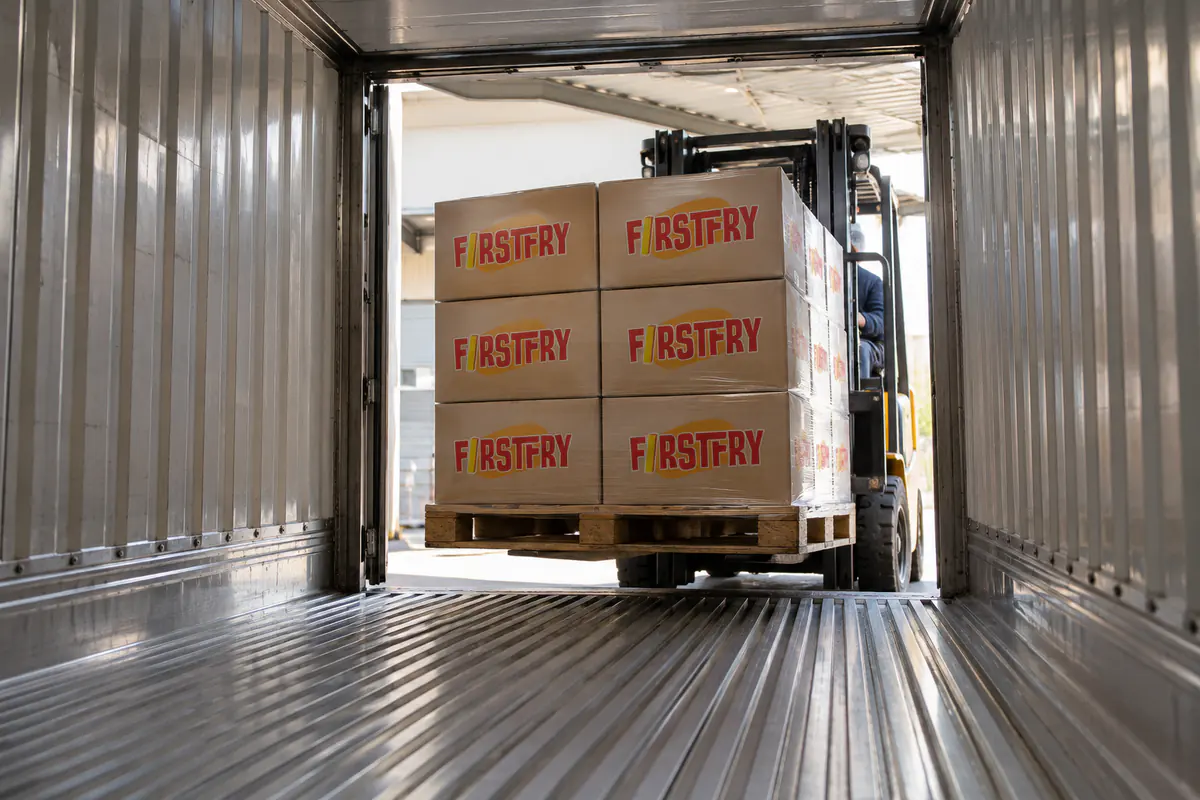
The single most common misconception about refrigerated containers is that they are freezers. They are not. A reefer unit is sized to remove the heat that leaks in through the walls and to circulate air; it is not sized to pull warm cargo down to temperature. Load product at -12°C and it will arrive at roughly -12°C, having spent the voyage slowly degrading.
Everything else about loading follows from that one fact. The job is not cooling. The job is getting cold air to every carton and back to the unit.
Setpoint and pre-cooling
Set the unit to -18°C or colder for frozen potato products. Some shippers set -20°C or -21°C to build a buffer against door openings and inspection stops; that is a reasonable precaution provided the cargo was already at that temperature.
Pre-cool the empty container before stuffing, then stuff quickly. Every minute the doors are open on a hot apron is heat the unit has to remove later, and warm air carries moisture that becomes frost on the evaporator.
How long can a reefer container be unplugged?
There is no single safe number, and no standard that sets one. Container leasing companies quote around 4 to 6 hours for a loaded unit, depending on the outside temperature. Carriers and terminals set their own, shorter limits for planned moves: Maersk's Irish terminals, for example, leave an import reefer unplugged for a maximum of three hours before plugging it back in.
For frozen fries, keep each unplugged leg as short as the move allows and treat about two hours as the working limit: the gate-out, a short road move, a lift between stacks. Anything longer, such as a road leg to an inland cold store, needs a clip-on generator set. The cartons at the door end and against the walls warm first, long before the core of the stow moves, and a reefer is not built to pull warm cargo back down except very slowly: the West of England P&I bulletin on reefer carriage describes a load stowed at about -5°C whose core took more than three days to reach -18°C. Every power-off period shows in the container's recorder, which is one more reason to agree access to the download in the contract.
The T-floor and the red line
The floor of a reefer is corrugated — the T-bar or T-floor. Cold air is delivered down these channels from the unit at the front, travels the length of the container underneath the cargo, rises through and around it, and returns along the ceiling to the unit.
Two rules protect that circuit, and both are marked inside the box.
- Do not stack above the red load line. The space above it is the return-air path. Fill it and warm air pools at the ceiling and never gets back to the unit.
- Do not block the T-floor channels. Cargo, dunnage or slip sheets laid flat across the floor stop air reaching the back of the container. The far end then warms while the sensor at the front reports a perfect setpoint.
That second failure is the dangerous one, because the container reports success the whole way. The delivery temperature record looks clean and the last pallets out are the ones with soft product.
Floor-loaded or palletised
| Palletised | Floor-loaded | |
|---|---|---|
| Payload | Lower — pallets take space and weight | Higher — more cartons per box |
| Handling at destination | Fast, forklift out | Slow, manual unload |
| Air circulation | Good, if pallets do not block channels | Good, if stacked with deliberate gaps |
| Damage risk | Lower | Higher, cartons take the load |
| Best for | Distributors with a dock | Price-driven trades, manual unload markets |
Ask the buyer how they will unload before deciding. Floor-loading squeezes in more product, but a distributor without a dock and forklift will spend hours hand-unloading a container that is warming while they do it — and the extra tonnes bought at origin are lost to product degraded at destination.
How much fits
A 40 ft high-cube reefer commonly carries in the region of 20 to 24 tonnes of palletised frozen potato product. Where a given load lands in that range depends on carton dimensions, how cleanly they cube out on the pallet, pallet height against the load line, and the road weight limits at both ends.
Do not plan an order quantity from a rule of thumb. Give your forwarder the carton dimensions and weight and the pallet configuration and ask for the actual figure. Ordering to a number that does not fit means either a part-empty container or a load that has to be broken at the port.
The recorder, and why it matters more than the setpoint
The container records its own temperature, and that record is what gets produced when a consignment is disputed. Two practical points follow.
- Agree in the contract who is entitled to the download and within what period. Requesting it three weeks after discharge is often too late.
- Understand what the sensor measures. Supply and return air temperatures are not the same as product core temperature, and a container can log a perfect supply reading while cargo at the door end sits warmer.
For higher-value or first-time shipments, a data logger placed inside the cargo at the door end costs very little and answers the question the container sensor cannot. If a claim ever arises, it is the difference between an argument and an answer.
Frequently asked questions
What temperature should a frozen fry container be set to?
-18°C or colder. Some shippers set -20°C or -21°C to build a buffer against door openings and inspection stops. The setpoint only holds temperature though — cargo must already be at temperature when it is loaded.
How many tonnes of frozen fries fit in a 40 ft reefer?
Typically around 20 to 24 tonnes palletised, depending on carton dimensions, pallet configuration, load height against the red line and road weight limits at both ends. Get the exact figure from your forwarder using your actual carton spec rather than planning to a rule of thumb.
What is the red load line in a reefer?
A marked height inside the container above which cargo must not be stacked. The space above it is the return-air path back to the refrigeration unit. Stacking through it stops warm air returning and the far end of the container stops being cooled properly.
Is floor-loading or palletising better for frozen fries?
Floor-loading fits more product; palletising unloads faster and damages less. The deciding question is whether the buyer has a dock and a forklift. A hand-unloaded container spends hours warming, which can cost more than the extra tonnes were worth.
How long can a reefer container be unplugged?
There is no universal limit. Container suppliers quote around 4 to 6 hours for a loaded unit depending on the outside temperature, and carriers set shorter caps for planned moves, such as three hours at Maersk's Irish terminals. For frozen fries, keep unplugged moves under about two hours and use a generator set for anything longer, because the cartons at the door end warm first and the unit is slow to bring them back down.
Planning a container?
Send us your destination and whether your buyer unloads by forklift or by hand, and we will send carton dimensions, a pallet configuration and a realistic payload figure before you fix the order quantity.
Email BuyFry@FirstFryFoods.com or request a quote. The export desk replies within one business day.