Blanching, Dipping and Par-Frying: How a Frozen Fry Is Actually Made
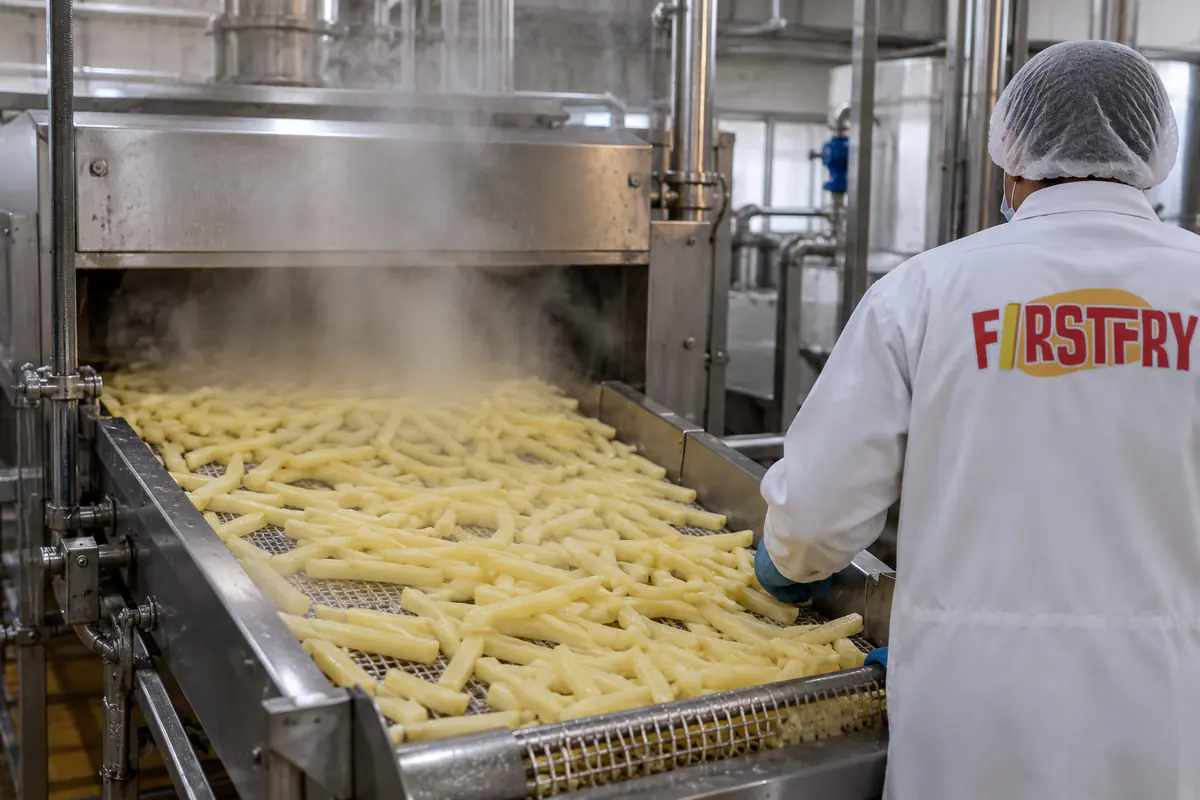
A frozen fry is made in roughly nine stages: reception and destoning, steam peeling, optical sorting, water-knife cutting, blanching, a dextrose and SAPP dip, drying, par-frying for 30 to 60 seconds at around 175 to 180C, then IQF freezing and packing. Blanching removes reducing sugars that would otherwise burn. The dip standardises colour and prevents grey discolouration. Par-frying sets the shell that lets the fry cook from frozen.
Published 2026-08-04 · FirstFry Export Desk · Specifications & product science
Before the cut: reception, peeling and sorting
Potatoes arrive from cold store, are destoned and washed, then peeled. Industrial lines use steam peeling: tubers are pressurised with steam for a few seconds so the skin lifts, then the skin is scrubbed off. It removes less flesh than abrasive peeling, which matters because peel loss is pure yield loss.
Optical sorters then remove discoloured tubers, green flesh and foreign material. This stage is quiet but decisive: most defects that reach a customer are defects that were not removed here. Skin-on formats skip peeling entirely, which is why skin-on fries that skip the peeling stage carry a different yield profile.
Cutting with water, not blades
Modern lines cut with a hydro-knife. The tuber is accelerated in a water stream and fired through a fixed blade grid at speed, so the potato meets a stationary knife rather than a moving one. The cut face is cleaner, cell damage at the surface is lower, and throughput is far higher than mechanical cutting.
Cut geometry is set by the blade grid, which is how a line changes between 7mm, 9mm and crinkle formats. After cutting, strips are graded by length and slivers are screened out.
Blanching: the stage that decides colour
Blanching is hot-water immersion, typically in two stages between roughly 60C and 85C. It is not there to cook the fry. It does three separate jobs at once.
- Removes reducing sugars - glucose and fructose leach into the water. Left in, they caramelise in the fryer and produce dark or burnt-looking fries
- Inactivates enzymes - particularly polyphenol oxidase, which causes browning during storage
- Gelatinises surface starch - creating the structure that later crisps into a shell
Sugar control is the reason blanch parameters are guarded so carefully. Potatoes stored too cold convert starch to sugar, a phenomenon called cold sweetening, and a batch that arrives high in sugar needs a longer or hotter blanch to compensate. Get it wrong and the entire run has dark ends.
| Blanch | Sugar removal | Texture effect | Risk |
|---|---|---|---|
| Too short or cool | Incomplete | Firm but uneven | Dark ends, burnt appearance, enzyme browning |
| Correct | Sufficient for target colour | Set surface, intact centre | None |
| Too long or hot | Excessive | Soft, fragile strips | Breakage, mushy centre, nutrient and solids loss |
The dip: dextrose and SAPP
After blanching, strips pass through a short dip that usually contains two functional ingredients.
Dextrose adds back a controlled, uniform amount of sugar. This sounds contradictory after removing sugar, but it is the point: blanching strips sugar out unevenly and unpredictably, and dextrose puts a known quantity back so every fry browns to the same target colour regardless of the raw material's starting condition.
SAPP, sodium acid pyrophosphate, prevents after-cooking darkening. Potatoes contain iron and chlorogenic acid, which combine after frying to form a grey-blue complex, sometimes visible minutes after service. SAPP sequesters the iron so the complex never forms. It is a processing aid used at very low levels and appears on ingredient declarations.
Drying and par-frying
Surface water is removed in a hot-air drier before frying. Skipping or shortening this stage means water entering hot oil, which degrades the oil faster, spits, and produces a softer shell. Some lines target a specific surface moisture reduction to tune final crispness.
The par-fry itself is short: roughly 30 to 60 seconds at around 175 to 180C. It is not intended to cook the fry through. It dehydrates the outer millimetre and sets a starch shell, which is what allows the finished product to go from frozen into a fryer and crisp in three minutes rather than steaming.
Par-frying deposits 4 to 8 percent oil into the fry. That figure is set by fry time, temperature, cut size and dry matter, and it is worth asking for because it forms part of the total fat in the served product.
Freezing, checking and packing
Fries are de-oiled on a shaker, cooled, then frozen. IQF freezing drives the core below -18C fast enough to keep ice crystals small, which is the difference between a crisp fry and a watery one. What happens in the IQF freezer covers that stage in detail.
| Stage | Typical condition | What it controls |
|---|---|---|
| Steam peeling | Seconds under pressure | Peel loss and therefore yield |
| Hydro-knife cutting | Water-driven through a fixed blade grid | Cut geometry, surface cell damage |
| Blanching | Roughly 60-85C, two stages | Reducing sugars, enzymes, surface starch |
| Dextrose and SAPP dip | Short immersion | Final colour uniformity, after-cooking darkening |
| Drying | Hot air before frying | Surface moisture, oil life, shell quality |
| Par-frying | About 30-60 s at 175-180C | Shell set, 4-8% oil uptake |
| IQF freezing | Core below -18C within minutes | Ice crystal size, texture |
After freezing, product is graded again for colour and length, passed through metal detection and check-weighing, then packed. The standard export format is 2.5kg bags, four to a 10kg carton, with production codes that let a consignment be traced back to a shift and a raw-material lot.
Every stage above compounds. A good potato badly blanched makes a poor fry; a mediocre potato cannot be rescued by a perfect par-fry. That is why variety selection sits upstream of everything else, and why why variety decides how the process behaves is worth reading alongside this.
Frequently asked questions
Why are frozen fries blanched before freezing?
Blanching does three jobs: it leaches out reducing sugars that would otherwise burn and produce dark ends, it inactivates enzymes that cause browning in storage, and it gelatinises surface starch so the fry can later form a crisp shell. It is not intended to cook the fry through.
What is SAPP in frozen french fries?
Sodium acid pyrophosphate, a processing aid used at very low levels to prevent after-cooking darkening. Iron and chlorogenic acid naturally present in potato combine after frying to form a grey-blue complex. SAPP binds the iron so that discolouration never appears on the plate.
Why is dextrose added if blanching removes sugar?
Because blanching removes sugar unevenly. Dextrose adds back a known, uniform quantity so every fry browns to the same target colour regardless of how much sugar the incoming potatoes started with. It is a colour-standardisation step, not a sweetener.
How long are frozen fries par-fried for?
Roughly 30 to 60 seconds at around 175 to 180C, depending on cut size and dry matter. The aim is to dehydrate the outer millimetre and set a starch shell, not to cook the fry. That shell is what lets the finished product crisp in about three minutes from frozen.
How much oil is added during par-frying?
Typically 4 to 8 percent by weight, set by fry time, oil temperature, cut size and the dry matter of the potato. Thinner cuts and lower-solids potatoes absorb more. Ask suppliers for this figure, since it forms part of the total fat in the fry your customer eats.
Want the process parameters for your spec?
We can share blanch, dip and par-fry targets for the cut you are considering, plus the resulting colour and oil-uptake ranges. Email the export desk with your market and intended application.
Email BuyFry@FirstFryFoods.com or request a quote. The export desk replies within one business day.