The Global Frozen French Fry Trade: Who Exports, Who Buys, What Changed
The global frozen french fry trade is dominated on the supply side by a small number of dense processing regions: northwest Europe, especially Belgium and the Netherlands, plus North America. Demand growth is concentrated elsewhere, in the Gulf, Southeast Asia, Africa and Latin America, where quick-service restaurants are expanding and domestic processing capacity is limited. That mismatch is what created room for newer origins such as India.
Published 2026-08-17 · FirstFry Export Desk · Market intelligence
Why processing concentrates
Frozen fry production clusters in a few places for reasons that are structural rather than historical accident. A plant needs four things simultaneously, and few regions offer all of them.
- A dense supply of processing-grade potatoes within a short haul - potatoes are bulky and low value per tonne, so long inland transport is uneconomic
- Large-scale cold storage to hold the crop between harvest and processing
- Reliable, affordable energy for freezing and continuous cold storage
- Port access for reefer containers, ideally without a long inland leg
Northwest Europe assembled all four decades ago. A cool maritime climate suited to high-solids potatoes, intensive agriculture, dense infrastructure and the ports of Antwerp and Rotterdam produced a processing cluster that became the global reference point for the product.
The established exporting regions
| Region | Characteristics | Typical destinations |
|---|---|---|
| Belgium and Netherlands | Highest processing density, long history, strong brand recognition | Global, particularly EU, Middle East, Asia |
| Other northwest Europe | Integrated with the Belgian and Dutch cluster | EU and nearby export markets |
| North America | Large domestic demand, Russet-based long cuts | Domestic, plus Japan, Korea, Latin America |
| India | Newer entrant, cost and freight advantage into nearby markets | GCC, Southeast Asia, Africa |
| Egypt and others | Emerging processing capacity serving regional demand | Regional, Middle East, Africa |
| Argentina | Regional supplier within South America | Latin America |
Belgium's position is worth understanding specifically. It processes far more potatoes than a country of its size would suggest, importing raw potatoes from neighbours to feed capacity, and exports a very high share of what it produces. It is effectively a processing hub rather than simply a producing country.
The scale is striking for a country of its size: Belgium exported roughly USD 3.3 billion of cooked frozen potato products in 2025, close to three times the figure of a decade earlier, and its growers were expected to harvest in the region of five million tonnes.
Where demand is growing
Consumption growth is not where production is. Mature markets in Europe and North America grow slowly, because per-capita fry consumption is already high and populations are stable.
The growth is in markets with three features in common: rapid expansion of quick-service and casual dining chains, a growing modern retail sector with freezer capacity, and little or no domestic potato processing industry.
| Region | Demand driver | Local processing |
|---|---|---|
| GCC | High foodservice spend, QSR density, tourism | Very limited - near total import dependence |
| Southeast Asia | Fast QSR expansion, urbanisation | Some, but well below consumption |
| East and West Africa | Growing urban middle class, QSR entry | Minimal |
| Latin America | Established QSR, growing retail freezer penetration | Regional capacity in parts |
| South Asia | Rapid domestic QSR growth | Growing, including India itself |
The GCC is the clearest case: a region with substantial foodservice demand, a climate unsuited to potato production at the required scale, and therefore near-complete dependence on imports. The GCC as an import market covers it in detail.
What changed in the last decade
Three developments reshaped the flows.
Freight and energy volatility. Periods of sharply higher container rates and European energy costs eroded the competitiveness of long-haul European supply into Asia and the Middle East, and buyers who had never seriously evaluated alternative origins began doing so.
New processing capacity outside the traditional regions. India in particular built capacity aimed at both a growing domestic market and export, engineering its own processing potato supply to do it. How India entered this trade covers that story.
Supply shocks. Poor European harvests in some years tightened availability and pushed buyers to qualify second sources. Once a buyer has qualified an alternative origin, that relationship tends to persist even when the original supply normalises - which is how temporary disruptions produce permanent share shifts.
The dynamic has since run in the opposite direction. Favourable weather produced the largest European potato harvest in around eight years going into 2026, creating a surplus at the same time as tariff measures disrupted some export routes and newer Asian suppliers took share in markets European processors had treated as secure. A glut is a different problem from a shortage, but it teaches buyers the same lesson: origin concentration transmits somebody else's weather and somebody else's trade policy straight onto your shelf.
How the trade actually moves
Frozen fries move under HS heading 2004.10, covering potatoes prepared or preserved otherwise than by vinegar, frozen. Most destination markets apply further national subheadings beneath that, and classification detail matters for duty rates and preferential treatment. The HS code this trade moves under covers the classification.
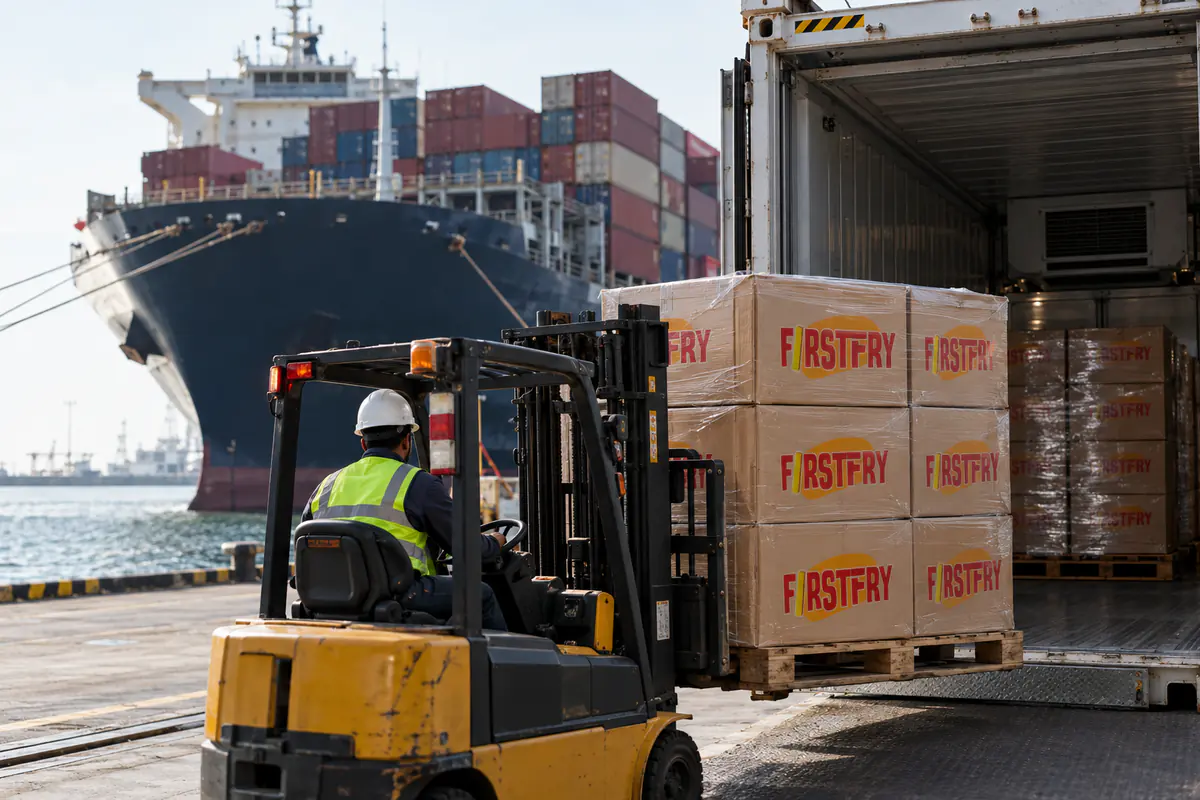
Physically, the trade is reefer containers at -18C, typically 20 to 24 tonnes in a 40 foot high-cube. Because the product is frozen and shelf-stable for 18 to 24 months, it tolerates long sailings well, which is what makes a genuinely global trade possible at all. What long sailings cost is reefer power, shelf life on arrival and working capital tied up in transit.
What this means for a buyer
Two practical conclusions follow from the structure above.
- Qualify more than one origin. A single annual harvest in a single region is a concentrated risk. Qualifying a second origin before you need it is far cheaper than doing it during a shortage.
- Compare origins on landed cost and remaining shelf life, not on price. A lower ex-works price from a distant origin can arrive more expensive and with less usable life, and the reverse is equally possible.
Comparing Indian and European origins sets out the specific trade-offs, and specifications for export-ready frozen fries and potato specialties give the fields needed to compare like with like.
Frequently asked questions
Which country exports the most frozen french fries?
Belgium has long been the largest exporter by volume, with the Netherlands also prominent. Belgium functions as a processing hub, importing raw potatoes from neighbouring countries to feed capacity well beyond what its own farmland supports, and exporting a very high proportion of what it produces.
Why do so few countries export frozen fries?
Because a plant needs four things at once: a dense local supply of processing-grade potatoes, large-scale cold storage, reliable affordable energy, and reefer port access. Potatoes are bulky and low in value per tonne, so long inland haulage is uneconomic, which forces processing to cluster near the crop.
Where is frozen fry demand growing fastest?
In markets combining rapid quick-service restaurant expansion, growing modern retail with freezer capacity, and little domestic processing: the Gulf, Southeast Asia, East and West Africa, and parts of Latin America. Mature European and North American markets grow slowly by comparison.
Why have buyers started sourcing fries from India?
Chiefly because of freight and energy volatility making long-haul European supply less competitive into Asia and the Middle East, combined with new Indian processing capacity and short sailings to the Gulf. Supply shocks in Europe accelerated it, and buyers who qualified an alternative origin generally kept it.
What HS code do frozen french fries move under?
Heading 2004.10, covering potatoes prepared or preserved otherwise than by vinegar or acetic acid, frozen. Most destination markets apply further national subheadings beneath that, and the detail matters because it determines duty rates and eligibility for preferential trade treatment.
Qualify a second origin before you need one
A single annual harvest in a single region is a concentrated risk. Email the export desk with your specification and destination and we will quote against it so you have a qualified alternative on file.
Email BuyFry@FirstFryFoods.com or request a quote. The export desk replies within one business day.