Fry Cut Sizes Explained: 6mm to 13mm and What Each One Costs You
French fry cut size is the cross-section of the strip in millimetres. Shoestring at 6mm and thin cuts at 7mm crisp in under three minutes and give the highest piece count per kilo, but absorb the most oil. Regular 9mm is the all-purpose foodservice standard. Crinkle at around 10mm carries sauce and survives delivery. Steak cuts at 11 to 13mm hold heat longest and absorb least oil per kilo.
Published 2026-08-02, updated 2026-10-15 · FirstFry Export Desk · Specifications & product science
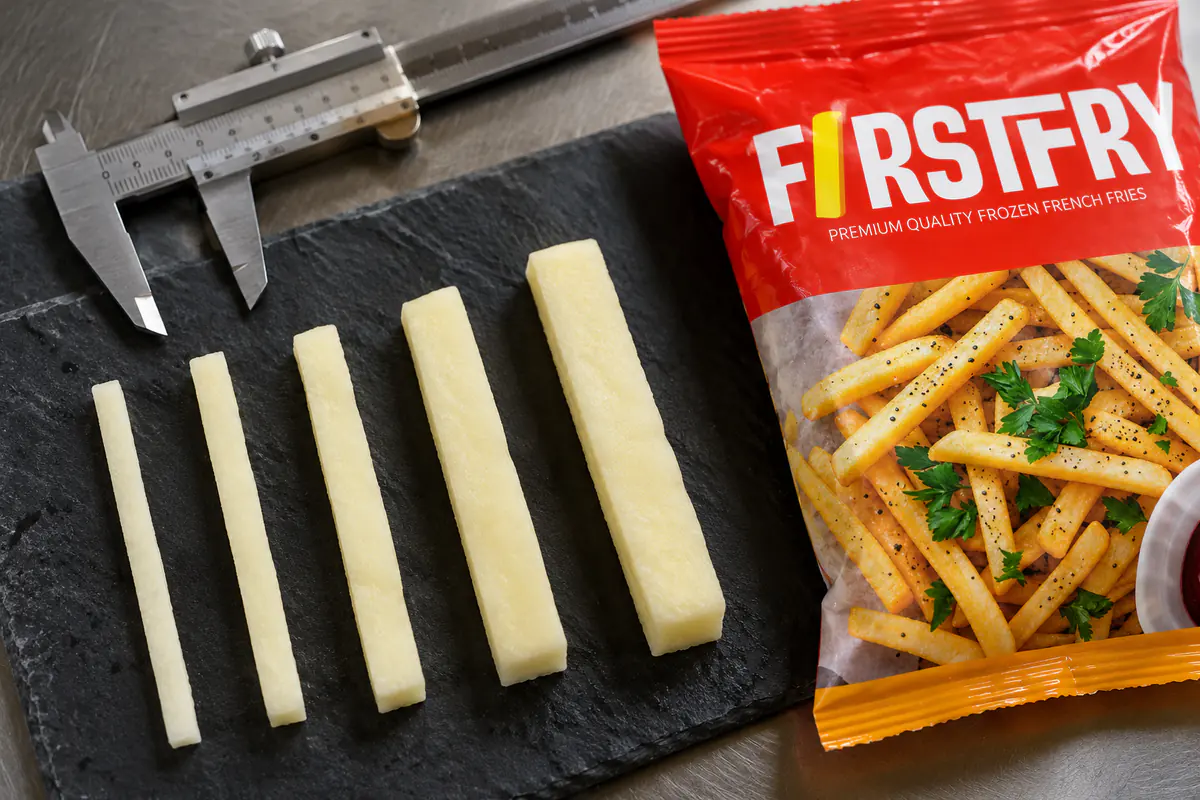
Cut size is really a surface-area decision
Everything a cut size changes follows from one ratio: surface area to volume. A thin fry has far more surface per gram of potato. Surface is where crisping happens, where oil is absorbed, and where heat escapes once the fry leaves the fryer.
So a 6mm shoestring crisps faster, tastes crisper, costs more in oil and goes cold sooner. A 13mm steak cut does the opposite on every count. There is no cut that wins all four; you are choosing which trade-off suits your menu.
The cut names, and what each one is in millimetres
Cut vocabulary is regional and inconsistent, which is how a buyer in Chicago and a plant in Gujarat end up agreeing on a name and disagreeing on a product. American specifications are usually written in inches, European and Indian ones in millimetres, and several names describe the same cross-section. The table below is the translation layer. When it matters, specify the millimetre figure and treat the name as a label.
| Name | Cross-section | What it actually is |
|---|---|---|
| Matchstick, julienne | About 6mm (1/4in) | The thinnest commercial fry. Culinary julienne is finer still, around 3mm, which is why the term travels badly between kitchens and factories. |
| Shoestring | 6-7mm | Thin, fast, high piece count. The classic quick-service and bar fry. |
| Thin straight cut | 7mm (5/16in is 7.9mm) | A step up in body from shoestring while still crisping quickly. |
| Regular, standard, 3/8 inch | 9-9.5mm | The global foodservice default. 3/8in is 9.5mm, which is why 9mm and 3/8in are used interchangeably in practice. |
| Crinkle cut | About 10mm with corrugations | A straight cut through a fluted blade. The ridges add surface area, carry sauce and stiffen the fry. |
| Steak cut, thick cut, chips (UK) | 11-13mm (7/16in to 1/2in) | A heavy rectangular strip cut lengthwise. Longest heat retention, lowest oil uptake per kilo. |
| Wedge | Radial, skin-on | Not a strip at all: cut from the whole potato around its axis, so the cross-section is triangular and one face keeps the skin. |
| Waffle, lattice | About 8-10mm lattice | Cut on a rotating corrugated blade to produce a grid rather than a strip. |
| Curly | Spiral, about 8mm | Cut on a spiral blade, usually seasoned or battered, sold on novelty and plate coverage. |
The cut comparison table
| Cut | Cook time | Pieces per 150g portion | Relative oil uptake | Hold time |
|---|---|---|---|---|
| 6mm shoestring | 2.0-2.5 min | About 55-70 | Highest | 3-5 min |
| 7mm thin | 2.5-3.0 min | About 40-50 | High | 4-6 min |
| 9mm regular | 3.0-3.5 min | About 25-35 | Moderate | 5-8 min |
| 10mm crinkle | 3.5-4.0 min | About 22-30 | Moderate | 7-10 min |
| 11-13mm steak | 4.0-5.0 min | About 14-20 | Lowest | 10-14 min |
| Skin-on wedge | 4.5-6.0 min | About 9-14 | Low | 12-18 min |
7mm and 9mm fries: the two sizes buyers ask for by name
Most fry enquiries name one of two numbers. 7mm is the thin cut, slightly finer than the 5/16 inch (7.9mm) American size: about 40 to 50 strips in a 150g portion, 2.5 to 3 minutes in the fryer, and at its best eaten at the counter or held briefly in a coated form. 9mm is the regular cut and the metric partner of 3/8 inch (9.5mm): about 25 to 35 strips a portion, 3 to 3.5 minutes, and the safer choice when one fry has to cover dine-in, holding and retail.
Neither number is a full specification. Ask for the tolerance on the cross-section, the length distribution, whether the fry is coated and the colour after frying, then compare offers on those fields. Our straight-cut Classic Fries are cut in the 7 to 10mm range with the size set to your specification, and the Extra Long Fries are a 9mm cut graded for length.
Piece count is a perception lever
A 150g portion of 7mm fries looks noticeably more generous than the same 150g in steak cut, because the eye counts pieces and volume, not grams. Operators trying to raise perceived value without raising food cost usually go thinner rather than heavier.
The catch is that thin cuts lose heat quickly and absorb more oil, so the saving on portion weight partly returns as oil cost and as complaints about cold fries. Yield and cost per portion maths puts numbers on both sides of that trade.
Matching a cut to a service channel
| Channel | Recommended cut | Reason |
|---|---|---|
| Dine-in, fryer to table | 6-7mm uncoated | Crispness peaks immediately and is eaten immediately |
| QSR with a holding station | 7-9mm coated | Survives a lamp without going limp |
| Delivery and takeaway | 10mm crinkle or wedge, coated | Ridges and mass slow steam-driven sogginess |
| Pub and casual dining | 11-13mm steak | Reads as premium, holds while the rest of the plate finishes |
| Retail freezer aisle | 9mm regular | Most familiar to home cooks, forgiving in a domestic oven |
| Buffet and banqueting | Skin-on wedge | Longest hold before texture collapses |
Delivery is the channel where cut choice matters most, because the fry spends 15 to 30 minutes in a sealed container generating its own steam. Mass and surface texture both help. See 10mm crinkle cut fries for the format most delivery operators settle on.
The comparisons buyers actually make
- Shoestring vs straight cut - the same product at different thickness. Shoestring at 6-7mm crisps faster, yields more pieces per kilo and absorbs proportionally more oil; a 9mm straight cut holds heat longer and looks more substantial on a plate.
- Crinkle cut vs julienne - opposite ends of the range. Julienne is the thinnest strip available; crinkle is a thicker fluted cut. If the choice is between them, the real question is whether the fry has to survive a delivery bag, in which case crinkle wins outright.
- Steak fries vs potato wedges - not the same cut. A steak fry is a thick rectangular strip cut lengthwise through a peeled potato. A wedge is cut radially from the whole potato, keeps skin on one face and has a triangular cross-section. They fry differently and cost differently.
- Crinkle cut vs straight cut - the corrugation adds surface area without adding thinness, so a crinkle fry crisps like a thinner cut while eating like a thicker one. It is the reason crinkle dominates delivery menus.
- Shoestring vs hand cut - hand cut describes appearance, not dimension: irregular edges, skin fragments, variable length. It is a style a plant can produce deliberately, not a size.
None of these is a quality ranking. Every one of them is a trade between crispness, hold time, oil uptake and how many pieces the customer sees, and the right answer depends entirely on how long the fry sits between the fryer and the mouth.
Length, not just cross-section
Cut size describes the square section but says nothing about length, and length is what customers notice on the plate. Long-cut grades are produced by selecting larger, more elongated tubers before cutting, which is why they carry a premium and why supply is tighter.
- Standard grade - a normal length distribution with a share of shorts and slivers
- Long-cut grade - minimum length screened up, fewer shorts, higher visual impact
- Extra long - the top length band, priced accordingly and usually allocated
If a menu photograph shows fries standing tall in a cone, that is a length grade decision rather than a cut size decision. Extra long premium cut is the format built for it.
Practical advice on choosing
Most buyers over-think the cut and under-think the coating. If you are unsure, order 9mm as your base and let the channel dictate exceptions: crinkle or wedge for anything that travels, thin for anything eaten at the counter.
One further consideration is fryer capacity. Thicker cuts occupy more basket volume per portion and take longer, so a kitchen running steak cuts at peak needs either more fryer capacity or a longer holding strategy. Cut choice quietly sets your throughput ceiling.
A mixed-SKU container is the usual way to test two or three cuts in one market before committing to one. You can compare the FirstFry cuts side by side and split a first order across them.
Frequently asked questions
What is the difference between 7mm and 9mm fries?
Roughly 30 percent more surface area per gram on the 7mm. It cooks about half a minute faster, gives around 40 to 50 pieces in a 150g portion against 25 to 35 for the 9mm, absorbs more oil, and goes cold sooner. The 9mm is the safer all-purpose choice for a mixed menu.
Which fry cut is best for delivery?
A coated 10mm crinkle cut or a skin-on wedge. Both carry enough mass to hold heat for 15 to 30 minutes, and the ridged or rustic surface delays the sogginess caused by steam trapped in a closed container. Thin uncoated cuts are the worst performers in a delivery bag.
Do thinner fries cost more to run?
Usually yes, in oil rather than in purchase price. More surface area per kilo means more oil absorbed during frying, and faster heat loss means more product discarded when it goes cold. The higher piece count improves perceived portion size, which is why operators still choose them.
What does extra long mean on a fry specification?
It is a length grade, not a cut size. Larger, more elongated tubers are selected before cutting so the finished bag has a higher minimum length and fewer short pieces. It is priced above standard grade because the raw material is screened harder and supply is tighter.
Can I order more than one cut in a single container?
Yes. Mixed-SKU loading is the normal way to trial several cuts in a new market, splitting one reefer across two or three formats so you can test which sells before committing a full container to a single specification.
What are the different types of french fry cuts?
By cross-section: matchstick or julienne at about 6mm, shoestring at 6-7mm, thin straight cut at 7mm, regular or 3/8 inch at 9-9.5mm, crinkle at about 10mm, and steak or thick cut at 11-13mm. Wedges, waffle and curly cuts are shaped differently rather than simply thicker - a wedge is cut radially from the whole potato and keeps its skin, a waffle is cut on a corrugated rotating blade, and a curly fry is cut on a spiral blade.
What is the difference between steak fries and potato wedges?
A steak fry is a thick rectangular strip, 11 to 13mm, cut lengthwise through a peeled potato. A wedge is cut radially from the whole potato, so its cross-section is triangular and one face keeps the skin. The wedge has more skin, more surface area for seasoning and a different bite; the steak fry is more uniform and portions more predictably.
What is a 3/8 inch fry in millimetres?
9.5mm. That is why 3/8 inch and 9mm are used interchangeably in the trade and why they are both described as the standard foodservice cut. The other conversions worth knowing are 1/4 inch at 6.35mm, 5/16 inch at 7.9mm, 7/16 inch at 11.1mm and 1/2 inch at 12.7mm.
Not sure which cut fits your menu?
Send us your service channel, portion size and holding setup. The export desk will recommend a cut and coating combination, and can split a first container across two or three formats so you can test before committing.
Email BuyFry@FirstFryFoods.com or request a quote. The export desk replies within one business day.