What IQF Freezing Actually Does to a French Fry
IQF stands for individually quick frozen. Fries are frozen loose and fast, usually on a fluidised-bed or spiral freezer, so the core reaches below -18C in minutes rather than hours. Fast freezing forms small ice crystals that leave cell walls intact, which is why IQF fries cook out crisp and dry. Slow freezing forms large crystals that rupture cells, and those fries cook out limp and watery.
Published 2026-08-03, updated 2026-08-21 · FirstFry Export Desk · Specifications & product science
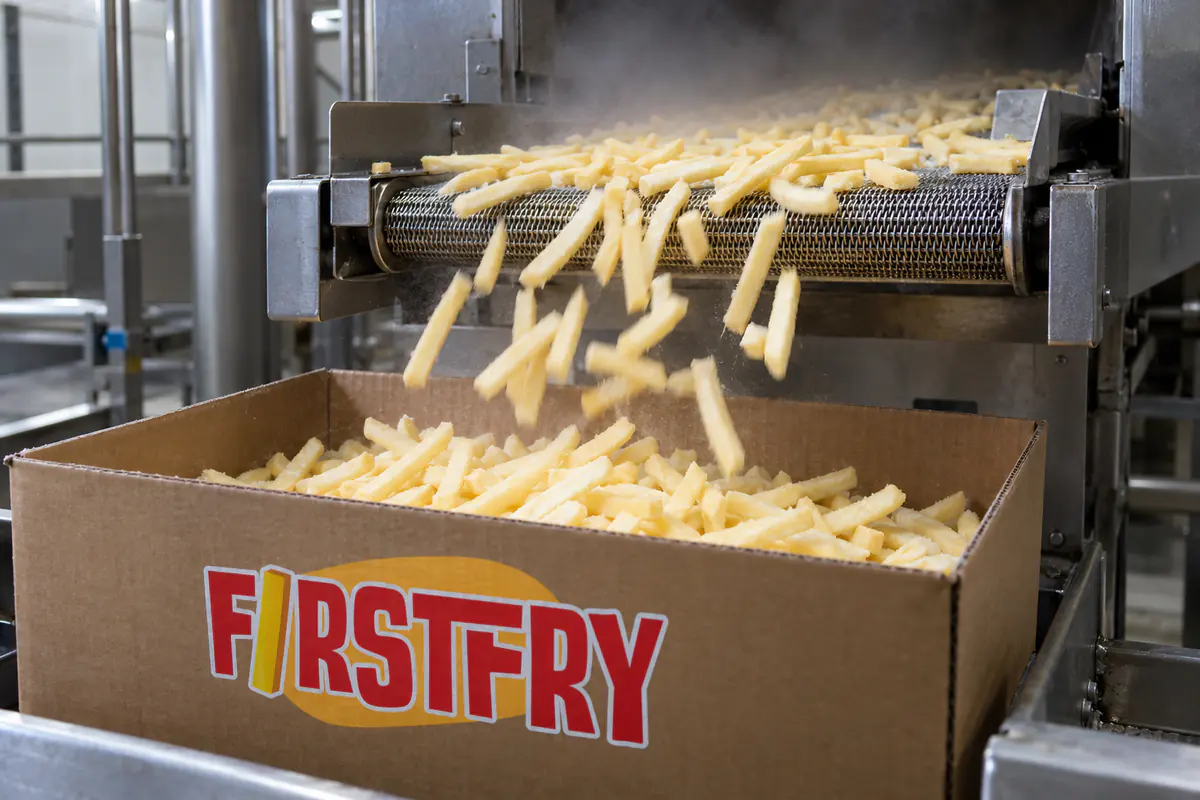
Why freezing speed decides texture
A potato strip is mostly water held inside cell walls. When that water freezes, it expands and forms crystals. How big those crystals grow is decided almost entirely by how fast the strip passes through the freezing range.
Freeze slowly and water migrates out of the cells before it solidifies, forming large crystals between cells that puncture the walls as they grow. The damage is invisible while frozen. It appears the moment the fry is cooked, when the ruptured cells release their water and the fry steams itself from the inside instead of crisping.
Freeze quickly and the water has no time to migrate. Crystals form small and inside the cells where they belong, the walls survive, and the cooked fry keeps a dry, fluffy interior behind a crisp shell.
How an IQF freezer works
Two designs dominate potato processing. A fluidised-bed freezer blows cold air upward through a perforated belt hard enough to lift and separate the fries, so each piece is surrounded by moving air and none touch long enough to bond. A spiral freezer runs a long belt in a helix through a cold chamber, which suits heavier or coated products.
| Method | Time to core -18C | Crystal size | Result in the bag |
|---|---|---|---|
| Fluidised-bed IQF | Minutes | Small, intra-cellular | Free-flowing, cooks crisp |
| Spiral IQF | Minutes to tens of minutes | Small to moderate | Mostly free-flowing, good for coated cuts |
| Blast freezing in cartons | Hours | Large, inter-cellular | Partly bonded, softer texture |
| Static cold-room freezing | Many hours | Very large | Solid block, watery when cooked |
Most industrial fry lines crust-freeze the surface first, then finish the core, because a frozen skin stops pieces sticking to each other on the belt. That is why a well-made bag pours even after months in storage.
IQF, blast frozen, block frozen and BQF: four terms, two different questions
Buyers routinely compare IQF against blast freezing as if they were alternatives. They are not, and the confusion costs money at the quotation stage. IQF describes the format the product arrives in - loose, separate pieces. Blast freezing describes how the cold is applied - high-velocity air across the product. A blast freezer can produce IQF fries or a solid block, depending entirely on how the product is presented to it. The pair of terms that genuinely oppose each other is IQF against block frozen.
| Term | What it describes | What a fry buyer receives |
|---|---|---|
| IQF - individually quick frozen | The finished format: pieces frozen separately and free-flowing | Fries that pour, portion by weight and fry from frozen without separating first |
| Blast frozen | The method: rapid cold air across the product | Either format - the term tells you about the equipment, not the pack |
| Block frozen | The finished format: product frozen as one solid mass | A slab that must be broken or thawed before use, with damage and waste at the break |
| BQF - block quick frozen | A block frozen quickly rather than slowly | Better crystal structure than slow block freezing, but still a block to break |
For frozen french fries the answer is settled: IQF is the only sensible format, because a fry is portioned by weight and dropped into oil from frozen. A block forces thawing or breaking, and both put water and broken pieces into a fryer. Block and BQF persist in seafood and some vegetable lines, where a solid pack protects the product or where the buyer processes it further, which is why most comparison articles on the web are written about shrimp and berries rather than potatoes.
The test you can run on arrival
You do not need a laboratory to check whether the cold chain held. Open a carton from the middle of the pallet, not the top, and empty a bag into a tray.
- Pour the bagFries should separate and pour loose. A few light clusters that break with finger pressure are acceptable; solid blocks are not.
- Look for frost inside the bagHeavy internal frost or ice sheets on the film mean moisture migrated out of the product and refroze, which only happens with temperature swings.
- Check surface colourPale, dried, papery patches on the fry surface indicate freezer burn from sublimation during storage.
- Fry a control sampleCook to the specified time. Watch for excessive steam and limpness, both signs of ruptured cell structure.
- Photograph and logIf anything fails, record it against the carton code before the consignment is broken down. Claims are far harder to support later.
Why IQF matters commercially, not just technically
Free-flowing product changes how a kitchen operates. Staff scoop what a basket needs and reseal the bag, so a slow lunch does not force a full bag into the fryer. Block-frozen product has to be broken up or thawed, which wastes labour and pushes operators toward over-frying.
| What the bag does | Verdict | Action |
|---|---|---|
| Pours completely loose | Cold chain held | Accept, log the check |
| Light clusters that break under finger pressure | Acceptable | Accept, note on the receiving record |
| Clusters needing firm force to separate | Marginal | Pull the reefer log before accepting |
| Solid blocks, bag holds its shape | Failed | Photograph, retain samples, notify within the claim window |
| Ice sheets on the inside of the film | Failed | Temperature swing in transit or storage; treat consignment as suspect |
- Portion control - basket loads can be weighed consistently
- Less waste - partial bags are usable, so slow periods do not cost stock
- Consistent cook - separated pieces cook evenly instead of the outside of a block burning
- Cold-chain evidence - the pour test gives receiving staff a fast, objective check
For an importer, that last point is the most valuable. IQF gives you a quality signal that survives the journey and can be checked at the port without specialist equipment.
Keeping the benefit after delivery
IQF at the factory only helps if the chain holds afterwards. Storage at a stable -18C or colder matters less for the average temperature than for the absence of swings; repeated small excursions do more damage than one steady degree of warmth, because each cycle melts and refreezes a little more water into progressively larger crystals.
Practical rules: keep pallets off the door line, avoid restacking in ambient areas, and never refreeze product that has visibly thawed. what actually sets a shelf life sets out the storage discipline in more detail, and every cut in IQF flash-frozen fries and potato specialties is produced to the same freezing standard.
Frequently asked questions
What does IQF mean on a frozen food label?
Individually quick frozen. Each piece is frozen separately and rapidly, usually on a fluidised-bed or spiral freezer, so the product stays loose in the bag rather than bonding into a block. For fries it also indicates the fast freezing that preserves cell structure and therefore texture.
Why are my frozen fries stuck together in a block?
Because they thawed partially and refroze. Correctly IQF fries pour loose from the bag even after months of storage. Blocks are evidence of a cold-chain break in transit or storage, and the texture damage is already done - the fries will cook out softer and wetter than specified.
Is IQF the same as flash frozen?
The terms are used interchangeably in the potato trade. Flash frozen describes the speed, IQF describes both the speed and the fact that pieces are frozen individually rather than in a mass. In practice a supplier saying either should be able to state the freezer type and the core temperature achieved.
Can I refreeze frozen fries that have thawed?
No. Refreezing produces large ice crystals that destroy the remaining cell structure, so the fries cook out limp and watery, and it also creates a food-safety record you cannot defend. Product that has visibly thawed should be logged, photographed and taken out of stock.
What temperature should frozen fries be stored at?
-18C or colder, and stable. Consistency matters more than the exact figure: repeated small temperature swings cause more crystal growth and freezer burn than a steady temperature a degree or two above target, because every cycle melts and refreezes a little more of the product's water.
What is the difference between IQF and blast freezing?
They answer different questions. IQF describes the format - individually quick frozen, loose free-flowing pieces. Blast freezing describes the method - rapid, high-velocity cold air. A blast freezer can produce either IQF product or a solid block depending on how the product is loaded, so the two terms are not alternatives. The genuine opposite of IQF is block frozen.
What does BQF mean, and is it used for french fries?
BQF is block quick frozen: product frozen fast but as one solid mass rather than as separate pieces. It is common in seafood, where a block protects the product, and it is not used for retail or foodservice french fries, because a fry is portioned by weight and fried from frozen. A block would have to be broken or thawed first.
Ask about our freezing process
We can share freezer type, core temperature targets and the cold-chain records that follow each consignment from our line to your port. Email the export desk with your destination and required documentation.
Email BuyFry@FirstFryFoods.com or request a quote. The export desk replies within one business day.