Skin-On Fries for Wholesale: Specification, Skin Coverage and Where They Belong on a Menu
Skin-on fries are straight-cut fries made from washed, unpeeled potatoes, so each strip keeps a band of natural skin along one or two faces. Buying them wholesale means specifying cut size, skin coverage, length grading and defect limits the same way as a peeled fry, plus one extra field, the proportion of strips carrying skin. They fry from frozen in three to three and a half minutes at 175°C, take slightly more oil than a peeled cut, and suit gastro-pub, homestyle and retail menus where the rustic look is the point.
Published 2026-09-06 · FirstFry Export Desk · Specifications & product science
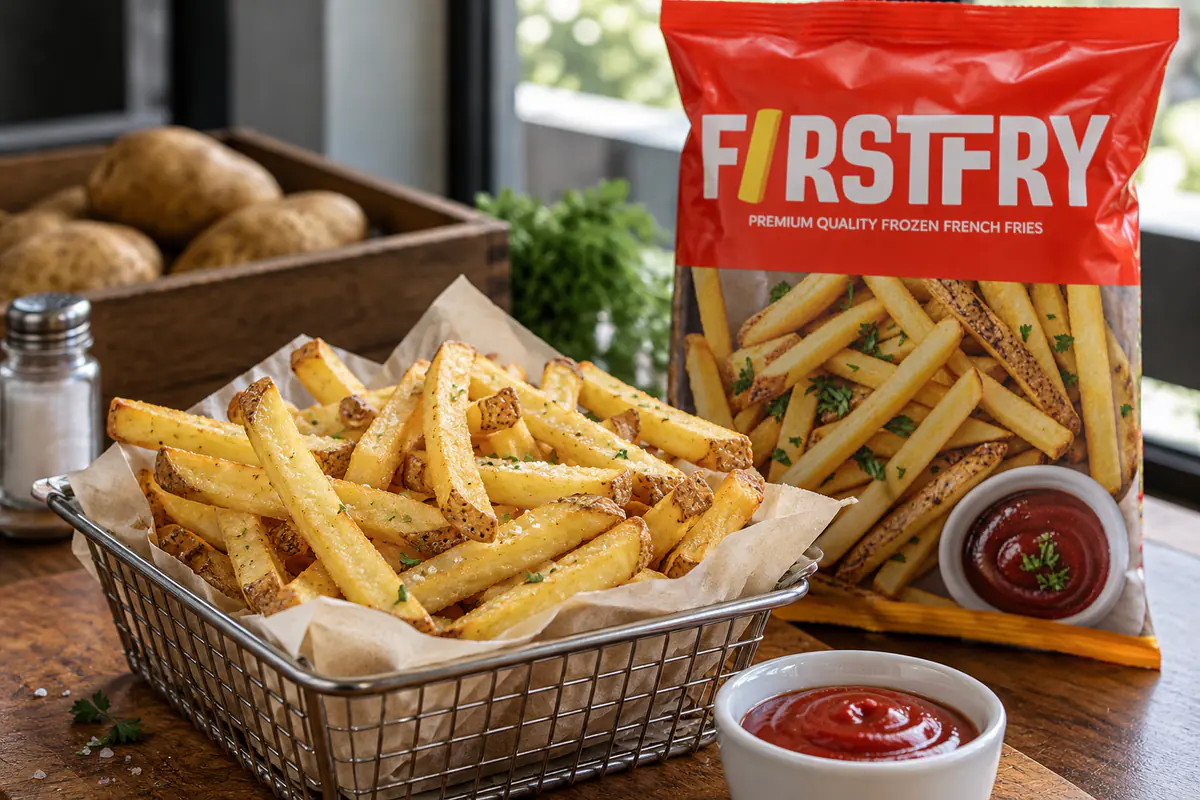
A skin-on fry is what a peeled fry would have been if one process step had been skipped. That sounds like a saving and it is not, because leaving the skin on removes the step that hides most of a potato's surface faults. Everything peeling used to take away — eyes, greening, scab, sunburn — now has to be graded out by hand or by camera, or it ends up in the bag.
That is why the cut is priced close to, and sometimes above, a peeled fry despite the missing step. It is also why buying it wholesale means asking for one field that no peeled-fry spec carries: how much skin, on how many strips. Everything else on the sheet follows the same logic as the six spec fields that decide performance on any fry.
What changes in the process when the skin stays on
A peeled line runs the tuber through a steam or abrasive peeler, then a trimming station, before the cutter. A skin-on line washes and brushes instead, which removes soil and loose skin but leaves the periderm intact. The tuber then goes through the same cutter, blanch, dry, par-fry and IQF sequence as a peeled fry, so the interior of the strip is identical. The difference is entirely at the surface.
Because the skin is thin and only on the outside faces of the tuber, most strips from a cut carry skin on one edge, some on two, and the strips from the centre of the potato carry none. That is normal, and it is why skin coverage is written as a proportion rather than as a promise that every fry has skin. A spec that says every strip carries skin describes a wedge, not a fry, which is what the coated skin-on wedges format is for.
Skin-on versus skin-off on the plate
| Field | Skin-on | Peeled |
|---|---|---|
| Appearance | Rustic, visibly potato, uneven edges read as intentional | Uniform, pale, clean edges |
| Flavour | More earthy, slightly bitter note from the skin | Neutral, seasoning-led |
| Oil uptake | Slightly higher — the skin face absorbs and holds oil | Baseline for the cut size |
| Holding under a lamp | Slightly shorter — the skin softens before the flesh does | Baseline for the cut size |
| Raw-material grading | Surface faults must be graded out | Peeling removes most surface faults |
| Portion count per kilo | Same — set by cut size, not skin | Same |
| Price position | Premium or parity, depending on grading cost | Baseline |
None of those rows says one is better. They say the cuts are for different menus. A quick-service operation running thin cuts at volume is buying uniformity and throughput, and skin gets in the way of both. A gastro pub, a burger concept with a homestyle positioning or a retailer selling a rustic bag is buying the look and the flavour, and will pay for them.
The spec fields that matter for skin-on
Ask for the same fields you would on any fry and add one. The how cut size changes cook time and portion count logic is unchanged: a 9 mm skin-on fries by its thickness, not by its skin.
- Cut size — most skin-on product is 9 mm or thicker, because a thin skin-on strip loses its skin band in the cutter and looks like a mistake
- Skin coverage — the share of strips carrying skin on at least one face, typically written as a minimum percentage, and a visual reference photograph
- Length grading — the share of strips over a stated length, exactly as for a peeled cut
- Defect limits — a separate line for skin-related defects (eyes, greening, scab) beyond the usual colour and shape defects, because peeling no longer removes them
- Dry matter — the same solids range as a peeled fry from the same variety; the skin does not change it
- Colour — measured on the flesh face, not the skin, and stated as a target and a tolerance
On arrival, sample the carton the way you would for any fry and score by weight, following scoring fry defects by weight. Add a skin-specific count: strips with green skin, strips with visible eyes, and strips where the skin has lifted from the flesh, which is a sign of over-blanching rather than of raw material.
Variety and skin condition
The skin you see on the plate was decided in the field. Processing varieties with thin, uniform, light skin and shallow eyes produce a clean skin-on fry; varieties with thick, netted or deep-eyed skin produce a fry that looks dirty however well it is graded. The potato varieties used for frozen fries that dominate Indian processing were chosen for solids and sugar behaviour, and most of them also happen to have skin that suits the cut, which is one reason the format has grown.
Storage matters too. Late in the storage season skin thickens and eyes deepen, so a skin-on line sees more grading loss from the same variety in the last quarter of the year than in the first. A supplier who can tell you how skin quality drifts through their storage year is one who has actually run the cut at scale.
Where the cut earns its price
- Gastro pubs and homestyle menus — the visual is the product; a peeled fry looks wrong beside a hand-formed burger
- Loaded and seasoned fries — the skin face holds a dry rub and reads as deliberate under a topping
- Retail rustic bags — a skin-on bag justifies a higher shelf price without a coating or a claim
- Hotel and buffet service — the earthy flavour carries without sauce, which suits self-service
Where it does not earn its price is high-volume thin-cut service, extreme-crisp positioning, and any menu where the fry is a neutral carrier for a sauce. For delivery, the skin-on fry behaves like any uncoated straight cut of its size: acceptable in a vented container for the first ten to fifteen minutes and soft after that. If delivery is the main channel, the coated wedge is the skin-on format that survives it.
Buying wholesale: carton, pallet and the first order
Our skin-on straight-cut fries ship in the standard export format of 2.5 kg x 4 bags per 10 kg carton, on the same pallet footprint as every other cut in the range, with a 24-month frozen shelf life at -18°C. That means the cut drops into an existing container plan without changing the arithmetic, and the guidance on how a first wholesale order is sized applies unchanged: a first order is usually a few pallets of skin-on inside a container of the volume cuts rather than a container on its own.
A short checklist before ordering skin-on
- Skin coverage written as a minimum proportion with a reference photograph
- Cut size 9 mm or above, with length grading stated
- A separate defect line for eyes, greening and lifted skin
- A sample fried in your own kitchen and held under your own lamp before the order
- The menu it is for identified, and the delivery share of that menu checked against an uncoated cut's limits
- Pallet count set inside the container plan with the volume cuts
Frequently asked questions
Do skin-on fries take longer to cook than peeled fries?
No. Cook time is set by cut thickness, not by skin, so a 9 mm skin-on fry cooks from frozen in about the same three to three and a half minutes at 175°C as a 9 mm peeled fry. The skin face does take slightly more oil and softens slightly sooner under a heat lamp.
Why are skin-on fries not cheaper if peeling is skipped?
Because peeling also removed most surface faults. With the skin left on, eyes, greening and scab have to be graded out by hand or camera, and the grading loss is higher late in the storage season. The saved peeling step is usually offset by grading cost, which is why skin-on prices at parity with or above a peeled cut.
Does every skin-on fry have skin on it?
No, and a spec that promises it is describing a wedge. Strips from the outside of the tuber carry skin on one or two faces; strips from the centre carry none. Skin coverage is therefore written as a minimum proportion of strips carrying skin, with a reference photograph, not as a guarantee on every piece.
Are skin-on fries suitable for delivery?
They behave like any uncoated straight cut of their size: fine in a vented container for the first ten to fifteen minutes, soft after that. If delivery is the main channel, a coated skin-on wedge is the format that holds. For dine-in gastro-pub and homestyle menus, skin-on straight cut is the right choice.
Specifying a skin-on cut?
Send us the menu it is for and your target cut size. We will send the specification with skin coverage and defect limits written in, a fried sample, and the pallet count for your container plan.
Email BuyFry@FirstFryFoods.com or request a quote. The export desk replies within one business day.