Frozen Fry Defects: How to Inspect a Consignment and Score What You Find
Inspect a frozen fry consignment by drawing cartons from several pallet positions, not the top layer. Check bag temperature and whether the product pours loose, then grade a weighed sample for short pieces, dark ends, defect colour, peel residue and foreign material. Express each defect as a percentage by weight against contract tolerance, cook a control sample, and photograph everything against carton codes before the pallet is broken down.
Published 2026-08-08 · FirstFry Export Desk · Specifications & product science
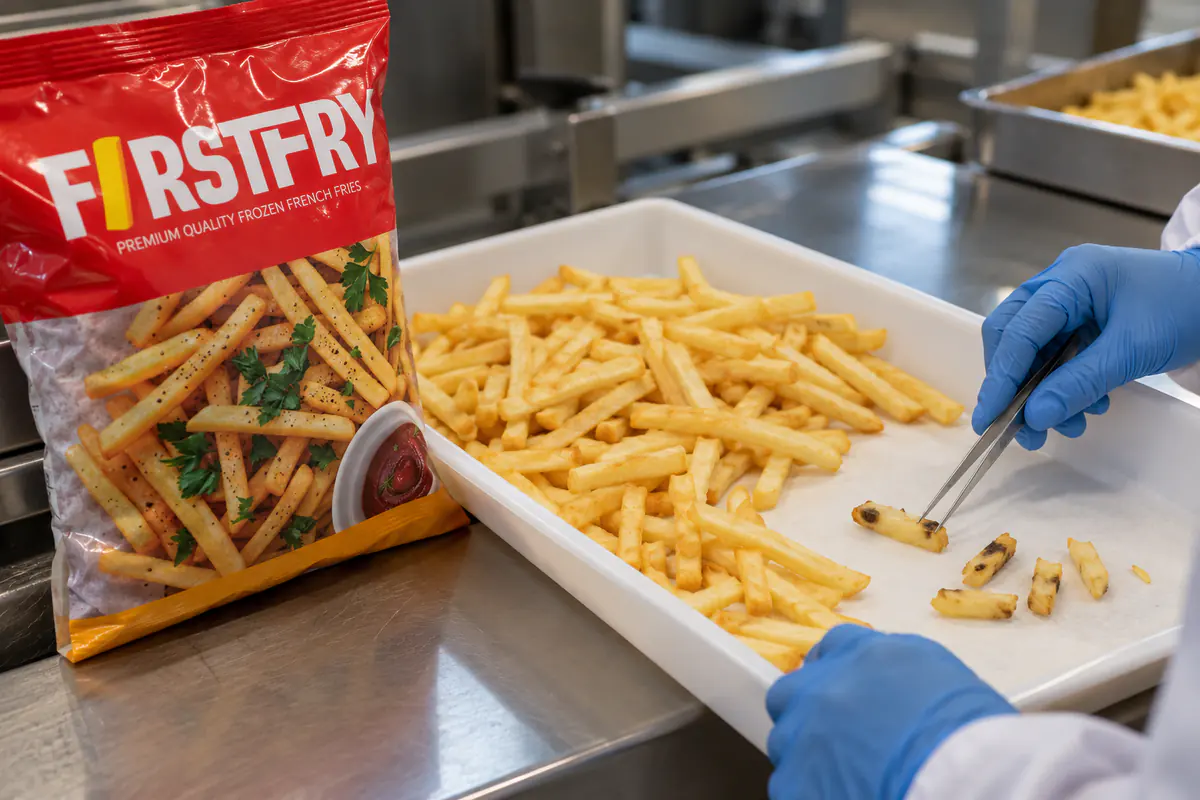
Sample properly or do not bother
The single most common inspection mistake is opening the carton nearest the container door. That carton had the warmest, roughest journey and is unrepresentative in both directions - it may look worse than the consignment, or it may be the one carton loaded last from a different pallet.
Draw cartons from several positions: front, middle and rear of the container, and from different pallet layers. For a full container load, a working practice is a minimum of five to eight cartons spread across the load, with more if anything looks wrong. Record which position each sample came from.
Do this before the consignment is broken down and distributed. Once pallets are split across a warehouse, traceability collapses and so does any claim you might want to make.
The two checks that take sixty seconds
Before any grading, two fast checks tell you whether the cold chain held.
- Temperature. Probe between bags, not by piercing a bag. Product should be at or below -18C. Anything warmer needs the reefer log pulled immediately.
- Pour test. Empty a bag onto a tray. Correctly frozen fries pour loose. Light clusters that break under finger pressure are acceptable; solid blocks are not.
Blocks mean the product thawed and refroze. That is a cold-chain failure affecting the whole consignment, and it is far more serious than any cosmetic defect you will find afterwards. Cold-chain failures behind most texture defects covers where in the journey it usually happens.
Grading defects by weight
Defects are specified as a maximum percentage by weight, so they must be measured that way. Weigh out a sample - 500g to 1kg from each sampled bag is workable - sort the defects into categories, weigh each category, and express it against the sample weight.
| Defect | How to identify | Likely cause upstream |
|---|---|---|
| Short pieces and slivers | Fragments below the specified minimum length | Weak screening after cutting, or small raw material |
| Dark ends | Brown or black tips visible after frying | High reducing sugars, inadequate blanching |
| After-cooking darkening | Grey or blue-grey cast appearing minutes after frying | Insufficient SAPP in the dip stage |
| Colour variation | Mixed pale and dark fries in the same batch | Uneven blanch or inconsistent raw material |
| Peel and eye residue | Skin flecks or dark eyes on a peeled cut | Under-peeling or poor optical sorting |
| Green flesh | Greenish tinge in the strip | Light-exposed tubers not removed at sorting |
| Clumping | Fries bonded together in the bag | Thaw-refreeze, or inadequate IQF |
| Freezer burn | Pale, dry, papery surface patches | Temperature fluctuation or damaged packaging |
| Foreign material | Any non-potato matter | Sorting, magnet or metal-detection failure |
The control cook
Cook a sample exactly to the specification - stated time, stated temperature, no adjustments to flatter the product. The point is to test the specification, not to get the best possible fry.
Assess four things: colour uniformity, crispness immediately out of the fryer, texture at the stated holding time, and interior condition when a fry is broken open. A dry, fluffy centre is correct. A wet or dense centre indicates ice damage or low dry matter.
Watch the steam as well. Excessive steam and spitting suggests the fries carry more water than they should, whether from low solids or from recrystallisation during transit.
Documenting a claim
Suppliers settle documented claims and argue undocumented ones. The difference is usually half an hour of work at the point of receipt.
- Photograph before openingContainer seal, door-side stow, pallet condition, then carton codes on every sampled carton.
- Record the temperature logExport the reefer data, not just a spot reading. A flat trace or a visible excursion is the whole argument.
- Weigh and photograph each defect groupDefects on a tray beside a scale reading, with the carton code visible in frame.
- Photograph the control cookFries out of the fryer and again at the specified holding time.
- Retain samplesKeep sealed retention samples frozen from the affected codes. Without them, third-party verification is impossible.
- Notify within the contractual windowMost contracts limit claim notification to a set number of days after discharge. Miss it and the merits stop mattering.
Set tolerances before the first order
Most disputes come from tolerances that were never agreed. A contract saying good commercial quality gives you nothing to measure against, and a supplier can meet it with almost anything.
| Step | Quantity | Note |
|---|---|---|
| Cartons sampled | 5-8 minimum | Spread across front, middle and rear of the load |
| Pallet layers | At least two different heights | Never judge from the door-side carton alone |
| Sample weight per bag | 500g-1kg | Enough to weigh defect groups meaningfully |
| Control cook | One sample per sampled carton | Cooked strictly to the stated specification |
| Retention samples | One sealed bag per affected code | Kept frozen; without these, verification is impossible |
| Photographs | Seal, stow, codes, each defect group, control cook | Taken before the pallet is broken down |
Agree numeric limits for short pieces, dark ends, colour range and foreign material before the first container ships, along with the sampling plan itself - how many cartons, from where, and who witnesses. Suppliers who are confident in their line will agree readily; hesitation on this point is itself informative, which is why it belongs in qualifying a manufacturer before you order.
Published tolerances for each cut are part of specifications and defect tolerances for each cut, and they are the numbers we expect to be measured against.
Frequently asked questions
How should I sample a container of frozen fries?
Draw five to eight cartons minimum, spread across the front, middle and rear of the container and across different pallet layers, recording the position of each. Never judge a consignment from the door-side carton alone, and always sample before the pallets are broken down and distributed.
What causes dark ends on french fries?
Excess reducing sugars caramelising in the fryer, usually because the potatoes were high in sugar and the blanch did not remove enough. Cold sweetening during storage below about 4C is the common root cause. The defect is invisible in the frozen bag and only appears after cooking.
Why do fries turn grey after cooking?
After-cooking darkening, caused by iron in the potato combining with chlorogenic acid to form a grey-blue complex. It appears minutes after frying. It is prevented at the factory by a sodium acid pyrophosphate dip, so its presence points to the dip stage rather than to anything your kitchen did.
How are frozen fry defects measured?
As a percentage by weight against an agreed tolerance. Weigh a sample of 500g to 1kg, sort the defects into categories, weigh each category and calculate its share. Visual estimates are not defensible in a claim, and colour defects must be graded on cooked samples rather than frozen ones.
What should I photograph if I want to make a claim?
Container seal and stow before opening, carton codes on every sampled carton, the reefer temperature log as exported data, each weighed defect group beside a scale reading with the code in frame, and the control cook both fresh and at the specified holding time. Retain frozen samples from the affected codes.
Agree tolerances before the first container
Send us your intended sampling plan and we will confirm defect tolerances for your cut in writing, along with the production coding that makes any consignment traceable back to a shift and raw-material lot.
Email BuyFry@FirstFryFoods.com or request a quote. The export desk replies within one business day.