Frozen Hash Brown Specifications: Shred, Solids, Weight and Par-Fry
A frozen hash brown specification should state shred size, potato solids content, piece weight and tolerance, binder and coating if any, par-fry level, oil content of the finished piece, and the pack format. Solids content and shred size do most of the work: solids decide how crisp the piece can get and how much oil it takes on, and shred size decides whether it eats ragged and light or dense and croquette-like.
Published 2026-08-21 · FirstFry Export Desk · Specifications & product science
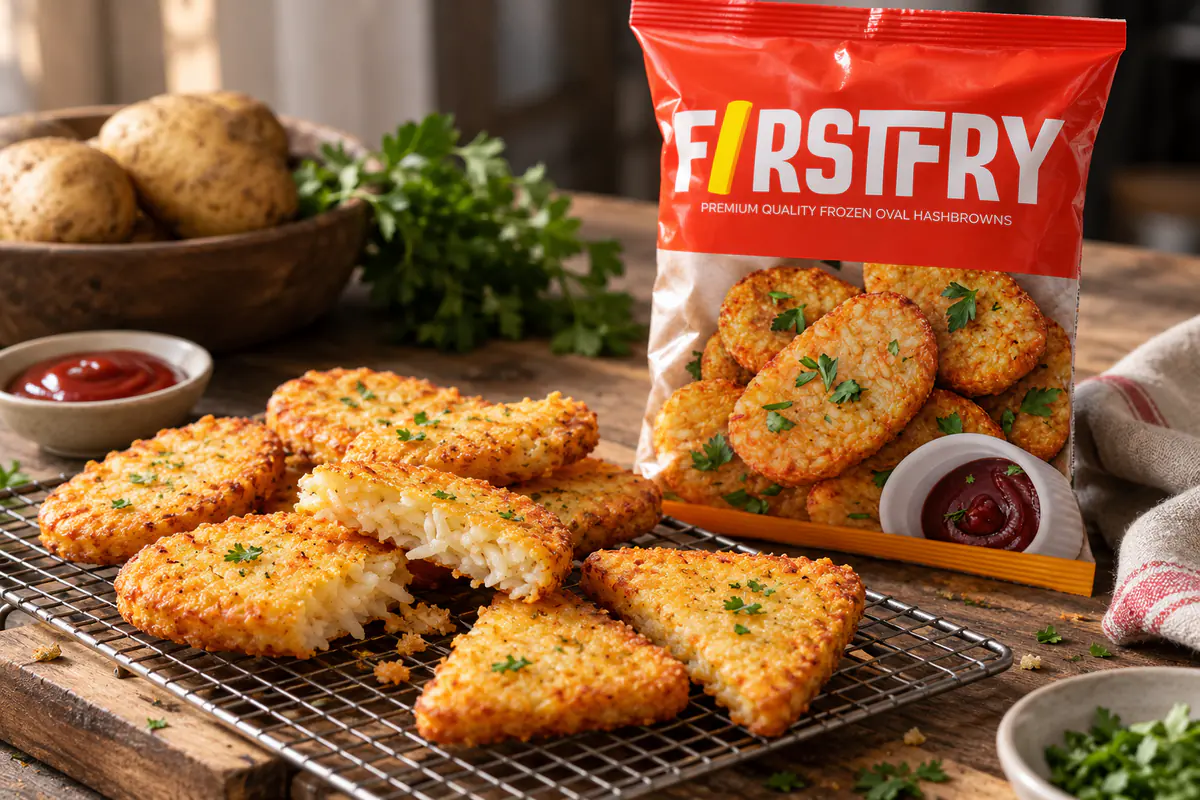
A hash brown specification looks simple next to a fry specification. There is no cut size to argue about and no length distribution to grade. That simplicity is misleading: the same four or five fields carry all the variation, and a buyer who only compares piece weight and price is comparing the two least informative numbers on the sheet.
Potato solids
Solids content is the dry matter in the raw potato, usually expressed as a percentage. Processing varieties are grown for it. It is the field that predicts most of what a buyer cares about, and it is the one most often left off a quotation.
Higher solids means less water in the piece. Less water means less energy spent boiling it off in the fryer, a shorter cook, a crisper edge and lower oil pickup. Lower solids means a wetter piece that steams itself from the inside, takes longer to colour and carries more oil when it finally does.
| Solids | Cook behaviour | Eating quality | Oil pickup |
|---|---|---|---|
| Low (~18–19%) | Slow to colour, steams internally | Soft edge, collapses on holding | Higher |
| Typical (~20–22%) | Colours predictably | Crisp edge, defined shred | Moderate |
| High (~23%+) | Fast to colour, watch for over-browning | Very crisp, drier centre | Lower |
Shred size
The potato is shredded before forming, and the shred dimension sets the texture. A coarse shred leaves visible strands with loose ends that fry hard and give the ragged crispness the format is known for. A fine shred packs tighter, holds together more reliably and eats denser — closer to a potato croquette than to a classic hash brown.
Neither is wrong. Coarse suits a breakfast plate where texture contrast is the point. Fine suits high-handling operations where breakage in transit and on the line costs more than a slightly denser bite.
Piece weight and tolerance
Piece weight is where portion cost lives. A 60 g target with a ±5 g tolerance and a 60 g target with a ±12 g tolerance are very different products to a caterer serving two pieces a cover.
Ask for count per kilogram as well as piece weight. Count is the number your kitchen actually plans against, and it exposes tolerance problems that an average weight hides: a bag that averages 60 g can still contain a mix of 48 g and 72 g pieces.
Binder, coating and ingredient list
Shredded potato needs help holding its shape. Commercial hash browns typically use a small amount of starch or flour as a binder, sometimes with dextrose for colour control and an antioxidant to prevent greying. Some SKUs add a light coating for extra crispness and better holding.
For an importer this section of the specification is not culinary detail, it is a compliance document. It drives your ingredient declaration, your allergen statement and, in several markets, whether the product needs a halal certificate covering the processing aids as well as the potato. Get the full list before you register the product, not after.
Par-fry level and oil content
Par-frying sets the exterior so the piece survives freezing, packing, shipping and handling. A light par-fry leaves a more delicate piece that finishes fresher; a heavier one is more robust but arrives with more oil already in the product.
Finished oil content should be on the specification as a percentage. It matters twice: it is a cost you are paying for by weight, and it is a nutrition-panel figure your destination market may require.
A specification worth signing
| Field | Why it matters | Ask for |
|---|---|---|
| Solids content | Crispness and oil pickup | Range, not a single figure |
| Shred size | Texture and breakage | Dimension, plus a photograph |
| Piece weight | Portion cost | Target and tolerance |
| Count per kg | Kitchen planning | Range at the stated tolerance |
| Ingredients | Labelling and certification | Full declaration including processing aids |
| Oil content | Cost and nutrition panel | Percentage of finished product |
| Pack format | Handling and storage | Bag weight, bags per carton, carton dimensions |
If a supplier can produce all of that in one document without a delay, it usually indicates a line that measures these things routinely. If the sheet arrives with gaps, that is information too.
Frequently asked questions
What piece weight is standard for frozen hash browns?
Commercial ovals typically run 55–65 g and triangles 60–70 g, but piece weight is specifiable on contract volumes. What matters as much as the target is the tolerance around it, since that is what determines portion consistency in a kitchen.
What does solids content mean on a hash brown specification?
The dry matter in the raw potato, as a percentage. Higher solids means less water to drive off, so the piece crisps faster, eats drier and absorbs less oil. It is the single most predictive field on the sheet and moves with the crop and season.
Do frozen hash browns contain anything besides potato?
Almost always. A binder such as starch or flour holds the shred together, and dextrose and an antioxidant are common for colour control. Get the full declaration including processing aids before registering the product in your market.
Want the specification sheet?
Tell us the format and piece weight you are working to and we will send the full specification — solids range, shred size, ingredient declaration, oil content and pack format — for your technical review.
Email BuyFry@FirstFryFoods.com or request a quote. The export desk replies within one business day.