Frozen Aloo Tikki and Potato Patties: Specification and Export Notes
A frozen aloo tikki or potato patty is spiced mashed potato, formed to a set diameter and weight, usually coated, then par-fried and IQF frozen. For export the fields that matter are piece weight and diameter, spice level calibrated to the destination market, the coating type, a full vegetarian and allergen declaration, and confirmation that no animal-derived processing aids are used anywhere on the line.
Published 2026-08-21 · FirstFry Export Desk · Specifications & product science
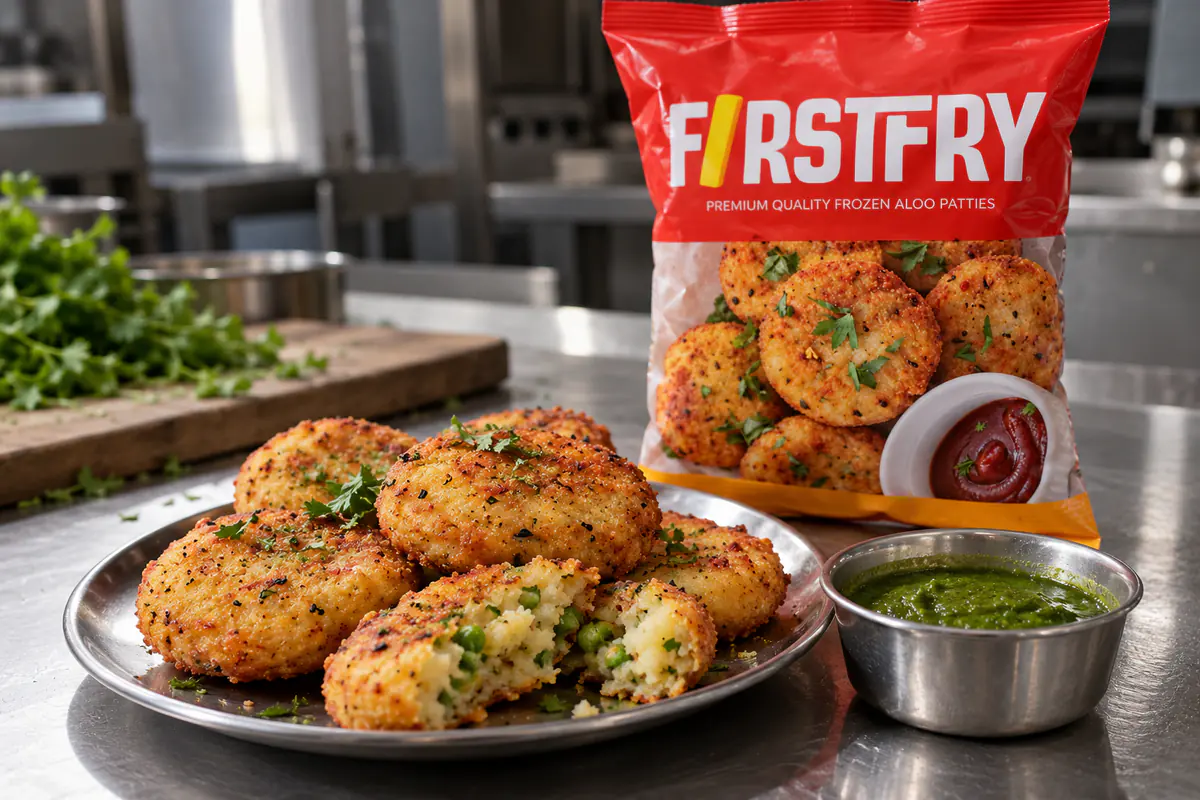
Frozen potato patties travel under several names. Aloo tikki in South Asia, veg burger patty in Gulf and Southeast Asian foodservice, potato patty on a European specification sheet. The product is broadly the same: cooked potato, mashed, spiced, formed, usually coated, par-fried and frozen individually so pieces separate in the bag.
It is a commercially useful SKU precisely because it demands nothing new from the kitchen. A burger line that already runs a fryer can add a vegetarian option without new equipment, new training or a second process. That is why the specification questions are mostly about fit rather than about food science.
Diameter and weight: match the bun, not the catalogue
The first number to agree is diameter, and it should be dictated by the bun the buyer already purchases. A patty narrower than the bun looks mean; wider than the bun and it will not assemble cleanly. Chains that get this wrong discover it after the first container has landed.
Weight follows from diameter and thickness. A 60 g patty at bun diameter is thin and cooks fast; an 80 g patty at the same diameter is substantial and needs longer for the centre to come up to temperature. Both are legitimate; they are different products on a plate and different numbers on a food-cost sheet.
| Weight | Character | Typical use |
|---|---|---|
| 50–60 g | Thin, fast-cooking | Snack menus, kids items, sliders |
| 60–70 g | Standard burger fill | Café and cloud-kitchen burgers |
| 70–80 g | Substantial, slower centre | Signature vegetarian burger |
| 80 g+ | Plated main component | Casual dining, tikki chaat service |
Spice: a market decision, not a recipe decision
This is where the format most often fails on export. A seasoning profile built for a domestic Indian audience reads as aggressive in most Gulf and Southeast Asian foodservice, and a profile toned down for those markets reads as bland to a South Asian diaspora customer buying the same product in the same city.
Treat spice as a specification field with a target, not as the factory house recipe. On contract volumes it is adjustable, and the sensible process is a three-way sample: the factory standard, one step milder, one step hotter, tasted by the people who will actually sell it.
Coating
Most export patties carry a light coating — a thin batter or crumb — for three reasons: it crisps, it holds the piece together through handling, and it extends the window between fryer and plate before the surface softens.
A crumb coating gives more visible texture and a longer holding window. A thin batter is smoother and closer to the traditional homestyle tikki. The trade-off is that heavier coatings carry more oil and change the ingredient declaration, sometimes adding a gluten source that the buyer then has to declare.
Vegetarian and allergen declarations
The commercial reason this SKU exists is that it is vegetarian. That claim needs to be documented properly, because in most destination markets it is the claim the product is sold on.
- Ingredients — the full declaration, in descending order by weight
- Processing aids — anything used on the line that does not appear in the finished product but must still be free of animal derivation
- Frying medium — vegetable oil, specified by type, with confirmation it is not shared with animal-protein production
- Allergens — gluten from a crumb or batter is the common one; declare it rather than discovering it at customs
- Halal certification — where required, covering the processing aids and the oil, not only the potato
A supplier who can produce all five in one document is a supplier who has exported this category before. It is a reasonable proxy for competence at the qualification stage.
Cooking and holding
Fry from frozen at 175–180°C. Hotter and the coating colours before the centre is hot; cooler and it absorbs oil. A coated patty holds usable texture for roughly ten minutes after frying — noticeably less than a fry, because the coating is thinner than a fry surface and softens faster under a lamp.
For assembly lines that means cooking to order or on a short batch cycle. It is not a product to fry ahead of a rush and hold, and any kitchen that plans to will be disappointed by the fifteen-minute mark.
Frequently asked questions
Is aloo tikki the same as a frozen potato patty?
Same product, different name. Aloo tikki is the South Asian term for a spiced potato patty; on an export specification the same item is usually written as a potato patty or vegetarian burger patty, formed to a set diameter for burger assembly.
Can the spice level be adjusted for our market?
Yes, on contract volumes. Seasoning should be treated as a specification field with a target rather than a fixed house recipe — milder profiles for the GCC and Southeast Asia, hotter ones for South Asian and diaspora menus. Ask for a three-way sample before deciding.
Does a coated potato patty contain gluten?
Frequently, if the coating is a wheat-based crumb or batter. It must appear on the allergen declaration. Ask for the full ingredient and allergen statement at the quotation stage, since it affects both labelling and market registration.
How long does a fried patty hold before serving?
Roughly ten minutes with acceptable texture. The coating softens faster than a fry surface does, so this is a cook-to-order or short-batch item rather than something to fry ahead of a rush.
Specifying a vegetarian patty?
Send us your bun diameter, target weight and destination market and we will send a specification, a three-way spice sample and the full vegetarian and allergen documentation.
Email BuyFry@FirstFryFoods.com or request a quote. The export desk replies within one business day.