Frozen Samosa for Bulk Supply and Export: Specification, Piece Count and What to Check
A ready-to-fry frozen samosa is a spiced filling folded in a thin wheat pastry, then IQF frozen raw or after a short flash fry so it cooks from frozen in about four to six minutes at 170–175°C. For bulk or export supply the fields to fix are piece weight and count per carton, filling type and spice level for the destination, pastry thickness and moisture, a full vegetarian and allergen declaration, halal status where the market needs it, and a frozen shelf life of eighteen months at -18°C.
Published 2026-09-06 · FirstFry Export Desk · Specifications & product science
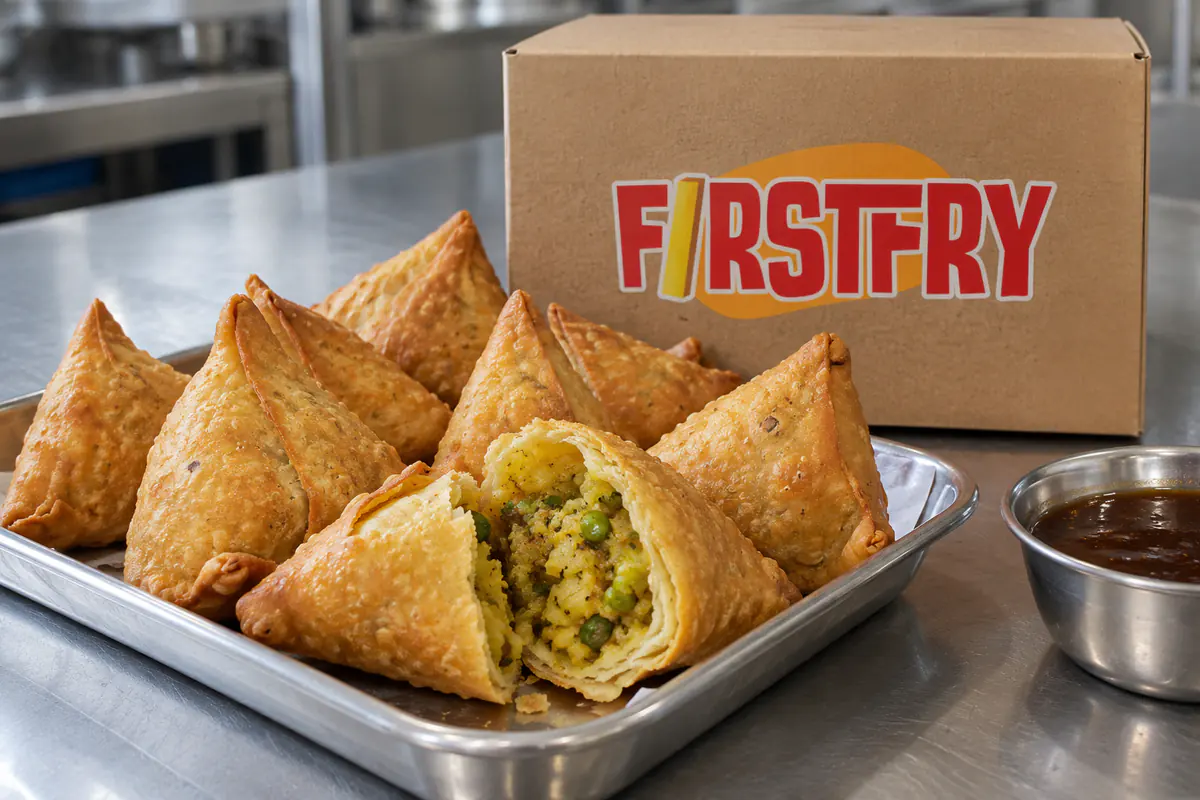
Samosa sits in a different part of the freezer from fries, but it is bought by the same people. An ethnic-food distributor, a foodservice group running a starters menu or a retailer with a frozen snack aisle already has the fryer, the cold store and the container. Adding a ready-to-fry frozen samosa to a fry order costs them nothing in process and opens a category the fry range does not touch.
That is why the SKU travels well. It is also why the order goes wrong in predictable places. Nobody rejects a container of samosa because the recipe was wrong. They reject it because pieces weighed 42 g against a 50 g spec, because pastry split in the fryer, or because the label carried a claim the supplier could not document.
What a ready-to-fry frozen samosa actually is
The format is a filling — most often spiced potato and pea, sometimes with onion, lentil or paneer — folded into a thin wheat-flour pastry sheet and sealed into a triangle. It is then either frozen raw or given a short flash fry to set the pastry before IQF freezing. Either way it is cooked from frozen by the end user, which is what ready-to-fry means: no thawing, no proofing, no second process step.
The two freezing routes matter to the buyer. A raw-frozen samosa fries paler and takes slightly longer, and relies more on pastry quality to hold together. A flash-fried piece is more forgiving in a busy kitchen and colours faster, at a small cost in oil already carried in the pastry. Ask which one you are being quoted, because the fry-time guidance on the carton follows from it.
Piece weight and count: the number that sets the carton
Agree piece weight first and let everything else follow. Weight sets the number of pieces per bag, bags per carton and cartons per pallet, and it sets what a foodservice buyer pays per portion. A cocktail piece and a full-size piece are different products with different customers, even when the filling is identical.
| Format | Indicative piece weight | Typical use |
|---|---|---|
| Cocktail | 20–30 g | Catering platters, hotel buffets, party packs in retail |
| Standard | 45–60 g | Foodservice starters, ethnic retail, delivery sides |
| Large | 80–100 g | Street-style outlets, meal boxes, single-piece snack service |
Write the weight as a target with a tolerance, not as a single figure. A forming line holds a band, and the fair way to accept a batch is to weigh a sample of pieces and compare the average and spread against the band, the same way you would sample a fry carton for defects. Piece count per carton on our ready-to-fry frozen samosa is configured to the channel for exactly this reason: a retail count and a foodservice count are rarely the same.
Filling and spice: a market decision
The filling that sells in Ahmedabad is not the filling that sells in Manchester, Dubai or Toronto, and the difference is mostly heat and salt. Treat spice as a specification field with a target rather than as the factory recipe. On a first order, ask for three samples at mild, medium and the house level, fry them in your own kitchen and pick one. That sample becomes the reference the production batch is judged against.
Two things drift after freezing. Chilli heat reads lower from frozen storage and slightly higher again after frying, and salt reads flatter once the pastry has taken oil. Judge samples only after frying to the carton instruction, never from a thawed piece, and hold them for five minutes before tasting, because that is how the end customer meets them. The same discipline applies when specifying a frozen potato patty for export, which shares the filling logic with a different shape.
Pastry: where the product fails in the fryer
Pastry is a thin sheet of wheat flour, water and a little fat, and it is the most fragile part of the product. Too thick and the piece is doughy at the fold and takes oil. Too thin or too dry and it cracks during freezing and handling, then splits in the fryer and leaks filling into the oil. Moisture that migrates from the filling into the pastry during frozen storage produces blisters on frying and a soft, greasy shell.
- Ask for pastry thickness and fold style on the specification, with a photograph of the reference piece
- Ask whether the line seals with water, flour paste or heat, because a poorly sealed corner is the usual leak point
- Ask for the moisture and fat range of the finished frozen piece, which predicts blistering better than any description
- On arrival, fry a bagged sample and count split or leaking pieces in a batch of twenty — that is your acceptance test
- Check for freezer burn on the pastry surface, which shows a temperature history problem rather than a recipe one
Frying from frozen
Cook from frozen at 170–175°C for roughly four to six minutes depending on piece weight, until the pastry is evenly golden and the centre is hot. Hotter oil colours the pastry before the filling is through; cooler oil soaks it. Do not thaw first: a thawed samosa softens at the fold, takes far more oil and spits in the fryer. Air-fryer service works for smaller pieces at around 190°C with a light oil spray, but the pastry does not crisp the way it does in oil and holding time is shorter.
For a buffet or delivery use, a fried samosa holds better than a fry because the pastry shell is a barrier; it stays acceptable for twenty to thirty minutes in a vented container. It does not survive a sealed box, where steam softens the shell within ten minutes. Vent the packaging or serve open.
Declarations: vegetarian, allergen and halal
The commercial reason a potato samosa exists on an export list is that it is vegetarian and, in many markets, expected to be halal. Both are claims and both need paper. Wheat pastry means gluten must be declared everywhere, and many fillings carry mustard, sesame or nut traces from the spice room that need a may-contain statement in markets that require one.
- Ingredient list in descending order with the filling and pastry broken out
- Allergen statement in the format the destination market requires — bold within the list, a separate box, or both
- Vegetarian declaration confirming no animal-derived fat, processing aid or release agent on the line
- Halal certificate from a body the destination authority recognises, where the market asks for it — see halal certification for frozen potato products
- Country of origin and manufacturer address as the label rules of the market demand
Shelf life, packing and the container
Frozen samosa carries an eighteen-month shelf life at -18°C on our specification, shorter than a fry because the pastry is the limiting component. The shelf life and the cold chain behind it apply exactly as they do for fries: fluctuation damages the product more than the nominal temperature does, and a destination market with a remaining-shelf-life rule needs the arrival date worked back from production.
Pieces are packed in a food-grade inner bag inside a printed or plain carton at a configurable count, and the carton is dimensioned to the standard pallet so it loads alongside fry cartons. That is the practical point: samosa is almost always ordered as a few pallets inside a fry container rather than as a container of its own, so the export packaging and carton arithmetic is worked out alongside the fry SKUs. The procedure for adding a snack SKU to a mixed container is the same as for a second cut.
A short checklist before the first order
- Piece weight agreed as a target with a tolerance, and count per carton fixed for your channel
- Spice level chosen from a three-way fried sample, and that sample kept as the reference
- Raw-frozen or flash-fried confirmed, with fry time and temperature on the carton
- Pastry thickness, seal method and a split-piece acceptance test written down
- Ingredient, allergen, vegetarian and halal documentation received before artwork is signed off
- Shelf life on arrival checked against the destination market's remaining-life rule
Frequently asked questions
What is the minimum order for frozen samosa?
Samosa is normally ordered as a few pallets inside a mixed frozen container alongside fries rather than as a full container of its own, so the practical minimum is set by the container plan and the piece count per carton. Send the destination and the fry SKUs you are already ordering and the export desk will size the samosa line into that load.
How long does a frozen samosa take to fry?
About four to six minutes from frozen at 170–175°C depending on piece weight, until the pastry is evenly golden and the centre is hot. Do not thaw first: a thawed piece softens at the fold, absorbs more oil and can spit in the fryer. Flash-fried product colours a little faster than raw-frozen product.
Is frozen samosa vegetarian and halal?
A potato samosa can be both, but each is a claim that has to be documented. Vegetarian status needs confirmation that no animal-derived fat, processing aid or release agent is used on the line. Halal status needs a certificate from a body the destination market recognises. Ask for both documents before artwork is approved.
What is the shelf life of frozen samosa?
Eighteen months stored frozen at -18°C with an unbroken cold chain, shorter than a fry because the pastry is the limiting component. For markets with a remaining-shelf-life rule at import, work the arrival date back from the production date before booking.
Why did samosa split or leak in the fryer?
Usually pastry that is too thin or too dry, a poorly sealed corner, or moisture migration during frozen storage that weakened the sheet. Occasionally it is oil that is too hot, which sets the outside before the filling expands. Fry a sample of twenty pieces to the carton instruction and count the splits; that number is the acceptance test.
Adding samosa to a fry order?
Tell us the piece weight, channel and destination market. We will send the specification, a three-way spice sample and the vegetarian, allergen and halal documentation, and size the samosa pallets into your container plan.
Email BuyFry@FirstFryFoods.com or request a quote. The export desk replies within one business day.