Packaging Frozen Fries for Export: Film, Cartons, 2.5kg × 4 and Retail Packs
The frozen fry export standard is 2.5 kg × 4 per carton — 10 kg net — because it balances kitchen handling, freezer stacking and pallet efficiency. Pack format is a commercial decision rather than a packaging one: it determines how much product fits a container, how many film runs a private label programme needs, and how well the product survives handling at temperature. Retail formats change all three.
Published 2026-07-31 · FirstFry Export Desk · Private label & OEM
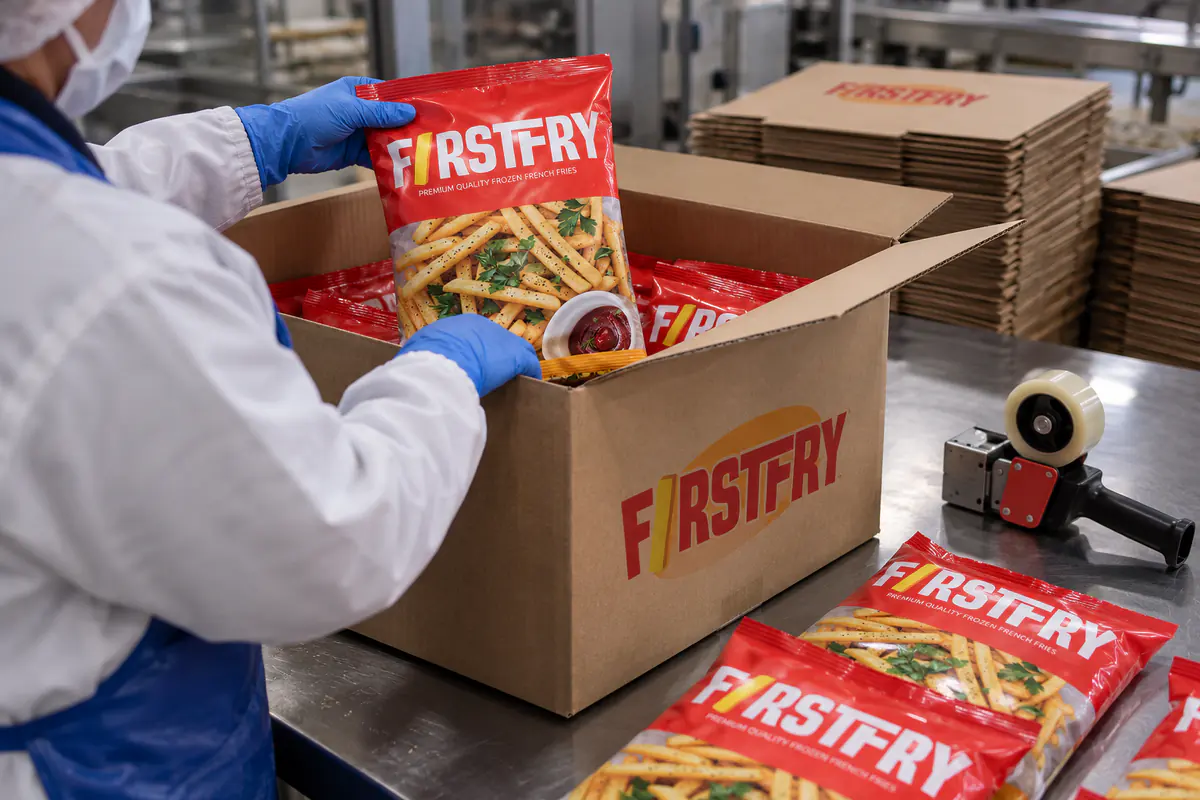
Buyers treat pack format as a late-stage detail and it is one of the earliest decisions that constrains everything else. Change the pack size and you change the container economics, the private label minimum order, the registration workload and the product's tolerance for a hot port.
Why 2.5 kg × 4 became the standard
The 2.5 kg bag, four to a carton for 10 kg net, is the dominant frozen fry export format for reasons that are all operational rather than traditional.
| Consideration | Why 2.5 kg × 4 works |
|---|---|
| Kitchen handling | One bag is roughly one service period — opened and used, not part-used and refrozen |
| Freezer stacking | 10 kg cartons stack and palletise predictably |
| Portion control | A known bag weight makes yield per bag easy to calculate |
| Line efficiency | Fewer, larger bags run faster than many small ones |
| Film cost per kilo | Larger bags use less film per kilo of product |
| Damage tolerance | Fewer seals per tonne means fewer failure points |
The row that matters most for a frozen product is the first. A part-used bag that goes back into a freezer is where quality complaints originate, and a pack size matched to a service period largely eliminates the problem.
What the film has to survive
Frozen export packaging is asked to do more than retail freezer packaging. It is filled with cold product, sealed, frozen hard, palletised, shipped, possibly transhipped, handled at a hot port and moved through a warm dock into a cold store.
Pack format also decides how the product performs after it leaves the kitchen. Vented cartons and the right cut are what keep fries crisp through a delivery run, and fries that survive a delivery bag covers the packaging and product combination that works.
- Low-temperature flexibility — film that goes brittle at −18 °C splits when a pallet is handled
- Seal integrity through thermal cycling — the seal, not the film, is usually what fails
- Puncture resistance — fries have hard frozen edges and pallets get bumped
- Moisture barrier — the mechanism behind freezer burn and ice crystal formation
- Print durability — abrasion in transit should not render the date code unreadable
- Coding window — a clear area for production and expiry dates, printed on the line
Carton and pallet arithmetic
The carton is not just a box — it is the unit that determines how efficiently a reefer fills. Two suppliers quoting the same product can produce materially different container payloads through carton dimensions alone.
| Question | Why it matters |
|---|---|
| Exact carton external dimensions | Determines cartons per pallet layer |
| Cartons per pallet, and pallet height | Determines pallets per container |
| Pallet type and whether it is heat-treated | Wooden pallets carry their own treatment requirements |
| Net vs gross weight per carton | Payload limits are gross, not net |
| Whether the product ships palletised or floor-loaded | Floor loading raises payload and handling time |
| Carton board grade and freezer performance | Board that softens in a humid cold store collapses a stack |
Ask for these before you model landed cost per kilo, not after. The container-level arithmetic and what a realistic first order looks like are in container loading and first-order volumes.
Retail packs are a different business
Moving from 2.5 kg foodservice bags into 750 g or 1 kg retail packs is not a packaging variation. It changes the economics in four directions at once, and distributors consistently underestimate it.
| 2.5 kg foodservice | 750 g – 1 kg retail | |
|---|---|---|
| Film per kilo of product | Lower | Substantially higher |
| Bags from one film run | Fewer | Many more — a bigger commitment |
| Line throughput | Higher | Lower — more bags per tonne |
| Artwork requirements | Functional | Consumer-facing, market-specific, more regulated |
| Barcode requirements | Case-level usually sufficient | Retail barcode, verified |
| Buyer | Distributor to kitchens | Retailer with listing fees and planograms |
| Failure mode | Slow-moving stock | Delisting |
The second row is the trap. A film minimum that represents a sensible quantity of 2.5 kg bags represents a far larger commitment in 750 g bags, because film is bought by weight or length rather than by bag. That arithmetic is set out in how film minimums convert to bags.
Choosing a format, in order
- Decide the channel first — foodservice, retail, or both as separate programmes
- Fix the pack size to that channel, not to a price target
- Get the carton dimensions and pallet pattern from the manufacturer in writing
- Model the container payload from those figures, not from a rule of thumb
- Only then, if private label, get the film minimum in bags at that pack size
- Brief artwork last, against a confirmed dieline with a coding window
Doing this in the wrong order is how a programme ends up with beautiful artwork for a pack size whose film minimum it cannot absorb.
Our export formats
FirstFry's standard export pack is 2.5 kg × 4 per carton, 10 kg net, which is the format most Gulf, African and Southeast Asian foodservice programmes run on. Carton dimensions, pallet configuration and loading figures are available on request so you can model container payload before ordering, and specifications for the whole export SKU range are published — most programmes open with plain cuts without a coating. If you are combining formats or cuts on one container, read mixed-load planning alongside this.
Frequently asked questions
Why is 2.5 kg × 4 the standard frozen fry export pack?
Because it balances several operational constraints at once. One 2.5 kg bag approximates a single service period, so kitchens do not part-use and refreeze; 10 kg cartons stack and palletise predictably; larger bags use less film per kilo and run faster on the packing line; and fewer seals per tonne means fewer failure points in transit.
What does export packaging film need to withstand?
Filling with cold product, sealing, hard freezing, palletising, ocean transit and possible transhipment, handling at a hot port and movement through a warm dock into a cold store. That requires low-temperature flexibility so the film does not go brittle, seal integrity through thermal cycling, puncture resistance, a moisture barrier and print that survives abrasion.
Does moving to retail pack sizes cost more?
Substantially, and in more ways than the film price. Film per kilo of product rises, line throughput falls, artwork becomes consumer-facing and more regulated, retail barcodes must be verified, and — most importantly — one film run yields far more small bags than large ones, so the minimum order commitment in units is much larger for a new brand.
What should I ask a supplier before planning a container?
Exact carton external dimensions, cartons per pallet and pallet height, pallet type and whether it is heat-treated, net versus gross weight per carton, whether product ships palletised or floor-loaded, and the carton board grade's performance in a humid cold store. Carton dimensions alone can produce materially different container payloads between suppliers.
In what order should pack format decisions be made?
Channel first, then pack size to suit the channel, then carton dimensions and pallet pattern in writing, then model container payload from those real figures. Only after that should you obtain the film minimum in bags for private label, and artwork should be briefed last against a confirmed dieline with a coding window.
Modelling container economics?
Tell us your target pack format and destination port and we will send carton dimensions, pallet configuration and indicative loading figures so you can calculate payload and landed cost per kilo before placing an order.
Email BuyFry@FirstFryFoods.com or request a quote. The export desk replies within one business day.