Crinkle Cut Fries in Foodservice: Sauce Hold, Reheating and the Spec Behind the Ridge
Crinkle cut fries are straight-cut fries run through a wavy blade, giving a ridged strip of about 10 mm that has more surface area than a straight cut of the same weight. In foodservice that buys three things: a crisp-to-soft ratio that holds sauce and seasoning, a longer acceptable window under a heat lamp and in a delivery container, and better tolerance of reheating. They cook from frozen in three to three and a half minutes at 175°C. The cut costs a little fryer throughput and is the wrong choice for thin-cut, high-volume service.
Published 2026-09-06, updated 2026-10-15 · FirstFry Export Desk · Foodservice performance
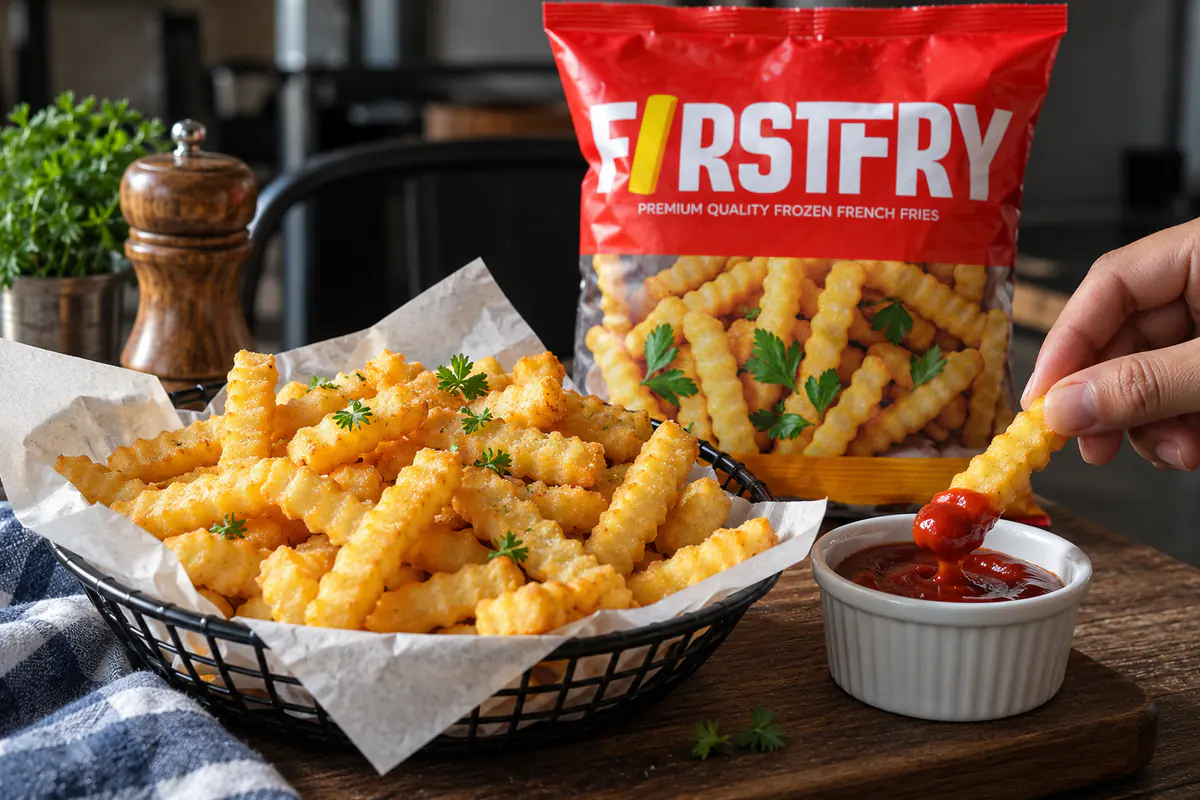
A crinkle cut is a straight cut with a different blade. The potato, the blanch, the par-fry and the freeze are the same as for any fry on the line. The wavy blade adds ridges, and the ridges add surface area, and that single change is behind every difference a kitchen notices between crinkle and straight cut. Understanding it stops the cut being bought for the wrong menu.
Bought for the right menu, crinkle is one of the more forgiving fries a kitchen can run. It is also one of the more frequently mis-specified, because buyers compare it to a straight cut of a different thickness and then blame the ridge for what the thickness did.
What the ridge actually does
Frying crisps the outside of a strip and steams the inside. The more outside there is for a given weight, the more crisp there is per bite, and a ridged strip has substantially more outside than a flat one of the same cross-section. The peaks of each ridge are thin and fry to a crisp; the troughs are thick and stay soft. A crinkle fry is therefore two textures in one strip, where a straight cut is one texture graded from edge to centre.
Those troughs also hold liquid. A sauce, a cheese pour or a dry seasoning sits in the valleys instead of sliding off a flat face, which is why crinkle is the default cut for loaded fries and why seasoned retail bags so often use it. The same geometry helps under a heat lamp: the ridges keep a crisp edge after the flat face of a straight cut has gone leathery.
Crinkle versus straight cut across a service
| Field | Crinkle cut ~10 mm | Straight cut 9 mm |
|---|---|---|
| Cook time from frozen at 175°C | About 3 to 3.5 minutes | About 3 minutes |
| Crisp per bite | High at the ridges, soft in the troughs | Even, moderate |
| Sauce and seasoning hold | Holds in the troughs | Sheds from the flat face |
| Acceptable under a heat lamp | Longer — ridges stay crisp after the face softens | Shorter for an uncoated cut |
| Delivery in a vented box | Better than an uncoated straight cut, short of a coated one | Soft within ten to fifteen minutes |
| Reheating | Recovers crisp at the ridges | Rarely recovers |
| Portion count per kilo | Slightly fewer strips than 9 mm — set by thickness | Baseline |
| Fryer throughput | Thick-cut throughput | Slightly higher |
The honest reading of that table is that crinkle trades throughput and portion count for hold and sauce behaviour. A kitchen that needs the most portions per basket in the shortest time wants a thinner straight cut. A kitchen that plates, sauces, holds or delivers wants the ridge. The full arithmetic behind the portion-count row is in cut sizes compared on cook time and portion count.
Where crinkle wins
- Loaded and sauced fries — the troughs hold cheese, gravy, chilli and dry rubs where a flat fry sheds them
- Reheat-heavy menus — buffets, canteens and anywhere a batch is fried ahead and finished to order
- Delivery without a coating — the ridges buy the extra minutes an uncoated straight cut does not have; the limits are set out in what makes a fry survive delivery
- Casual dining and retail bags — the cut reads as premium on a plate and on pack, without a coating or a claim
- Seasoned product — the geometry carries a spice blend evenly instead of concentrating it on a few strips
Where it is not worth paying for
Thin-cut, high-volume quick service is the wrong home for crinkle. The cut cooks like a thick fry, so at a fixed number of baskets it lowers peak capacity, and the plate does not need the ridge when the fry is a neutral side to a burger. The same applies to any menu built on extreme crispness, where a 7 mm shoestring or a coated cut does the job better. In those kitchens the 7 mm and 9 mm straight cut is the right product and crinkle is an expensive way to get less throughput.
Crinkle is also not a substitute for a coating. It extends holding time by geometry; a clear coat extends it by chemistry, and the coated cut still holds longer. Where delivery is the majority of sales, read what a clear coat buys in holding time before choosing between a crinkle and a coated straight cut, or ask for a coated crinkle, which exists for exactly that channel.
The spec fields to ask for
- Nominal thickness — most foodservice crinkle is around 10 mm; thinner crinkles lose the trough depth that makes the cut worth having
- Wave pitch and depth — the spacing and height of the ridges, ideally with a reference photograph, because two suppliers' "crinkle" can look nothing alike
- Length grading — the share of strips over a stated length, as on any cut
- Coating — uncoated, clear coat or seasoned, and which one the price refers to
- Colour and defect limits — stated on the same basis as the straight cuts you already buy, so the sheets compare
- Dry matter — the same solids range as the peeled straight cut from the same variety
Our crinkle cut fries at around 10 mm are specified on those fields and ship in the standard 2.5 kg x 4 bags per 10 kg carton, on the same pallet footprint as the straight cuts, with a 24-month frozen shelf life at -18°C.
Cooking, holding and reheating
Fry from frozen at 175°C for three to three and a half minutes, loading the basket to no more than half its volume so the oil temperature recovers. Shake once mid-cook: the ridges nest against each other more than flat strips do, and a single shake separates them. Never thaw, and never fry a second batch before the oil is back to temperature, because a crinkle fried in cool oil fills its troughs with oil rather than crisp.
Under a lamp, salt immediately and hold in a single layer in a slotted pan. The ridges stay crisp past the point at which a straight cut of the same size has gone soft; the real holding windows under a heat lamp for each cut are the numbers to test against. For a reheat, a hot oven or air fryer at 200°C for two to three minutes recovers the ridges; a microwave does not. Air-fryer service from frozen works well for crinkle because the geometry exposes more surface to the moving air, at about 200°C for ten to twelve minutes in a single layer.
Buying crinkle cut fries wholesale
Compare cuts on cost per portion, not cost per carton. A crinkle carton costs slightly more than a straight-cut carton and yields slightly fewer strips, and both are irrelevant if the ridge stops a sauced portion coming back or lets a delivery order arrive acceptable. Run the comparison the way the foodservice guide sets out: fry a weighed kilo of each, weigh the cooked output, hold under your own lamp and taste at intervals, and bag a portion for twenty minutes as the delivery proxy. Then order the cut that won on your service, not on the plate straight from the fryer. When you ask for a wholesale quote, ask for it on the same basis as your straight cuts: the cut and coating, the pack and cartons per container, the Incoterm and the remaining shelf life on arrival, so the two offers can be read side by side.
Frequently asked questions
Are crinkle cut fries better than straight cut for delivery?
Better than an uncoated straight cut of the same size, because the ridges keep a crisp edge after the flat face of a straight cut has softened. They are not as durable as a coated fry. For a delivery-led menu, compare crinkle against a coated straight cut, or ask for a coated crinkle, which combines both.
How long do crinkle cut fries take to cook from frozen?
About three to three and a half minutes at 175°C for a ~10 mm crinkle, with the basket no more than half full and one shake mid-cook to separate nested strips. In an air fryer, about ten to twelve minutes at 200°C in a single layer. Never thaw first.
Why do crinkle cut fries hold sauce better?
The wavy blade leaves troughs along each strip, and liquid or dry seasoning sits in those troughs instead of sliding off a flat face. That is why crinkle is the default cut for loaded fries, gravies and seasoned retail bags, and why a seasoning blend distributes more evenly across a crinkle batch than a straight-cut one.
Do crinkle cut fries reduce fryer throughput?
Slightly, because a ~10 mm crinkle cooks like a thick cut rather than like a 7 mm shoestring. At a fixed number of baskets that lowers peak capacity, which is why crinkle suits plated, sauced and delivery menus better than thin-cut, high-volume quick service.
Trialling crinkle on a sauced or delivery menu?
Tell us the menu and the delivery share. We will send the crinkle specification with wave pitch and coating options, a sample carton for a side-by-side test, and the pallet count for your container plan.
Email BuyFry@FirstFryFoods.com or request a quote. The export desk replies within one business day.