Fries That Survive Delivery: Fixing the Soggy Takeaway Problem
Fries go soggy in delivery because a closed container traps the steam they release, which condenses and re-wets the crisp shell. Three fixes are needed together: a clear-coated product to slow moisture migration, a thicker or ridged cut such as crinkle or wedge to hold heat and resist collapse, and vented packaging that lets steam escape. Fixing only one rarely works.
Published 2026-08-12 · FirstFry Export Desk · Foodservice performance
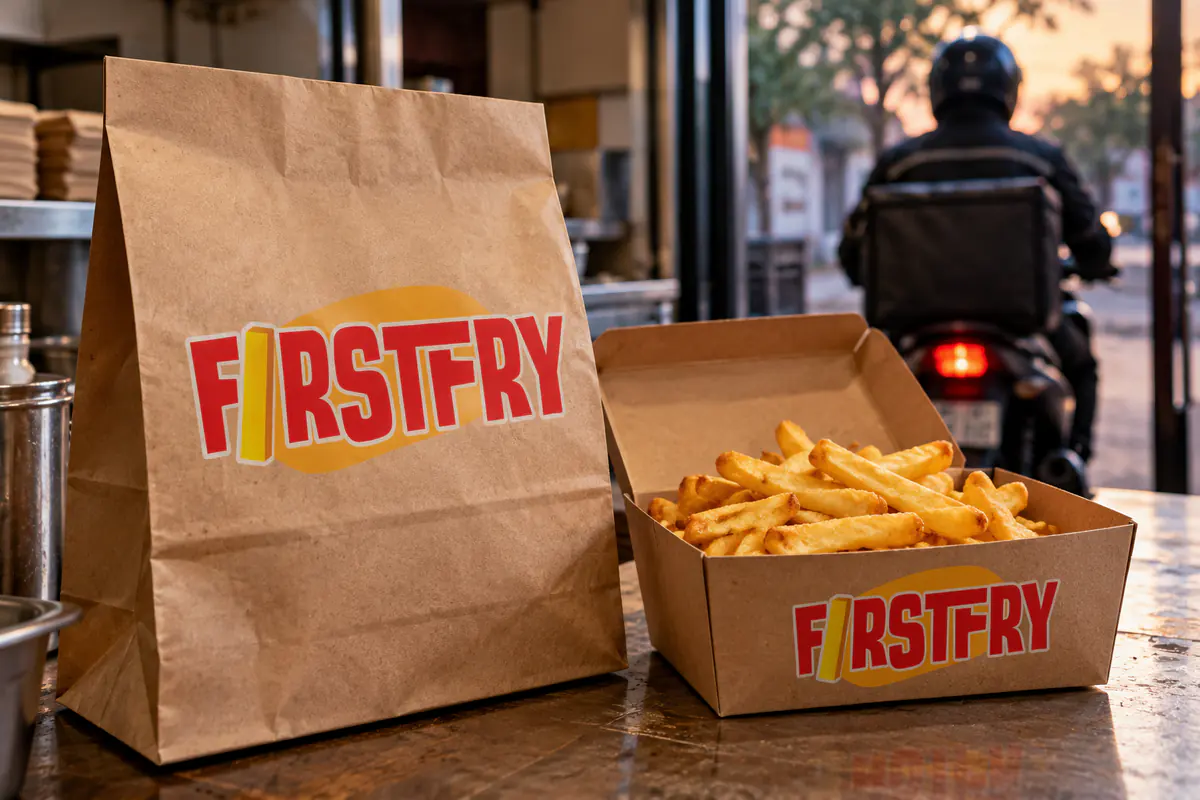
The delivery box is a steam chamber
A fry leaving the fryer holds a hot, wet interior behind a dry, crisp shell. That interior immediately starts converting water to steam. In open air the steam disperses. In a closed cardboard box it cannot: it saturates the air inside, condenses on the cooler container walls, and drips back onto the fries.
So the fry is being attacked from two directions at once - rehydrated from inside by its own escaping steam, and wetted from outside by condensation. Twenty minutes of that will defeat any fry that was not built for it.
The important consequence is that insulation alone makes things worse. A well-insulated sealed container keeps the fries hot, which keeps them generating steam, which has nowhere to go. Operators who upgrade to better-insulated packaging and see no improvement have usually made the problem slightly worse.
Fix one: coating
A clear-coat batter applied before par-frying slows moisture moving from the fry's centre to its surface. It roughly doubles or triples the window before the shell softens, which turns a five-minute product into a fifteen-minute one.
For delivery this is not optional. An uncoated fry has already failed by the time a rider reaches the first set of traffic lights. How a clear coat slows sogginess covers what the coating is and what it costs.
Fix two: cut selection
Thin fries lose heat quickly and have the highest surface-to-mass ratio, so they wet through fastest. Thicker and textured cuts do better on both counts.
| Cut | Heat retention | Texture after 20 min | Verdict for delivery |
|---|---|---|---|
| 6-7mm uncoated | Poor | Limp throughout | Avoid |
| 9mm uncoated | Fair | Soft, some structure | Weak |
| 9mm coated | Fair | Acceptable, softening | Workable |
| 10mm crinkle coated | Good | Ridges retain some bite | Strong |
| Skin-on wedge coated | Very good | Skin holds structure | Strongest |
| 11-13mm steak coated | Very good | Dense, holds heat | Strong |
Ridged and skin-on formats do something thin cuts cannot: the surface geometry means fries rest against each other at points rather than along flat faces, so less of each fry sits in contact with condensation. That is why 10mm crinkle cut for takeaway is the format most delivery-led operators converge on.
Fix three: packaging that vents
This is the fix operators skip, and it is the one that unlocks the other two. Steam must have an exit. A sealed clamshell keeps every gram of moisture in contact with the product.
- Perforated or vented cartons - small holes let steam out while retaining heat
- Open-top fry scoops inside a vented outer bag - common QSR solution
- Never seal fries in a plastic-lined or airtight container
- Never stack fries under hot burgers - the burger's steam rises into them
- Pack fries in their own compartment, separated from sauces and salads
Kitchen habits that matter more in delivery
Everything that shortens holding time in the kitchen is amplified once the box closes.
| Decision | Effect on the fry | Cost to change |
|---|---|---|
| Vented rather than sealed container | Large improvement - steam can leave | Packaging spec only |
| Fries packed in their own compartment | Large - no steam from burgers or sauces | Packaging spec only |
| Fries packed last, immediately before handover | Large - saves several minutes of the budget | Process change, no cost |
| Container filled loosely | Moderate - avoids a deep pile steaming itself | None |
| Salted at packing rather than in the tray | Moderate - salt draws moisture out | None |
| Insulated but sealed container | Negative - keeps steam in | Often an added cost for a worse result |
- Do not batch ahead for delivery orders. A fry that spent four minutes under a lamp before packing has spent a quarter of its budget already.
- Drain properly. Surface oil carries heat and moisture into the box.
- Salt at packing, lightly. Salt draws moisture out, and in a closed box that moisture has nowhere to go.
- Pack fries last. They should be the final item before the bag is sealed and handed over.
- Fill the container loosely. A packed-solid carton is a deep pile in a box, with the same steaming effect.
Packing last is the highest-value habit and the hardest to enforce during a rush, because fries are usually ready first. Building the rest of the order before the fries go into the fryer is the process change that fixes it. Holding time in the kitchen before the bag covers batch sizing.
Test it properly before you commit
Delivery performance cannot be judged in a kitchen. Run a real test: cook, pack exactly as you would for an order, seal the bag, and leave it untouched for twenty-five minutes at ambient temperature. Then open it and eat.
Do this for each candidate product and each packaging option, and taste them blind if you can. Most operators are surprised by two things: how much worse their current setup performs than they assumed, and how much of the improvement comes from packaging rather than product.
A first container can be split across two or three formats so a delivery-led operation can test properly before standardising. The coated and ridged cuts built for delivery all ship in the same mixed load.
Frequently asked questions
Why do fries go soggy in a delivery bag?
The fry's hot interior turns its water into steam, and a closed container traps it. The steam saturates the air inside, condenses on the walls and drips back onto the fries, so they are rehydrated from inside by their own steam and wetted from outside by condensation at the same time.
Which fries are best for delivery?
A clear-coated product in a thicker or ridged cut, typically a 10mm crinkle or a skin-on wedge. Coating slows moisture migration, extra mass holds heat longer, and the ridged or rustic surface means fries touch each other at points rather than along flat faces, reducing contact with condensation.
Does better insulated packaging fix soggy fries?
No, and it can make it worse. Insulation keeps the fries hot, which keeps them generating steam, and if the container is sealed that steam has nowhere to go. What delivery packaging needs is venting, which trades a small amount of heat for a large amount of texture.
Should fries be packed separately from the rest of the order?
Yes, in their own vented compartment. Fries stacked under a hot burger receive that item's steam on top of their own. Keeping them separated from sauces, salads and anything steaming is one of the cheapest improvements available to a delivery kitchen.
How should I test fries for delivery performance?
Cook and pack exactly as you would for a real order, seal the bag, leave it untouched for twenty-five minutes at ambient temperature, then open and taste. Test each candidate product and packaging option the same way, blind if possible, since kitchen tasting tells you nothing about delivery.
Build a delivery-proof fry spec
Tell us your average delivery time and packaging format, and the export desk will recommend a cut and coating combination. A first container can be split across formats so you can test in real orders before standardising.
Email BuyFry@FirstFryFoods.com or request a quote. The export desk replies within one business day.