Fryer Oil Management for Frozen Fries: Cost, Life and Temperature
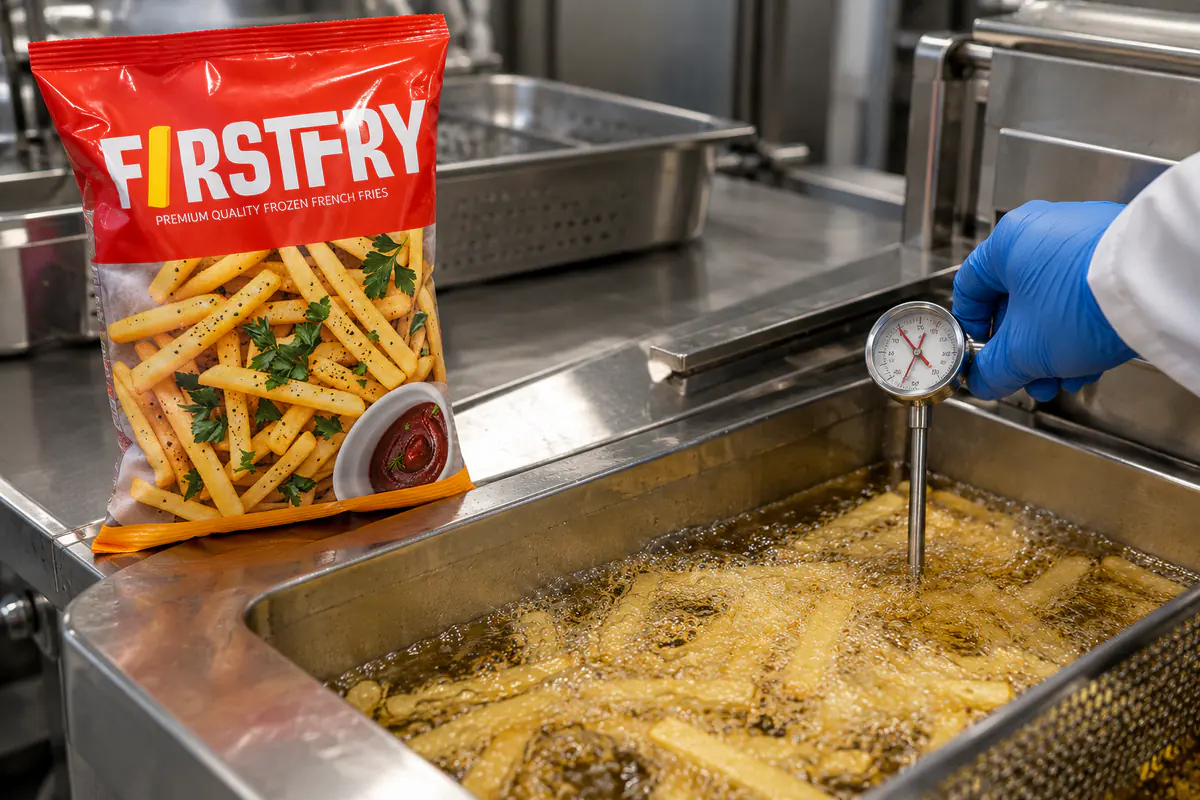
Fry frozen fries at 175 to 180C, never below 170C. Keep the product-to-oil ratio light, roughly one part frozen fries to eight or ten parts oil by weight, so the temperature does not crash when the basket goes in. Filter daily, skim debris between batches, and top up rather than only replacing. Discard oil when it darkens, foams, smokes early or transfers off-flavours.
Published 2026-08-13 · FirstFry Export Desk · Foodservice performance
Oil is consumed twice
Operators tend to think of frying oil as a consumable that gets thrown away periodically. In practice it disappears through two separate routes, and the larger one is invisible.
The first is absorption. Oil enters the fry as water leaves it, and that oil is sold to the customer. It never returns to the vat. Depending on cut size and dry matter this can be a substantial share of your oil purchases.
The second is degradation. Heat, water, oxygen and food debris break oil down chemically until it colours product badly, foams, smokes at service temperature and transfers off-flavours. At that point it must be discarded regardless of how much is left.
Good management reduces both: less absorbed per portion, and more portions per litre before discard. How oil enters cost per portion puts the figure into a food-cost calculation.
Temperature is the master control
Frozen fries should be fried at 175 to 180C. This is not a comfort range; it is the point where the physics works in your favour.
At correct temperature, water at the fry's surface flashes to steam immediately and the outward pressure of that steam actively resists oil entering. The shell sets fast and the fry crisps before much oil can penetrate. Drop below about 170C and the steam pressure weakens, so oil moves in freely. The fry comes out greasy, pale and limp, and you have paid for the oil now sitting inside it.
| Oil temperature | Oil uptake | Texture | Oil life |
|---|---|---|---|
| Below 160C | Very high | Greasy, pale, limp | Poor - long contact time degrades oil |
| 160-170C | High | Soft shell, uneven colour | Below average |
| 175-180C | Controlled | Crisp shell, dry centre | Best |
| Above 190C | Lower briefly | Dark outside, undercooked inside | Poor - accelerates breakdown |
Running hotter is not the answer either. Above about 190C the oil itself degrades faster, the fry colours before the centre cooks, and you shorten oil life to buy a marginal reduction in uptake.
Basket loading and recovery time
The most common cause of frying below temperature is not a badly set thermostat. It is an overloaded basket.
Frozen product at -18C entering hot oil pulls an enormous amount of heat out of the vat. Load too much and the oil temperature crashes, then takes minutes to recover - during which everything in the basket is frying in the greasy sub-170C range described above.
A working guide is one part frozen product to eight or ten parts oil by weight. A 15 litre vat therefore handles roughly 1.5kg of frozen fries per basket, not the 3kg that physically fits. Watch the recovery: if the thermostat takes more than a minute or so to climb back, the load is too heavy.
Water is the biggest enemy
Water drives hydrolysis, which splits oil into free fatty acids and lowers its smoke point. Every source of water in a fryer shortens oil life measurably.
- Thawed or partly thawed product. Fry from frozen, always. Thawed fries carry free surface water straight into the vat
- Ice crystals on the product. Shake bags before loading rather than tipping frost in
- Wet baskets after cleaning. Dry thoroughly before returning to service
- Condensation from covering a hot vat. Cover only once cooled
- Steam from adjacent equipment. Keep fryers away from steamers and dishwashers where possible
Frying from frozen also matters for the product. Thawed fries absorb far more oil, cook limp, and spit dangerously as free water hits hot oil.
Filtering, skimming and topping up
Food debris in oil acts as a catalyst for breakdown. Small fragments and slivers burn, carbonise, and accelerate degradation of everything around them, as well as sticking to product and colouring it unevenly.
- Skim between batchesA quick pass with a skimmer removes floating debris before it carbonises.
- Filter at least dailyMore often in high-volume operations. Filtering is the single highest-return oil practice available.
- Clean the vat when filteringWipe carbon off the vat walls and elements; leaving it seeds degradation in the fresh oil.
- Top up daily with fresh oilContinuous replenishment dilutes degradation products and materially extends the life of the whole vat.
- Cover when offOnce cooled, covering limits oxygen contact overnight.
A useful upstream control is the short-piece tolerance in your fry specification. Slivers and fragments are the debris that fouls oil fastest, so a product with tight length screening quietly extends oil life.
Knowing when to discard
Discard decisions made on a fixed calendar are usually wrong in both directions - throwing away serviceable oil in a quiet week, and running degraded oil through a busy one.
| Sign | What it indicates |
|---|---|
| Dark colour, syrupy movement | Advanced polymerisation |
| Persistent foaming at the surface | Breakdown products acting as surfactants |
| Smoking below normal frying temperature | Smoke point has dropped through hydrolysis |
| Product darkens too fast | Sugars and debris accumulated in the oil |
| Off-flavours transferring to product | Oxidation - the point at which customers notice |
| Excess foam on loading | Free fatty acid build-up |
Many jurisdictions regulate frying-oil degradation, commonly via a total polar materials limit measured with a handheld tester. Where that applies it gives an objective threshold rather than a judgement call, and a tester pays for itself quickly by preventing premature discard as much as by catching late discard.
Finally, remember the fry arrives carrying 4 to 8 percent oil from par-frying already. That oil enters your vat as product cooks, so the quality of the supplier's frying oil becomes part of your oil's chemistry - a reason to ask what they fry in. See the oil already in the fry from par-frying.
Frequently asked questions
What temperature should frozen fries be fried at?
175 to 180C, and never below 170C. At correct temperature, surface water flashes to steam and its outward pressure resists oil entering the fry. Below 170C that resistance weakens, oil moves in freely, and the result is a greasy, pale, limp fry that has absorbed oil you paid for.
How much product can I put in a fryer basket?
Roughly one part frozen product to eight or ten parts oil by weight, so about 1.5kg of fries in a 15 litre vat. Overloading crashes the oil temperature and everything fries in the greasy sub-170C range while it recovers, which reduces both quality and effective throughput.
How often should fryer oil be filtered?
At least daily, and more often in high-volume operations, with skimming between batches. Food debris carbonises and catalyses oil breakdown, so removing it is the highest-return oil practice available. Clean carbon off the vat walls when filtering, or it seeds degradation in the fresh oil.
When should fryer oil be changed?
On evidence rather than a fixed calendar. Discard when the oil darkens and moves syrupily, foams persistently, smokes below normal frying temperature, colours product too quickly, or transfers off-flavours. Where regulations set a total polar materials limit, a handheld tester gives an objective threshold.
Why should frozen fries never be thawed before frying?
Thawed fries carry free surface water into the oil, which drives hydrolysis and shortens oil life, causes dangerous spitting, and results in far higher oil absorption and a limp texture. The fry is designed to go from freezer to basket, and its par-fried shell depends on that thermal shock.
Ask what we fry in
The oil used at par-fry becomes part of your vat's chemistry. Email the export desk for our frying medium, oil-uptake figures and the short-piece tolerance that keeps debris out of your fryer.
Email BuyFry@FirstFryFoods.com or request a quote. The export desk replies within one business day.