Frozen Hash Browns for Foodservice: Formats, Cooking and Holding
Frozen hash browns for foodservice come in two practical formats: the oval, which is the volume breakfast piece, and the triangle, which is portion-consistent and stacks flat for buffets. Both are shredded par-fried potato, cooked from frozen in roughly two and a half to three minutes at 175°C, or twelve to fifteen minutes in a convection oven. The variables that decide performance on a line are piece weight, solids content, whether the piece is held on a rack or a solid tray, and how long it sits before service.
Published 2026-08-21 · FirstFry Export Desk · Foodservice performance
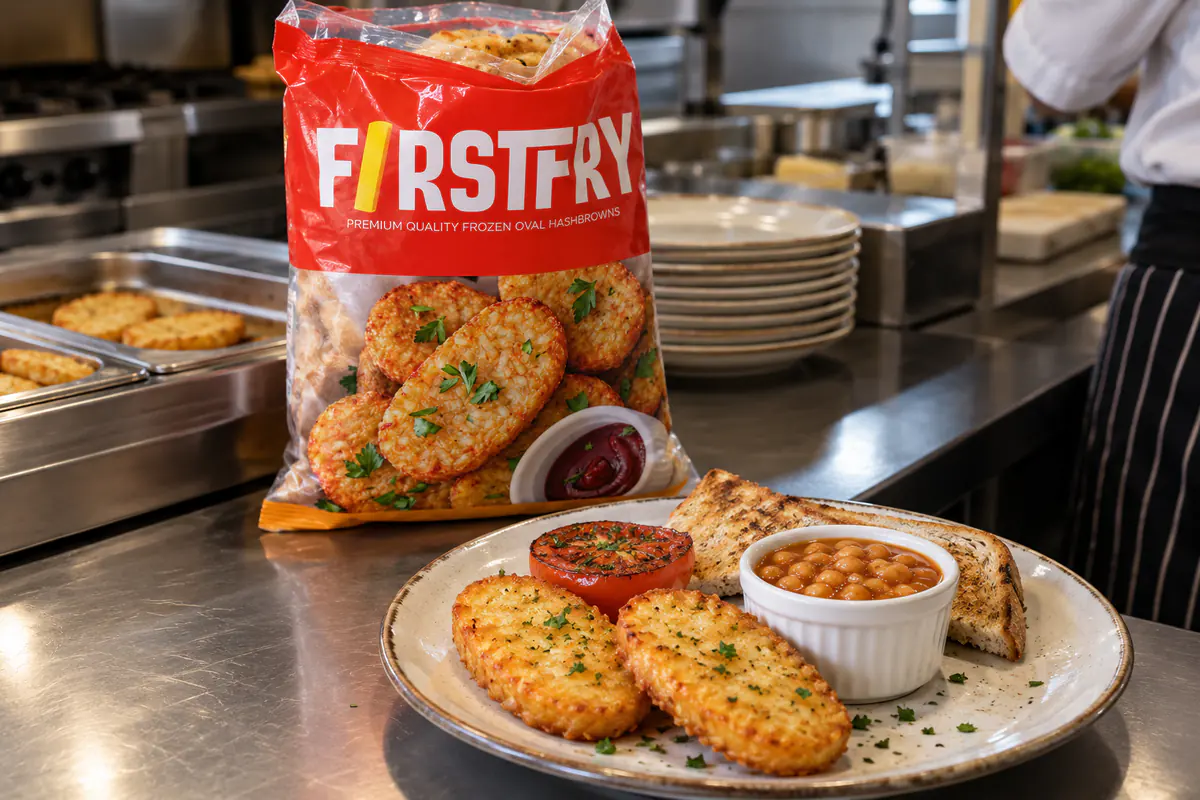
A hash brown is a harder product to serve well than a fry. A fry is cut potato; a hash brown is shredded potato held together by its own starch and a light binder, formed under pressure and par-fried so the outside sets. That structure is what gives it the shaggy, crisp edge people order it for, and it is also what makes it fragile. Handle it warm and it breaks. Stack it hot and it steams. Hold it on a solid surface and the base goes soft while the top still looks perfect.
For a buyer the practical question is not which hash brown is best in the abstract. It is which format suits the service you actually run, and what to write into the specification so every delivery behaves the same way.
Oval or triangle
The two formats are the same build in different shapes, and the choice is operational rather than culinary.
| Oval | Triangle | |
|---|---|---|
| Typical piece weight | 55–65 g | 60–70 g |
| Portion control | Good — pieces vary slightly | Exact — one piece is one portion |
| Plating | Reads as classic breakfast | Flat faces, sits square on a plate |
| Buffet behaviour | Rolls and settles in a gastronorm | Stacks and stays where placed |
| Fryer density | Rounder, needs more basket space | Flat, packs tighter per load |
| Best fit | QSR breakfast, hotel à la carte | Buffets, airline and institutional catering |
Hotels running a breakfast buffet usually settle on triangles, because a chafing dish of them looks deliberate and the food cost per cover stops drifting. QSR breakfast menus almost always specify ovals, because that is the shape the category has trained customers to expect and swapping it generates comment.
What to specify when you buy
Most hash brown complaints trace back to a specification that never mentioned the thing that failed. Four fields carry the weight.
- Piece weight and count per kilo. This is the number your food cost is built on. Ask for the target and the tolerance, not just the target.
- Solids content of the raw potato. Higher solids means less water to drive off, a crisper edge and less oil pickup. It is the single strongest predictor of how a hash brown eats.
- Shred size. A coarse shred gives the ragged, crisp exterior most buyers want. A fine shred eats denser and closer to a croquette.
- Par-fry level. A heavier par-fry sets the outside harder and survives handling better, at the cost of some oil already in the product.
Cooking from frozen
Cook from frozen, always. A thawed hash brown has released water into its own structure; it absorbs oil, loses the edge crisp and frequently breaks up in the basket. There is no operational upside to thawing and several ways it goes wrong.
| Method | Setting | Time from frozen | Notes |
|---|---|---|---|
| Deep fry | 175°C | 2.5–3 min | Single layer, half-full basket, no crowding |
| Convection oven | 200–210°C | 12–15 min | Turn once at the halfway point for even colour |
| Air fryer | 190–200°C | 10–14 min | Space the pieces; overlapping fuses the edges |
| Flat-top griddle | Medium-high, light oil | 4–6 min a side | Good for à la carte, impractical at volume |
Basket load matters more than the dial. A fryer that recovers to temperature in twenty seconds with a half load may take ninety with a full one, and every second of that is the product sitting in oil below frying temperature, absorbing rather than crisping. Two half loads beat one full load on both quality and, usually, total time.
Holding: the part that actually decides the guest experience
A hash brown out of the fryer is excellent for about ninety seconds and then begins a slow decline that the operator controls almost entirely. The enemy is its own steam.
- Hold on a rack. Air underneath lets steam escape. A solid tray traps it and the base goes soft in minutes while the top still looks crisp.
- Do not cover. A lid turns a holding cabinet into a steamer.
- Do not stack. Weight compresses the shred structure and the piece never recovers.
- Set a discard time and keep it. Twenty to thirty minutes is realistic under a lamp on a rack. An hour is not.
For a buffet the practical arrangement is a perforated gastronorm over an empty one, changed on a timer rather than when it looks empty. Topping up a tray that has been sitting mixes fresh product into stale and moves the whole batch to the age of the oldest piece in it.
Storage and cold chain
Hash browns are less forgiving of temperature swings than fries because the shred structure holds more surface water. A partial thaw and refreeze shows up as ice crystals inside the piece, and after cooking as a wet centre with a crisp shell. Keep stock sealed at -18°C, rotate strictly, and never refreeze anything that has softened.
If a delivery arrives with soft or clumped bags, photograph them before they go into the freezer. Clumping is the clearest visual evidence of a cold-chain break in transit, and it is a great deal easier to raise with the supplier on day one than after the stock has been consumed.
Frequently asked questions
How long do frozen hash browns take to cook?
Roughly 2.5 to 3 minutes deep fried at 175°C from frozen, or 12 to 15 minutes in a convection oven at 200–210°C. Fryer recovery and basket load shift this significantly, so run a timed batch test on your own equipment rather than adopting a supplier figure.
Should I choose oval or triangle hash browns?
Triangles for buffets and institutional catering, where fixed portion weight and flat stacking matter. Ovals for QSR breakfast and hotel à la carte, where the shape is what customers expect. The product inside is the same shredded par-fried potato.
Why do hash browns go soft under a heat lamp?
Their own steam. Held on a solid tray, moisture cannot escape from underneath and the base softens within minutes. A perforated tray or rack extends usable holding time to roughly 20–30 minutes.
Can hash browns be cooked from thawed?
They can, but they should not be. A thawed piece absorbs oil, loses its edge crisp and often breaks apart in the basket. Cooking from frozen is a requirement of the format, not a preference.
Adding hash browns to a breakfast line?
Tell us your format, target piece weight and monthly volume and we will send the specification, a cooking guide sized to your equipment, and a sample for your own line trial.
Email BuyFry@FirstFryFoods.com or request a quote. The export desk replies within one business day.