Air Frying and Oven Baking Frozen Fries at Foodservice Volume
Air fryers and convection ovens cook frozen fries acceptably but not identically to deep frying: drier, firmer, less golden, with lower fat. They suit sites without extraction or gas, cloud kitchens with modest fry volume, and health-positioned menus. They do not suit high peak throughput, because usable capacity depends on single-layer surface area rather than basket volume.
Published 2026-08-14 · FirstFry Export Desk · Foodservice performance
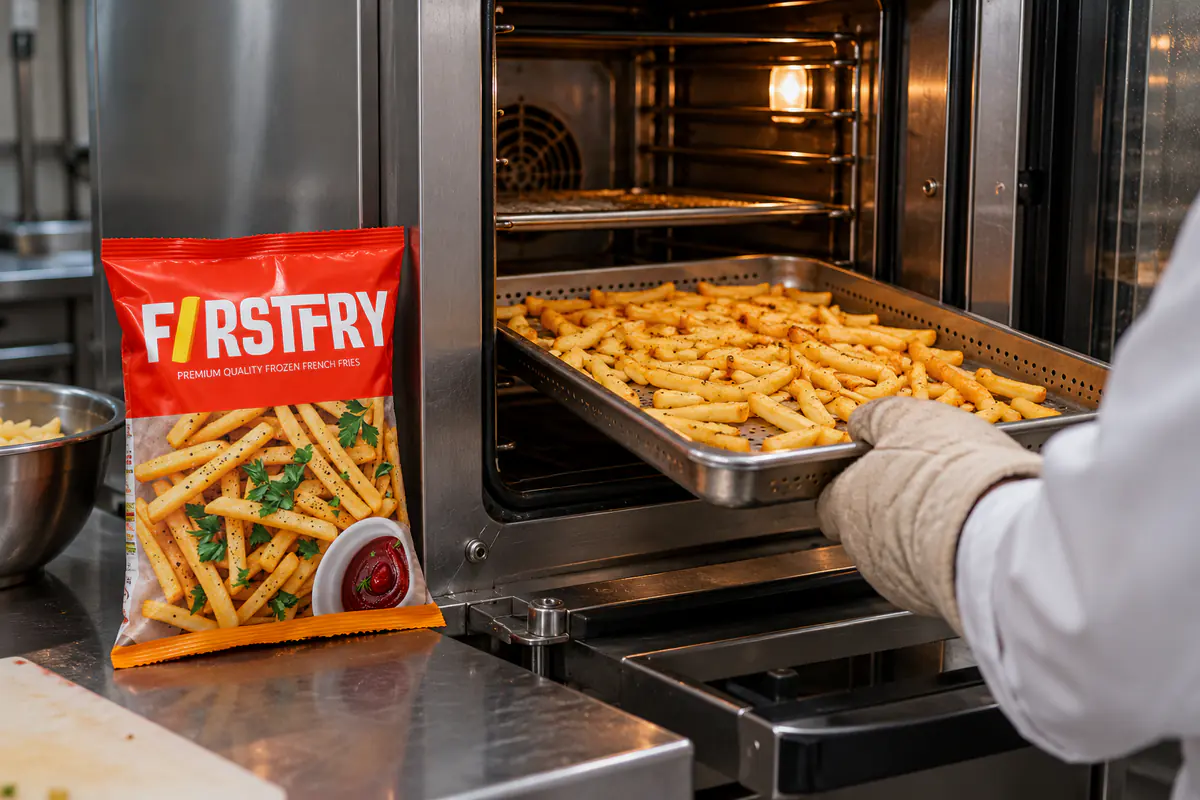
Why fries behave differently without oil
Deep frying transfers heat through hot oil in direct contact with every surface of the fry. It is fast, even and efficient, and the oil itself contributes to the crisp shell and to mouthfeel.
Air frying and oven baking transfer heat through moving hot air, which is a far less efficient conductor. The fry takes longer to reach the same surface temperature, so more water leaves before the shell sets. The result is drier, firmer and less golden - a good fry by its own standards, but recognisably not a deep-fried one.
This matters most for uncoated products. A clear coat is formulated to set in hot oil, and in an air fryer it can end up tough rather than crisp. Some coatings handle dry heat well and some do not, so it is worth testing rather than assuming. Why coating behaves differently without oil covers the interaction.
The throughput problem
This is where most operators are caught out. A deep fryer's capacity is a volume: fries fill the basket and oil surrounds them from every direction. An air fryer or oven's capacity is an area, because fries must sit in a single layer for the air to reach them.
Pile fries two or three deep in an air fryer and the middle ones steam rather than crisp. So a 10 litre air fryer does not hold anything like 10 litres of fries in practice - it holds one layer across its basket floor.
| Method | Typical batch | Cycle time | Batches per hour | Approx. portions per hour |
|---|---|---|---|---|
| Twin-basket deep fryer | 1.5kg per basket | 3-4 min | About 15-18 per basket | High |
| Commercial air fryer | 0.8-1.2kg single layer | 10-14 min | About 4-5 | Low to moderate |
| Convection oven, 4 trays | 2-3kg across trays | 15-20 min | About 3 | Moderate |
| Combi oven, dry mode | 2-3kg across trays | 15-20 min | About 3 | Moderate |
The practical reading: an oven can match a fryer on total volume over a shift, but not on peak-hour responsiveness, because a 15 to 20 minute cycle cannot react to a rush. Kitchens without fryers usually need to cook to a forecast and hold, which pushes them back into the holding-time problem.
Where these methods genuinely win
There are situations where an air fryer or oven is the right answer rather than a compromise.
- No extraction or gas. Many small units, food halls and shopping-centre kiosks cannot install a fryer canopy. An air fryer needs neither
- Cloud kitchens with modest fry volume. Where fries accompany a main rather than driving sales, a fryer's oil handling may not be worth it
- Health-positioned menus. Air-fried fries carry meaningfully less fat, and that is a legitimate menu claim
- Sites without oil disposal. Waste oil collection is a real constraint in some locations
- Low-skill or unmanned operations. No hot oil means a materially lower risk profile and simpler training
Fat reduction is the most commercially useful of these. Because no additional oil is absorbed during cooking, an air-fried portion carries only the 4 to 8 percent deposited during par-frying at the factory, rather than the 12 to 15 percent total typical of a deep-fried portion.
Getting the best result without a fryer
Technique matters more here than in deep frying, where the oil is forgiving.
| Cut | Dry-heat performance | Why |
|---|---|---|
| 6-7mm thin | Poor | Dehydrates through, eats brittle rather than crisp |
| 9mm regular | Fair | Workable, needs a light oil spray for colour |
| 10mm crinkle | Good | Ridges increase surface for air contact, mass holds the centre moist |
| 11-13mm steak | Good | Holds interior moisture while the surface dries |
| Skin-on wedge | Very good | Skin gives structure, mass resists drying out |
- Preheat fullyA cold cavity means the fries dehydrate before the surface sets. Preheat to 200-220C and let it stabilise.
- Single layer, alwaysOverlapping fries steam each other. This is the rule that decides the outcome.
- Use a perforated tray or basketAir must reach the underside. A solid tray gives one crisp side and one soft one.
- Add a light oil spray if permittedA few grams per kilo improves colour and crispness considerably without approaching fried fat levels.
- Shake or turn at the halfway pointNon-negotiable in an air fryer, strongly advised in an oven.
- Serve immediatelyAir-fried fries have a shorter holding window than deep-fried, because the shell is thinner and drier.
Cut choice also shifts. Thicker and ridged cuts do better in dry heat because they hold interior moisture while the surface dries, so they finish crisp outside and fluffy inside. Thin cuts tend to dehydrate all the way through and eat brittle. Crinkle cut, which air-fries well is a reliable starting point.
A realistic recommendation
If fries are a significant share of your sales and you have peaks, buy a deep fryer. Nothing else matches it for responsiveness, and the arithmetic on portions per hour is not close.
If fries are a side item, your volume is steady rather than peaky, or your site cannot support a fryer, air frying is a sound choice - provided you select a thicker cut, test the coating in dry heat, and size your equipment on single-layer area rather than on the manufacturer's stated capacity.
Either way, ask for samples and test in your own equipment before committing. Specifications for cuts suitable for oven and air-fry preparation include the formats that behave best without oil.
Frequently asked questions
Can you air fry frozen french fries in a commercial kitchen?
Yes, and the result is acceptable, though drier, firmer and less golden than deep frying. The main constraint is throughput: fries must sit in a single layer for air to reach them, so capacity is set by basket floor area rather than volume, and cycles run 10 to 14 minutes.
How much less fat do air-fried frozen fries contain?
Meaningfully less. A deep-fried portion typically carries 12 to 15 percent total fat, while an air-fried portion carries only the 4 to 8 percent deposited during par-frying at the factory, since no further oil is absorbed during cooking beyond any light spray applied.
Which fry cut works best in an air fryer?
Thicker and ridged cuts such as 10mm crinkle or skin-on wedges. They hold interior moisture while the surface dries, finishing crisp outside and fluffy inside. Thin cuts tend to dehydrate all the way through in dry heat and eat brittle rather than crisp.
Can a convection oven replace a deep fryer for fries?
For total volume across a shift, often yes. For peak-hour responsiveness, no. A 15 to 20 minute oven cycle cannot react to a rush, so kitchens without fryers have to cook to a forecast and hold, which reintroduces the holding-time and waste problems a fryer avoids.
Do coated fries work in an air fryer?
Sometimes. Clear coats are formulated to set in hot oil, and in dry heat some finish tough rather than crisp. Coating behaviour varies by formulation, so test the specific product in your own equipment rather than assuming a coated fry will outperform an uncoated one without a fryer.
Testing without a fryer?
Tell us your equipment and we will recommend cuts and coatings that perform in dry heat, and send samples so you can measure single-layer capacity and cycle time on your own kit before committing.
Email BuyFry@FirstFryFoods.com or request a quote. The export desk replies within one business day.