Private Label and OEM Frozen Fry Production: How It Actually Works
Private label frozen fry production means a manufacturer produces to an agreed specification and packs it in your brand's printed film. The product itself is usually standard; what you are really commissioning is packaging, artwork approval and label compliance. That is why minimum order quantities are driven by the printed film rather than by the fryer, and why artwork and market-specific label compliance sit on the critical path, not after the order.
Published 2026-07-06, updated 2026-07-31 · FirstFry Export Desk · Private label & OEM
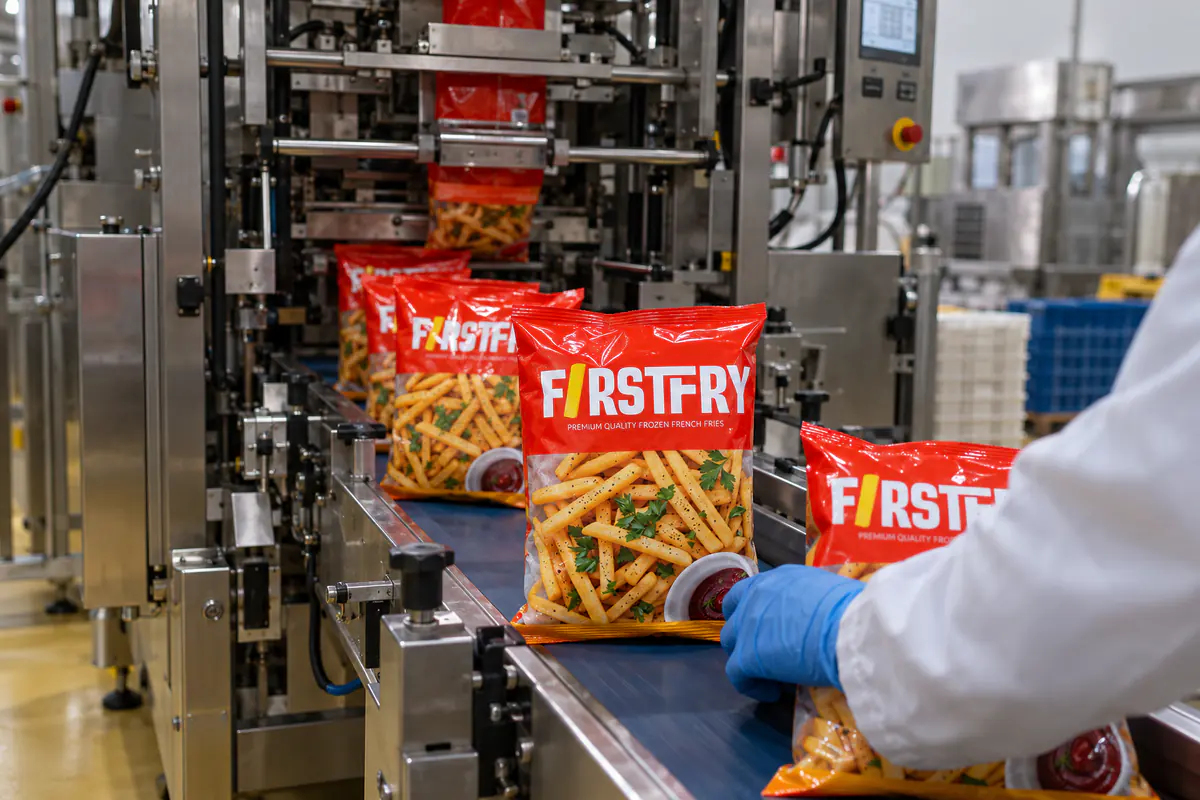
Private label is the most commonly requested and least well understood commercial structure in frozen potato products. Distributors ask for it expecting a pricing conversation. It is actually a packaging, compliance and liability conversation, and the pricing follows from those three.
This guide covers the whole structure: what is genuinely customisable, what sets the minimum order, how artwork approval works, what the lead times really are, where the cost sits, and when private label is the wrong answer for your business.
Before artwork, settle the product itself. Reading a frozen fry specification field by field covers the rows that decide performance, and air frying and oven baking at volume matters if your buyers cook without a deep fryer.
What private label means in this category
There are three distinct arrangements, and buyers routinely use one word for all of them. Getting the vocabulary right is the first step, because they have different MOQs, different lead times and different prices.
| Model | What varies | Typical commitment |
|---|---|---|
| Your brand, standard specification | Packaging and artwork only | Lowest — film minimum is the binding constraint |
| Your brand, adjusted specification | Cut, coating, seasoning or pack format, plus packaging | Higher — trial production and approval add time and volume |
| Full contract manufacture | Recipe, process parameters, dedicated formats | Highest — line time, development and often exclusivity terms |
The overwhelming majority of first private label programmes are the first row: a standard product, in your bag. That is not a lesser option — it is the sensible one. The product is proven, the specification is already documented, and the only new variable is packaging.
What is actually customisable
A frozen fry line is less flexible than buyers expect in some places and more flexible than they expect in others.
| Element | How customisable | Why |
|---|---|---|
| Printed artwork and brand | Fully | This is what private label is |
| Pack weight | Within the packing machine's format range | Format changes need machine setup, sometimes tooling |
| Carton configuration | Fairly | Carton print and case count are straightforward |
| Cut size | Standard sizes available; new sizes are a spec project | Cutting is tooling-dependent |
| Coating and seasoning | Possible; adds development and trial volume | Ingredient sourcing, trials and approval |
| Frying medium | Limited | The line runs one oil system at a time |
| Process parameters | Least — and correctly so | They are what makes the product perform consistently |
Why printed film decides your minimum order
This is the single most important mechanic in private label, and the one that surprises buyers most.
Standard product goes into standard packaging that the manufacturer already stocks and uses across many customers. Your product goes into film printed with your artwork, which is useful to precisely one customer. Printing has a minimum run — the plates, the setup and the press time do not scale down — so the film minimum, not the fryer, is what sets the floor on your order.
- Film is printed per SKU and per pack size. Three pack sizes is three film runs, not one
- Film is printed per language or market variant where labels differ
- Unused film is your cost, and it does not keep indefinitely
- A smaller first order usually means either a film minimum you exceed on paper, or plain film with a compliant applied label as an interim step
The practical consequence: narrow your opening SKU range hard. A first private label programme with two pack formats across two SKUs has four film runs behind it. The same volume in one SKU and one format has one. The detail of how those minimums work is in private label MOQ, artwork and lead time in detail, and the container-level arithmetic sits in container-level order volumes.
The artwork and approval flow
Artwork is not a design task with a compliance check at the end. It is a compliance task with design applied to it. Run it in this order and it is straightforward; run it backwards and you reprint film.
- 1. Confirm the destination label rulesMandatory declarations, language requirements, nutritional panel format and any market-specific statements. This defines the space your design has to work within.
- 2. Get the technical content from the manufacturerIngredient declaration with percentages, nutritional analysis, storage instructions, shelf life, preparation instructions, manufacturer identification and batch coding format.
- 3. Design to the confirmed contentYour designer places content that is already correct, rather than designing first and squeezing compliance in afterwards.
- 4. Compliance reviewYour importer or a label consultant reviews the artwork against destination rules — before anything is sent to a printer.
- 5. Registration, where requiredMany markets review label artwork as part of product registration, so this often runs concurrently with the regulatory filing rather than after it.
- 6. Print proof and sign-offA physical proof, checked against the approved artwork, signed by the brand owner. This is the last point at which a correction is cheap.
- 7. Film productionThe printer runs the film. From here, changes mean a reprint.
Notice that steps 1 and 2 can begin during supplier qualification, before an order exists. Programmes that start artwork after the order is placed are the ones that end up waiting on film while a production slot sits idle.
Realistic lead times
The single most useful thing to understand about private label timing is that the long items run in parallel, not in sequence — provided you start them together.
| Workstream | When it starts | Notes |
|---|---|---|
| Supplier qualification and samples | First | Product decision must precede artwork content |
| Destination label rules confirmed | Immediately, in parallel | Cheap, fast, and it constrains everything after it |
| Technical content from the manufacturer | In parallel | Specification, ingredients, nutrition, shelf life |
| Artwork design and compliance review | After content is confirmed | Iterations here are free; iterations after printing are not |
| Product registration in the destination | In parallel with artwork | Many markets review artwork as part of it |
| Film printing | After artwork sign-off | Has its own queue at the printer |
| Production slot | Booked against film availability | The line cannot run before the film arrives |
| Shipping | After production | The short, predictable part |
Read the table as a warning about one row: film printing has its own queue, at a supplier neither you nor your manufacturer fully controls. Build slack around it.
Where the cost actually sits
Private label is usually assumed to be cheaper. It often is, but not for the reason buyers give, and not on every line.
| Line | Direction | Why |
|---|---|---|
| Brand premium | Saves | You are not paying for someone else's marketing |
| Printed film | Adds | Plates, setup and minimum runs are yours |
| Artwork and compliance review | Adds | One-off per SKU per market, but real |
| Line changeover | Adds slightly | Format and film changes cost line time |
| Stock turns | Adds | You hold branded stock nobody else can sell |
| Margin capture | Saves | You own the customer relationship and the shelf price |
| Registration | Neutral to adds | Your brand is registered, not the manufacturer's existing one |
The honest summary: private label improves margin per kilo and worsens flexibility. If a SKU underperforms, branded stock is far harder to liquidate than a manufacturer-branded equivalent, because nobody else can sell your bag. Factor that into the opening range decision, not just into the price comparison in the nine factors behind landed cost.
Label compliance and who carries the liability
This is the part of private label that gets least attention and matters most.
In most markets, the party whose name appears on the pack as the brand owner carries responsibility for the accuracy of what the label says. The manufacturer is responsible for making the product to specification and for the facts it supplies. You are responsible for what you print.
- Get the ingredient declaration and nutritional analysis in writing from the manufacturer, and keep the version you printed from
- Have the artwork reviewed against destination rules by someone who knows that market
- Agree who signs off the final proof, and record it
- Establish how specification changes are notified, so a recipe change does not silently invalidate your printed label
- Confirm the batch coding and traceability format, because a recall runs on it
When private label is the wrong answer
A supplier telling you when not to buy their service is more useful than one who does not. Private label is a poor fit when:
- You are testing a market. Test with manufacturer-branded stock first. Learn what sells, then print film for the winner
- Your volume is below the film minimum and will stay there. You will carry dead film or overpay per kilo
- Your range is wide and shallow. Many SKUs at low volume each is the worst possible shape for a film-driven cost structure
- Your customer specifies a known brand. Some foodservice and retail buyers do, and private label removes the thing they are buying
- You cannot commit to repeat volume. The economics only work across repeat runs on the same film
The strongest sequence for most distributors is to open with manufacturer-branded product, prove the SKU mix in the market, then convert the proven lines to private label once the volume justifies the film.
How to start, concretely
- Decide the opening SKU range — narrower than instinct suggests, ideally one or two lines
- Fix the pack format before artwork, because format drives film size
- Ask the manufacturer for the technical content pack for those SKUs
- Confirm destination label rules in parallel
- Get a written film minimum and lead time from the manufacturer before designing
- Then, and only then, brief the designer
FirstFry manufactures in Morbi, Gujarat and runs private label alongside its own brand. Specifications for the full fry and specialty range are published, so the technical content behind step 3 is available before you commit to anything. Most private label programmes open with the standard 9mm cut, with crinkle-cut specification as the usual second line once the first has proved itself.
Frequently asked questions
What is private label frozen fry production?
A manufacturer produces to an agreed specification and packs the product in your brand's printed packaging. In most cases the product itself is the manufacturer's standard line; what you are commissioning is packaging, artwork and label compliance. Fuller arrangements — adjusted specifications or full contract manufacture — exist but carry higher minimums, longer lead times and development cost.
Why is the minimum order quantity higher for private label?
Because printed film sets the floor, not the production line. Film carrying your artwork is useful to one customer only, and printing has minimum run lengths since plates, setup and press time do not scale down. Film is printed per SKU and per pack size, so a programme with two SKUs in two formats has four film runs behind it.
How long does a private label programme take to launch?
It depends less on total duration than on whether the long items run in parallel. Destination label rules, the manufacturer's technical content pack and product registration can all start during supplier qualification. Artwork follows confirmed content, film printing follows artwork sign-off and has its own queue at the printer, and the production slot is booked against film availability.
Who is liable for what a private label pack says?
In most markets the brand owner whose name appears on the pack carries responsibility for the accuracy of the label. The manufacturer is responsible for producing to specification and for the technical facts it supplies. Get the ingredient declaration and nutritional analysis in writing, keep the version you printed from, and agree how specification changes are notified.
Is private label cheaper than buying a manufacturer's brand?
It usually improves margin per kilo and always reduces flexibility. You save the brand premium and capture the customer relationship, but you pay for plates, film minimums, artwork, compliance review, changeovers and slower stock turns — and branded stock that underperforms is far harder to liquidate, because nobody else can sell your bag.
When should a distributor not use private label?
When testing a new market, when volume sits below the film minimum and will stay there, when the range is wide and shallow, when the end customer specifically wants a known brand, or when repeat volume cannot be committed. The usual best sequence is to open with manufacturer-branded stock, prove the SKU mix, then convert the winners to private label.
Considering your own brand?
Tell us the SKUs, pack format and destination market you have in mind and we will send the film minimum, the technical content pack your artwork needs, and an honest view on whether private label or manufacturer-branded stock is the better opening move for your volume.
Email BuyFry@FirstFryFoods.com or request a quote. The export desk replies within one business day.