Own Brand vs Private Label for Frozen Fry Distributors: The Margin Comparison
Private label improves margin per kilo and reduces flexibility. A manufacturer-branded case can be sold to anyone; a case in your own bag can only be sold by you. The comparison that matters is therefore not gross margin but margin weighed against inventory risk, working capital tied up in printed film and finished stock, and how quickly a SKU that underperforms can be liquidated.
Published 2026-07-29, updated 2026-07-31 · FirstFry Export Desk · Private label & OEM
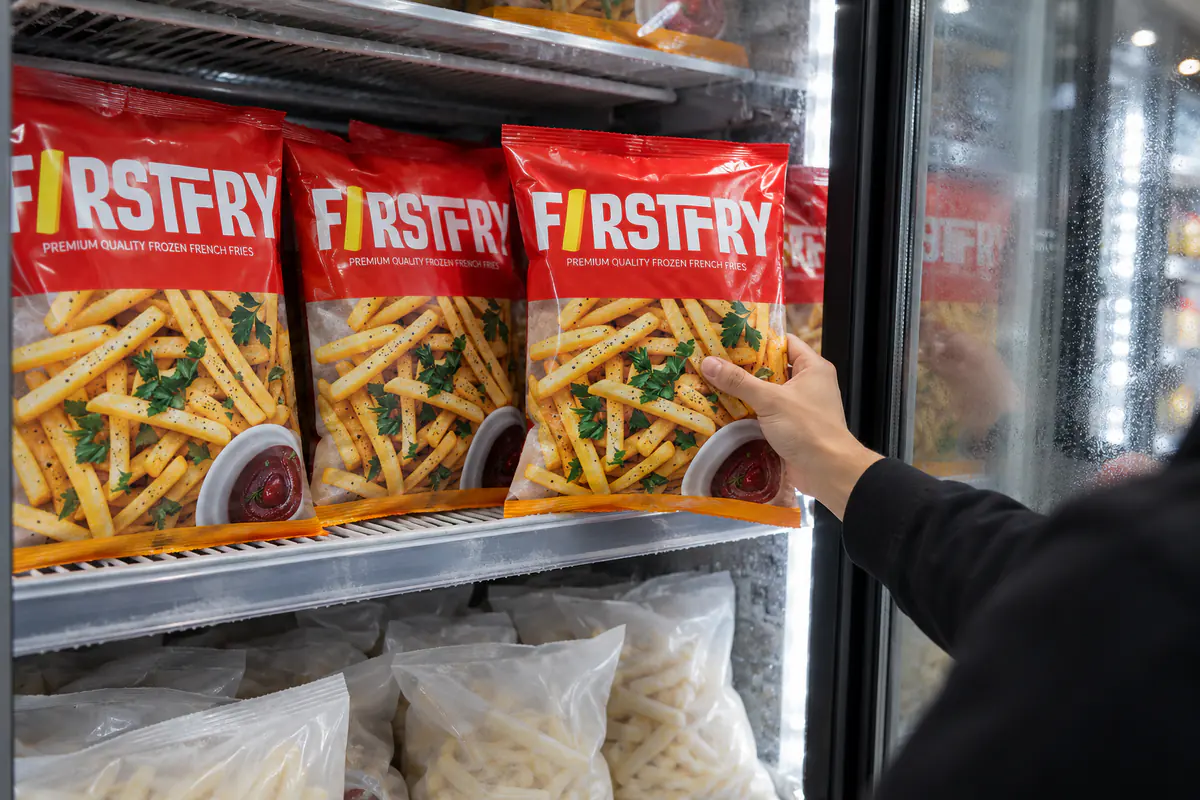
Distributors usually frame this as a margin question and answer it with a margin calculation. That calculation is not wrong, it is just incomplete: it prices the upside and ignores the thing that actually goes wrong.
One specification decision carries more weight than most brand choices: whether the fry is coated. It roughly triples holding time and decides whether your product survives delivery, at a modest cost per kilo - coated versus uncoated frozen fries covers the trade-off.
The margin side, done properly
Private label captures the brand premium you would otherwise pay a manufacturer, and it lets you set the shelf or contract price without a reference product sitting alongside it. Against that, it adds fixed costs that manufacturer-branded stock does not carry.
| Line | Own brand / private label | Manufacturer brand |
|---|---|---|
| Brand premium in the purchase price | Not paid | Paid |
| Printed film — plates, setup, minimum run | Your cost | None |
| Artwork and compliance review | Your cost, per SKU per market | None |
| Product registration | Registered in your brand | May already be registered |
| Line changeover | Slightly higher | Standard |
| Price control | Yours | Constrained by the brand's other buyers |
| Margin per kilo | Higher | Lower |
For a programme with genuine repeat volume, that table usually favours private label. The fixed costs amortise, the premium is captured, and the distributor owns the customer relationship rather than renting it. The per-kilo drivers underneath are in price-per-kg cost drivers.
The side the margin calculation misses
Now consider what happens when a SKU does not perform. This is not an edge case — it is the normal outcome for at least one line in any new range.
| Option | Manufacturer brand | Your own brand |
|---|---|---|
| Sell to another distributor | Straightforward | They cannot sell your brand |
| Move it to another market | Usually possible | Only if the label is compliant there |
| Discount into a different channel | Normal | Damages your own brand's price position |
| Return or exchange with the supplier | Sometimes negotiable | Effectively impossible — it is your packaging |
| Sell as unbranded or repack | Possible | Requires repacking cost and may not be permitted |
Working capital, which decides it for most distributors
Private label ties up cash in two places a manufacturer-branded programme does not: printed film held ahead of production, and finished stock that only you can sell. Both sit on your balance sheet for longer than the branded equivalent.
- Film is bought ahead and in minimum runs, so cash is committed before any product exists
- Unused film has no resale value and does not keep indefinitely
- Finished branded stock turns more slowly because the buyer universe is narrower
- Safety stock must be higher, because you cannot buy a competitor's equivalent to cover a gap
- Each additional market variant multiplies the film commitment — see film minimums and the approval gates
When each one is right
| Your situation | Choose | Because |
|---|---|---|
| Testing a new market | Manufacturer brand | You do not yet know which SKU sells |
| Proven repeat volume on a known SKU | Private label | Fixed costs amortise; premium is captured |
| Wide, shallow range | Manufacturer brand | Film cost per SKU is punishing at low volume |
| Narrow range, deep volume | Private label | The best possible shape for film economics |
| Customer specifies a known brand | Manufacturer brand | The brand is what they are buying |
| Building a defensible distribution business | Private label, eventually | You own the customer, not the manufacturer |
| Cash-constrained | Manufacturer brand | No film commitment ahead of sales |
The sequence that de-risks it
The strongest pattern is not choosing one — it is ordering them correctly.
- Open with manufacturer-branded stock across a slightly wider range than you expect to keep
- Let the market select — after two or three cycles you will know which one or two SKUs carry the volume
- Convert the winner to private label in a single pack format for a single market
- Keep the tail manufacturer-branded, so slow lines stay liquid
- Add a second private label SKU only when the first film run is consumed at a forecastable rate
- Add a second market variant only when the first market's volume justifies the second film run
This sequence costs a little margin in the first year and removes almost all of the inventory risk that kills first private label programmes. The mechanics of the conversion step are in the private label and OEM hub.
How we work with both
FirstFry supplies manufacturer-branded product and runs private label on the same lines, which means the transition above does not require changing supplier. A distributor can open with our brand, prove the range, and convert the proven SKU to their own film without re-qualifying the product or re-testing the specification. Specifications covering cut sizes, coatings and pack formats are published, and the SKU that most often survives the selection process is plain 9mm fries.
Frequently asked questions
Is private label more profitable than selling a manufacturer's brand?
Per kilo, usually yes — you capture the brand premium and control the price. But the comparison is incomplete without inventory risk. Private label stock is illiquid because nobody else can sell product in your bag, and printed film ties up cash before any product exists. Margin improves; flexibility falls.
What is the real risk of private label for a distributor?
Illiquidity. If a SKU underperforms, manufacturer-branded stock can be sold to another distributor, moved to another market or discounted into a different channel. Your own branded stock can do none of those without damaging your price position or repacking, and it cannot realistically be returned because the packaging is yours.
When should a distributor stay on the manufacturer's brand?
When testing a new market, when the range is wide and shallow, when the end customer specifically wants a known brand, or when cash is constrained and committing to printed film ahead of sales is not sensible. All four are situations where flexibility is worth more than margin per kilo.
What is the safest way to move into private label?
Sequence it. Open with manufacturer-branded stock across a slightly wider range, let two or three sales cycles show which SKUs carry the volume, then convert only the proven winner to private label in one pack format for one market. Keep the slow lines manufacturer-branded so they stay liquid.
How does working capital differ between the two?
Private label commits cash earlier and holds it longer. Film is bought ahead in minimum runs with no resale value, finished branded stock turns more slowly because the buyer universe is narrower, and safety stock must be higher because you cannot cover a gap with a competitor's equivalent product.
Deciding between the two?
Tell us your target market, expected annual volume and how many SKUs you are considering, and we will send the film minimum for your pack format alongside manufacturer-branded pricing — so you can compare both routes on the same numbers before committing to either.
Email BuyFry@FirstFryFoods.com or request a quote. The export desk replies within one business day.