Private Label Frozen Fries: MOQ, Artwork, Lead Time and Approval Flow
In a private label frozen fry programme the minimum order quantity is set by printed packaging film, not by the production line. Film is printed per SKU and per pack size in minimum run lengths, so the number of distinct bags you commission — not the total tonnage — is what drives the commitment. Artwork must be compliance-checked before printing, since a corrected label after film production means a reprint at your cost.
Published 2026-07-08, updated 2026-07-31 · FirstFry Export Desk · Private label & OEM
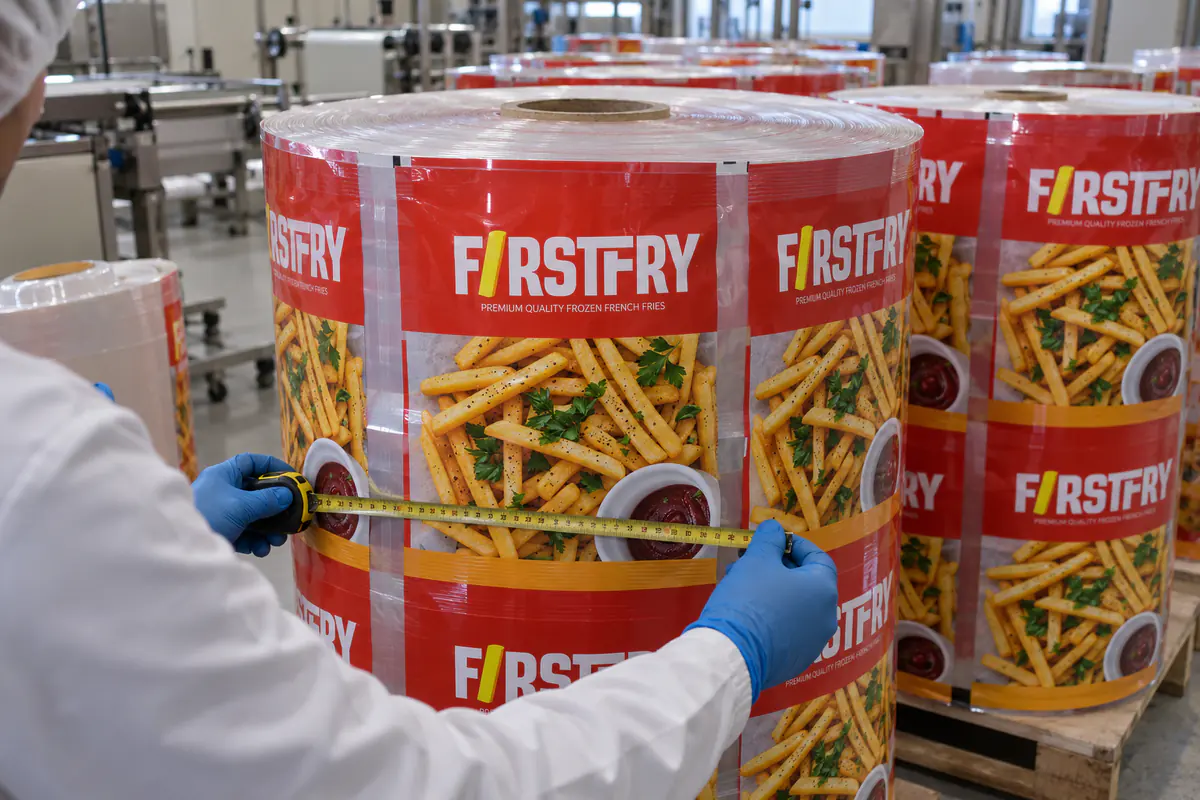
The structural picture is in how private label and OEM production works. This is the operational half: how the minimum is actually calculated, what a printer needs from your designer, where the approval gates sit and what to put in the purchase agreement.
How a film minimum becomes a bag count
Packaging film is bought by weight or length, not by bag. The conversion from a film minimum to a number of bags — and therefore to tonnes of fries — depends on your pack size, and it is worth doing yourself rather than accepting a headline number.
| Pack size | Bags from a given film run | Product volume that represents |
|---|---|---|
| 2.5 kg foodservice bag | Fewer bags — more film per bag | Lower bag count, high tonnage per bag |
| 1 kg retail bag | More bags from the same film | Higher bag count, lower tonnage per bag |
| 750 g retail bag | More bags again | Highest bag count for the same film |
The consequence is counter-intuitive and it catches retail-focused buyers repeatedly: a smaller pack size does not mean a smaller commitment. A film run that yields a manageable number of 2.5 kg foodservice bags can yield an unsellable quantity of 750 g retail bags for a new brand. Do this arithmetic before choosing the pack format.
The multiplier nobody budgets for
Every one of these creates a separate film run:
- Each SKU — straight-cut and crinkle-cut are two films
- Each pack size — 2.5 kg and 1 kg are two films
- Each market variant where label content or language differs
- Each brand if you run more than one
- Sometimes each carton print, though cartons are usually cheaper and more flexible than film
So a modest-sounding plan — two products, two pack sizes, two Gulf markets with different label requirements — is potentially eight film runs, not one programme. This is the single largest cause of private label programmes stalling after the enthusiasm of the first meeting.
| Opening plan | Film runs | Comment |
|---|---|---|
| 1 SKU, 1 pack size, 1 market | 1 | The sensible first programme |
| 2 SKUs, 1 pack size, 1 market | 2 | Reasonable if both lines are proven sellers |
| 1 SKU, 2 pack sizes, 1 market | 2 | Only if foodservice and retail are genuinely separate channels |
| 2 SKUs, 2 pack sizes, 1 market | 4 | Ambitious for a launch |
| 2 SKUs, 2 pack sizes, 2 markets | 8 | Almost always too much for a first programme |
What your designer actually has to deliver
Artwork for flexible packaging is not a graphics job with a print export at the end. Printers work to specific technical requirements, and a file that is beautiful but wrong costs a week.
Ask your manufacturer for the packaging supplier's specification before briefing a designer. It will typically define:
- The dieline — the exact flat shape, seal areas, gussets and where the print sits
- Bleed and safe areas — content near a seal or fold will be lost
- Colour system — the number of print colours available, and whether spot colours or process printing is used
- Minimum text size, particularly for the ingredient and nutritional panel
- Barcode placement, size and quiet zone, plus the barcode's verified accuracy
- Date and batch coding window — a clear area left blank for the coder on the line
- File format and resolution requirements, with fonts outlined
The approval gates, in order
- Gate 1 — Content approvalThe words and numbers, before any design. Ingredient declaration with percentages, nutritional analysis, net weight, storage and preparation instructions, shelf life, manufacturer identification, origin. Signed off by the brand owner against the manufacturer's written specification.
- Gate 2 — Compliance reviewApproved content checked against destination label rules by your importer or a label consultant. Cheapest possible moment to find a problem.
- Gate 3 — Design approvalLayout applied to approved, compliant content. Check that nothing was reworded during design — this is where accurate content quietly becomes inaccurate.
- Gate 4 — Prepress and dieline checkThe packaging supplier confirms the file is technically printable: dieline, bleed, colours, text sizes, barcode, coding window.
- Gate 5 — Print proof sign-offA physical proof checked against approved artwork and signed by the brand owner. The last cheap correction.
- Gate 6 — Film productionThe printer runs the film. From here a change is a reprint at your cost.
- Gate 7 — First-run pack inspectionCheck the first packed cases against the approved proof — coding legible, seals sound, barcode scanning, artwork registration correct.
Gate 3 is the one most often skipped and the most expensive to skip. Compliance-approved wording gets shortened to fit a layout, and nobody re-reviews it. Insist that the design output goes back past whoever did the compliance review.
Building a realistic timeline
Rather than quoting durations that vary by supplier and market, plan around dependencies. These run in parallel:
| Workstream | Depends on | Can start |
|---|---|---|
| Supplier qualification and samples | Nothing | Immediately |
| Destination label rules | Nothing | Immediately |
| Manufacturer technical content pack | SKU selection | As soon as SKUs are chosen |
| Product registration | Technical content | Alongside artwork |
| Artwork design | Approved content | After Gate 1 |
| Prepress | Approved design | After Gate 3 |
| Film printing | Proof sign-off | After Gate 5, then the printer's queue |
| Production slot | Film delivered to the plant | Book provisionally, confirm on film arrival |
| Shipping | Production complete | The predictable part |
Two scheduling rules follow. Book the production slot provisionally but confirm it against film arrival, because a slot held open with no film is a slot you may pay for. And build slack around the printer's queue — it is the only step where neither you nor your manufacturer controls the calendar.
What to put in the agreement
- The film minimum in bags at your pack size, and the tonnage it represents
- Who owns and stores unused film, and for how long it is held
- Artwork ownership and what happens to plates if the relationship ends
- The approval gate list and who signs at each
- Notification of specification changes, so a recipe change cannot silently invalidate a printed label
- Batch coding and traceability format, agreed before printing
- Responsibility for a reprint caused by an error at each gate
- Shelf-life and maximum age at loading, since branded stock is harder to redeploy
Point 5 matters more than it sounds. If the manufacturer adjusts an ingredient and your printed bag still shows the old declaration, the label is wrong in every market it has reached — and the liability follows the name on the pack.
A sensible first programme
The pattern that works: open with manufacturer-branded stock to learn what the market actually buys, then convert the proven line — usually 9mm fries in bulk cases — to private label in a single pack format for a single market. Add a second SKU once the first film run has been consumed at a rate you can forecast.
If you want the branded and unbranded volumes in one shipment while you transition, that is a mixed-load question — see building a mixed-SKU container and container-level minimum order quantities. Specifications for the whole product range with pack formats are published so you can select an opening SKU on the numbers rather than on a sales conversation.
Frequently asked questions
What sets the minimum order quantity for private label frozen fries?
Printed packaging film, not the production line. Film carrying your artwork is specific to one customer and is printed in minimum runs because plates, setup and press time do not scale down. The driver is the number of distinct printed bags you commission — each SKU, pack size and market variant is a separate film run — rather than total tonnage.
Does a smaller pack size mean a smaller private label order?
No, usually the opposite. Film is bought by weight or length, so a given film run yields far more 750 g retail bags than 2.5 kg foodservice bags. A film minimum that is manageable in foodservice packs can represent an unsellable quantity of small retail bags for a new brand. Ask for the minimum expressed in bags at your chosen pack size.
What does a packaging printer need from my designer?
The dieline showing seal areas and gussets, correct bleed and safe areas, artwork built to the available colour system, minimum text sizes for the ingredient and nutritional panel, correct barcode size and quiet zone, a clear coding window for production and expiry dates and the batch code, and files in the specified format with fonts outlined.
At what point can artwork no longer be changed?
Print proof sign-off. Up to that gate, corrections cost time only. After the printer runs the film, any change means a reprint at the brand owner's cost. This is why compliance review should happen before design, and why the finished design must go back past whoever did that review before it reaches prepress.
What should a private label agreement cover?
The film minimum in bags at your pack size, ownership and storage of unused film, artwork and plate ownership if the relationship ends, the approval gate list with signatories, notification of specification changes, the batch coding and traceability format, responsibility for reprints caused by errors at each gate, and a maximum age at loading for finished stock.
Want the film minimum in bags, not kilograms?
Tell us the SKU, pack size and destination market you are planning and we will send the film minimum converted to bags and tonnage, the packaging supplier's artwork specification, and the technical content pack your designer needs before Gate 1.
Email BuyFry@FirstFryFoods.com or request a quote. The export desk replies within one business day.